Breaking the Stigma: Understanding Veteran Mental Health with Dr. Ron Acierno

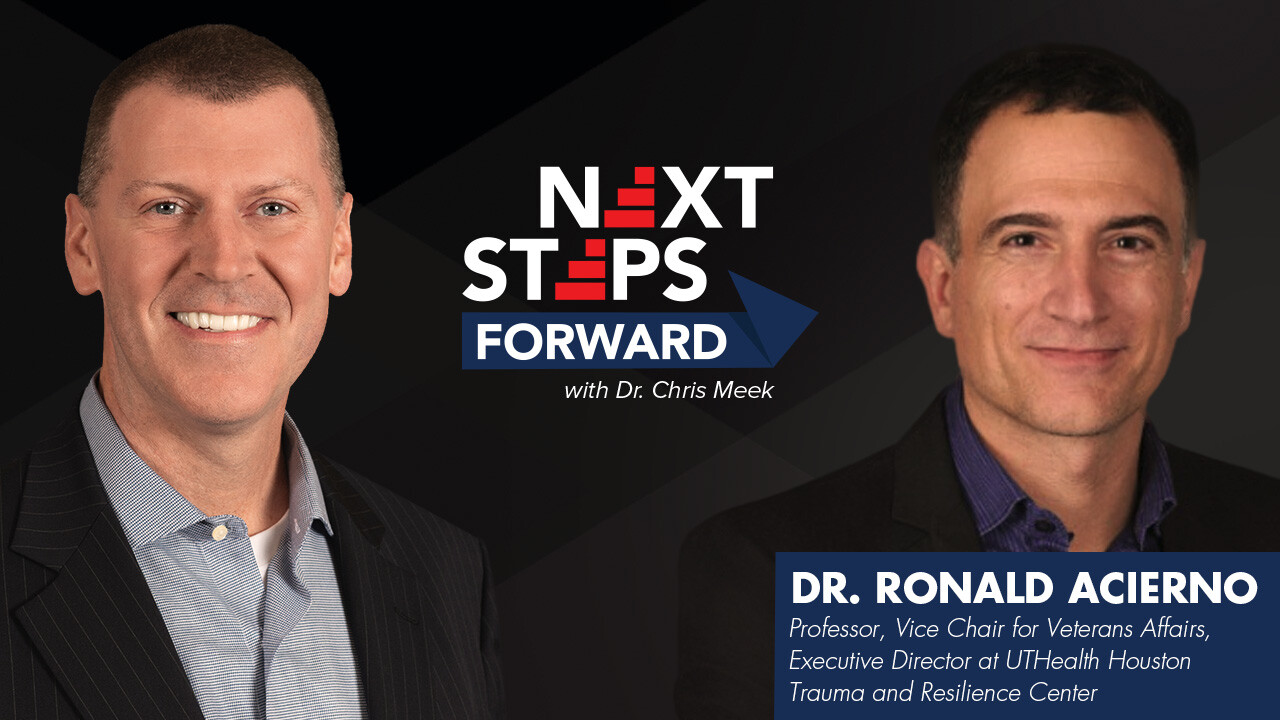


This week on Next Steps Forward, Dr. Chris Meek welcomes Dr. Ron Acierno, professor and vice chair of Veterans Affairs in the Department of Psychiatry and Behavioral Sciences at UTHealth Houston McGovern Medical School, and executive director of the UTHealth Trauma and Resilience Center. With more than 150 published articles, 30 book chapters, and decades of groundbreaking research, Dr. Acierno is a leading voice on trauma, resilience, and veteran mental health.
In this powerful conversation, Dr. Acierno and Dr. Meek explore:
-
The realities and misconceptions surrounding post-trauma stress and why language matters.
-
The urgent challenges of veteran suicide, moral injury, and stigma around seeking care.
-
How trauma affects not only service members but also spouses, partners, and children and what whole-family healing can look like.
-
Breakthroughs in treatment approaches, including telemedicine, peer-to-peer support, and innovative interventions that save lives.
-
Insights from working with veterans across generations, from Korea and Vietnam to today’s post-9/11 era.
Dr. Acierno also discusses his research on elder abuse, the future of trauma treatment, and how digital platforms and artificial intelligence may shape mental health care moving forward.
Whether you are a veteran, a family member, a clinician, or someone seeking a deeper understanding of trauma and resilience, this episode offers wisdom, hope, and actionable insights.
About Dr. Ronald Acierno: Ron Acierno is a professor and vice chair of Veterans Affairs in the Department of Psychiatry and Behavioral Sciences at UTHealth Houston McGovern Medical School. He also serves as the Executive Director of the UTHealth Trauma and Resilience Center (TRC). Acierno has two related but distinct research foci: epidemiological studies of elder mistreatment and treatment outcome studies, focusing on victims of trauma, disaster, combat or loss. He has served as Principal Investigator on grants from NIA, NIMH, NIJ, the Department of Defense, The Department of Veterans Affairs, the South Carolina Department of Public Safety, the Archstone Foundation, and the Retirement Research Foundation. Thus Acierno mixes epidemiological research with treatment outcome research, and keeps close to the clinical world as a clinician-administrator for treatment programs serving both civilian and military traumatized populations. Acierno has also been recognized for his personal investment in the mentoring of others, with over 20 current faculty researchers across the country having worked alongside him in his lab over the years. Acierno has over 150 published articles and 30 book chapters, and has served on the Editorial Boards of several journals. In addition, he is a member of several grant review committees for the VA, NIH, and DoD. Finally, he has worked on special expert panels in the areas of elder abuse for the CDC, the WHO, and the NIJ.
0:00 There are few things that make people successful. Taking a step forward to change their lives is one successful trait, but it takes some time to get there. How do you move forward to greet the success that awaits you? Welcome to Next Steps Forward with host Chris Meek. Each week, Chris brings on another guest who has successfully taken the next steps forward. Now here is Chris Meek. Hello. You've tuned to this week's episode of Next Steps Forward, and I'm your host, Chris Meek. As always, it's an honor to have you with us.
0:40 Next Steps Forward is committed to helping others achieve more than ever while experiencing greater personal empowerment and wellbeing. Our guest today is Dr. Rana Cherno. Dr. Cherno is a professor and vice chair of Veterans Affairs in the Department of Psychiatry and Behavioral Sciences at UT Health Houston McGovern Medical School. He also serves as the executive director of the UT Health Trauma and Resilience Center. He has served as principal investigator on grants for a number of agencies and entities, including the National Institute of Mental Health, the Department of Defense, the Department of Veterans Affairs, and the South Carolina Department of Public Safety. He has more than 150 published articles and 30 book chapters to his name and has served on editorial boards of several journals.
1:20 Dr. Rana Cherno, welcome to Next Steps Forward. Thank you so much for having me, Chris. Now I appreciate your time, and I know you're dealing with a bit of some folks under the weather, so I appreciate you jumping away from that. Happy for the break. Doctor, you spent decades researching trauma and working with veterans. What first drew you to this field and what's kept you in it all these years? Well, I started in the area of traumatized juvenile delinquents, basically, my people. And in 2005, I was asked to come over to the VA and do the evidence-based treatment that I was doing in the university clinic for our veterans.
2:06 At the time, a lot of the care was in groups that were just supportive groups that never ended, so people might be in a group for 10 or 15 years. And I saw our veterans sometimes coming into my civilian clinic. And basically, what I saw was our veterans couldn't go to the movie theater, for example, or couldn't go to Walmart when it was crowded. And basically, what I saw was our veterans who fought for our freedom had their freedoms taken away from them, and I don't abide that. And it was sort of a duty-bound thing.
2:51 I didn't serve. It's the one way I could serve was to work at the VA. I still work at the VA. I'm a university-VA hybrid. And September 11th was really a cementing factor, and I need to do this. And all of the last 20 years have sort of proven the point that we need to get the best care we can to our veterans for depression and PTSD and adjustment disorder. And because, just like first responders, when everyone's running one way, they have to run into the firefight as a part of their job.
3:33 We might do that if we see a family member in a fire, but goodness gracious, they do it for every opportunity every day. So it's sort of a sense of moral obligation, I think. You know, it's interesting you say what you just did, because we're birds of a feather on a lot of those fronts. So I've never worn the nation's uniform, and like you, it's one of life's regrets. And I've done a lot of work supporting veterans and first responders over the last 20 years. I was at ground zero on 9-11 across the street. And so to your point, one of my most lasting memories of that day is while thousands of us were running away from the towers, hundreds of first responders were rushing in.
4:16 And to your point, they have to do that. And I did my dissertation a few years ago on mental health for police officers. And one of the police officers I interviewed said that everybody has a bad day, but we see everybody's bad day every day. And so thank you for the work that you do. It's super important. It's very personal to me, and so I really appreciate the work that you've done all these decades. Yeah. And I see a lot of commonalities. You know, a lot of our first responders are veterans, particularly in Houston and in many other cities. So there's a lot of commonalities. But a major commonality is a value of service, a duty of service.
5:00 You can make more money not risking your life in a lot of other jobs, and you choose the military because of this service allegiance you feel. And you choose to do first responding. You sure as hell don't do it for the hours or the money. You do it because you feel like you need to do this. And like you said, they're there running toward the buildings falling. Hell, there were two buildings. They didn't stop running after the first one fell. And the military is the same way. So to then see these men and women's freedoms restricted, they can't go to their grandson's football game because the crowd jumps up, and that's too shocking, or they can't go to a July 4 celebration, or they can't go to Walmart when it's crowded.
5:53 It's not acceptable because there are tools to help with that. And so what we need to do is give people the action-oriented tools to help with that. And you know, might be leading a bit too soon into it, but talk is cheap. The treatments that work are very behaviorally focused. It's changing what you do to change how you feel. And if you want to feel the same way, then don't do anything different. And you know what? Veterans and first responders, they buy that. They understand it. They're action-oriented people. So that sort of fits with my personality, and that's sort of one of the reasons I'm in this field.
6:37 When post-trauma stress is discussed, some people insist on using the term post-traumatic stress disorder, or we know the acronym PTSD. While others contend it's either inaccurate or inappropriate to call it disorder. What's correct, or which you prefer? Is it disorder, or should we call it something else? Well, it's a matter of timing, right? So post-traumatic stress, or post-traumatic stress disorder, let's just talk about the reaction. Increased heart rate, increased muscle tone, fight or flight response. In this situation, every PTSD symptom, more or less, is the appropriate response. It's not a disorder in the situation, right?
7:20 In a firefight, to fear for your life, to be hyper-alert, to be tense as hell, that's going to keep you alive. Same thing if you're approaching a person who is radically high on drugs, has just stabbed his wife or his kid. Same thing if a bear is attacking you. Fight or flight. Normal response, not pathological. When reminders, though, of the original setting, so it's a marketplace with an IED and a lot of enemy combatants, now, it's two years later, you're in Walmart, and you have the same feelings because it's crowded and there's all crazy stuff going on, and there's a lot of neon clothes and spandex where there shouldn't be, and everything's insane.
8:12 You might feel that response. Remember, it was a normal response in the situation that you just left two years ago, but now, it is a problem because it's functionally impairing. I tell my students, if a person has symptoms of this, that, or the other thing, and it doesn't interfere their roles in life, they can still be a good father, good parent, good They can still enjoy life, then they have some quirks, they have some things maybe they can work on. But when it gets in the way of functioning, and it's a constellation of symptoms that's pretty reliably evoked, then it is a disorder. Because of the functional impairment, not because of the symptoms.
8:54 The symptoms were normal in the fight or flight situation. The symptoms are impairing. If you can't go to your grandson's football games because of the uncontrolled crowd responses, that is a disorder. I don't care what you call it. Let's call it a problem behavior that you need to get over, because your freedom is being restricted as a consequence of you fighting for our freedom. Again, I always go back to that, and I definitely go back to that with my minority veterans. You've seen your freedoms restricted 200 years ago. Are you going to abide by that now? I say it to the veterans too. You fought for our freedom, and you can't go to Walmart at three o'clock.
9:36 You choose not to, but you feel like you can't. Let's get that feeling changed. The treatment involves doing what you really don't want to do. But here's an analogy I use. If you are a sniper firing in a 25-knot crosswind, how do you recalibrate that rifle when you're in a calm condition? You don't talk to it. You don't adjust the scope without firing it, without engaging. So when you're in a 25-knot crosswind, that's one situation, and you engage with it, you adjust the scope, you become out on target.
10:20 When you come back into a calm situation, when you come back home here, if you don't interact with your environment, if you don't fire the weapon, you don't have the new scope setting. You can't recalibrate. And so you need to do those things. You need to engage in the community again. Now PTSD has a cardinal symptom of avoidance and withdrawal. It's like you never recalibrate the scope. You got to recalibrate the scope, and the only way to do it is not to talk to the scope. That would be ridiculous. Well, that, in PTSD, just talking about it is ridiculous. You got to get out there, but the trick, the art, is to figure out what a person's avoiding that they really want to do, maybe based on what they used to do, and then break it down into doable pieces.
11:12 You want to be able to go to Walmart at three on a Saturday? Maybe you need to just go to Walmart parking lot at nine on a Tuesday, until that's boring, and then go to the front door, and then go inside, but not far. We do this over a period of weeks, all of a sudden you're in Walmart. Will you like it? No, it sucks. You have PTSD, you had PTSD, whatever, but we take people from being overwhelmed to being bothered, and we call that a win, because we can't make people forget the things that you don't want to forget, the important things in your life, good or bad. Would you call it immersive therapy, or is it a different type of treatment?
11:52 You could do immersive therapy. They used to call it flooding. You could throw a person into the situation until they get over it. It's a good way to close your practice down, and maybe get punched in the face. What I like to do is break it down into doable parts, and do that two to four, maybe five hours a day. People are like, well, that's a lot of time. I say, okay, let's take your phone out. How long were you on the screen today? That's how long you need to take care of yourself. If you can do three hours of screen time, you can do three hours of behavioral therapy, getting back into the situation. We don't do it immersive, but we do immerse the day in it. We try and break it down into, I want you to be bothered by what you're doing therapeutically, not overwhelmed.
12:40 It's a workout analogy. No pain, no gain. If you're working out and you're not sore, you're not pushing hard enough. If you're in these situations where I'm having, we call it prolonged exposure. We could also call it processing emotions. If you're going into these situations where you're uncomfortable, because it reminds you of a past trauma, and you turn around and leave, you'll feel better. Avoidance has just been reinforced. That's not good. You need to stay in the situation until you start to get used to it, and then you can leave.
13:21 What you want to do is not make the situation so intense that the person feels like they have to leave. You want to be able to stay. It's like getting into a cold swimming pool. How do you get used to cold water? By jumping in and jumping out? No, you have to get in the water. You're a Northerner. You're in Connecticut. You know this. You get in the water, and you get used to it. Now, it won't be enjoyable. New York swimming pools and Connecticut swimming pools in the middle of August are still cold as hell, but you are less bothered by it. You can enjoy swimming and still be a little uncomfortable. That's what we're going for. You can call it a cure. I call it, let's get rid of functional impairment.
14:01 There are still so many misconceptions about post-trauma stress. What do you wish more people understood about what it is and what it isn't? The way it's been sold has something to do with what I just talked about, the avoidance character, which is it's a permanent condition. If you are in a situation that makes you uncomfortable, triggers remind you of the past trauma, and you leave the situation, and you make that your regular coping response, you will have PTSD for 15 or 20 years. It won't go away. If you can engage in some of these, I call them opportunities for exposure, some of these workout opportunities, it's like taking the stairs instead of the elevator.
14:48 If you can stay in the situation a few minutes longer, you will start to get better and overcome the PTSD. One of the things that I don't like is people sell PTSD as a permanent condition. It can be a permanent condition. It doesn't have to be. Now, I'm not saying you forget what happened. I'm not saying you can enjoy war movies like you used to before you went to war. If you see a movie about combat, you can't go to work the next day. No, we make it so that you have to turn off the TV, but you're fine in three hours.
15:30 I'll take that. That's the big misconception that there aren't treatments as a permanent condition. You see that in the movies. You see it when people say my PTSD instead of PTSD. Don't tell me my. I don't want you to own it, right? That's your fight or flight response stuck in the on position. It doesn't need to be always in the on position. We can help you turn it down a little bit. We'll never turn it off, and it should have never turned off. If you've seen horrible things, you've seen horrible things. I wish I'd have met you 23 years ago. My listeners and viewers know that I self-diagnosed myself with PTSD from 9-11.
16:14 Almost my entire career, I've worked within three or four blocks of there, and in 2018 was my first time actually going back to ground zero. But I didn't think about it that day, so I went the morning of 9-11, but I couldn't actually get there because of the ceremony they were having. I've never hyperventilated before, but I felt like that's what was happening to me. I'm like, well, that's fine because I've got New York's finest and bravest on either of my shoulders here, so that'll be okay. But actually, it was May of this year was the first time I've ever been back to physically touch the memorial. Yeah, I would have had to do that a lot sooner. Yes, you would have, and I would have listened to you. I went there three weeks after, and let me tell you why I went there three weeks after.
16:58 I'll tell you the wrong way to treat PTSD, and the wrong way. You don't force people into treatment. You help them recognize what they're avoiding, and you say, look, man, you can get your life back. You give people hope. But there on the street corner in front of me was a woman from the Red Cross trying to be helpful, a good soul, a good Samaritan, and she heard the person in front of her who had been in one of the apartment buildings that was evacuated right outside the ring. And she says, would you like to talk about it? Do you need counseling? We have counseling. And the woman turned to her and said, I've been wearing the same clothes every day for three weeks.
17:38 I don't need counseling. I need to get into my apartment and get my clothes back and get my life back. And I thought to myself, this is a natural resilience. This is a person who has a natural predilection toward resilience. I need to get back into my apartment, I need to get back into my life, and I need to do these things. Now, for her, it was manifest as clothing. But in reality, she was saying, I need to not be on my friend's couch. I need to get back on the horse. But you know what a real kick in the balls is to tell somebody, oh, just get back on the horse.
18:20 Because the horse might have just kicked them in the face, and they have a crushed skull. So what we do is we do the rehabilitation. We say, what are you avoiding? What did you used to do? What's important to you? Let's get that back. You fought for our freedom. You deserve the freedom to do these things. Here's how you do it in small pieces. When you're doing rehab after shoulder surgery, you don't go right to bench 220. And so when you went back to the 9-11, to the memorial, that was an approach behavior. Now, if it were me talking to you 23 years ago, 22 years ago, I would have said, listen, you need to look at as much material as you can digest that you've been avoiding.
19:07 You need to go to the places that are now realistically safe. You need to go into One World Trade Center, that new tower. You need to go around there. You need to talk to people about what happened. Not for talk's sake, but to put it in your mind and then recalibrate. So bad things happen. We survive. We have to function. Avoidance, avoidance is the poison pill. It's a good way to put it. You talk about coming back from shoulder surgery and you can't bench press 220 and it's the old adage of how do you eat an elephant? One bite at a time.
19:47 Same concept. Veteran suicide remains a national crisis. We're down from 22 suicides a day to roughly 17 a day. It should be zero a day. From your perspective, what's driving this and what are we still not addressing effectively? Well, that's a hard one, but let me put it this way. I think there are different reasons. But one thing that I hear from a lot of veterans, and I do both clinical work but I'm also doing clinical research, so I'm the on-call guy for about seven or eight studies, and a thing I hear repeatedly is things just don't matter anymore.
20:32 Everything here is bullshit. There was life and death. There I had my team. There I was protecting my team. And now it's just a bunch of bullshit. So that's a search for meaning. And that's why a lot of them go into firefighting, police work, EMT, intense jobs where there's meaning. The meaning is what you do every day. You don't have to look for it. So I think that, and this is sort of shifting gears because I told you talking about PTSD is a waste of time.
21:12 You have to do things differently. Now I'm shifting to a more existential thing because suicide is not just avoidance, it's complete avoidance, and it's deciding that there's not a meaning, right? So people need to do things that they value, family level, spiritual level, vocational level, hobby level. And so one thing is, can the veteran who's come back find a position in life, either as a parent, a spouse, or a worker, volunteer, that gives some meaning?
21:56 The other thing is, is there enough support to put some time in between the impulse and the act? So what we know about suicide and suicide prevention from Tom Joyner and Craig Bryan and Matthew Nock and these super famous researchers in this area is you need to put some minutes in between the urge, the intent, and the act. And if you can do that, think about what I'm saying. If you can put some minutes in between the decision to kill yourself and the action to kill yourself, you can prevent suicides. Because things can happen, the mind can change.
22:40 What's the major way veterans are killing themselves? Well firearms are a big issue. If there's a firearm present, it's very hard to slow the bullet down. So you no longer have the opportunity to put minutes. And guess who's armed? All of our veterans are first responders. Well the entire country more or less. I mean if you live in the southeast, the chances are 100%. I mean I have weapons, I live in the southeast, that's what happens. But if you've been suicidal, if you feel like you are going to kill yourself, think about the family, think about the kids.
23:22 If you have sons, you've just increased their potential tremendously and daughters, but particularly if you're a guy. You need to lock the weapons up or give them to a buddy for a few months. That's it. They're still your weapons, you can still get them. Make it inconvenient. Put some minutes in between. Well how is putting them in a safe in my neighbor's house going to do anything if I can go over there and he gave me the key to the house? Well it's some minutes. Put minutes in between the acts. So to answer your question, why is veteran suicide so active? Well because they have the means to do it too fast. And same thing with first responders. And so we want to put some minutes.
24:03 Now you can put some minutes by also, you have people you can call, you have battle buddies. A lot of times, I mean the last three veterans I called said, well I have my wife or I have my husband. That's great, but sometimes you want to protect them so you don't talk to them. So I want you to have somebody you don't need to protect. And your wife, and your husband, you know, whoever. So I try and build up, again, the number of people a person can call early, why? I want minutes in between the thought and the act. So that's the main reason. I think it's because the way of killing yourself is very accessible and very fast.
24:43 And we need to put some time. And so we can put some time through inconvenience, gun locks, neighbor's safe, whatever. We can put some time through people that you can call that you know you can call and you don't have to worry about it because they've been through it as well. What role does moral injury play in suicides? And for people who may not be aware of the term, would you please define moral injury? Yeah, well, that's the one that scares me the most. I'll give you a scenario that I've heard so many times, and these are the people I have my most to worry about in terms of suicide. You are engaging an enemy combatant who has a weapon on your team, and you have to kill that person.
25:25 And you see it's a 14-year-old or a 13-year-old kid. And now you have horrible guilt. Now, you know, if you didn't pull that trigger, you and the rest of your team could have been killed. And then the next day, another team could have been killed. So you had to pull the trigger, but you got a 14-year-old kid at home. Or what happens is your kid turns that age, and all of a sudden, everything comes back. Or another one is you rotate a tour, you want to call your wife. So somebody says, no, I'll grab this convoy. You take the next one. And they get killed. It should have been you, you think.
26:08 So this idea of guilt, can we treat it? Yes, we can. People understand on the surface, but they don't believe it. And so we actually have people go through treatment, go into the memories, go into the events over and over again, replay the movie. You don't want to replay the movie randomly. And when it triggers it, we have you replay it yourself. It's not you're being thrown into the pool. You're getting into the pool yourself. And we have them go through the memory and the experience in graphic detail, in present tense over and over and over again, not to torture themselves, but to help them get used to the memory so that the memory comes on their terms.
26:56 So it doesn't punch them in the face. It's a bad memory and you feel bad. But you start to see, I had no other choice. And you start to realize this is what had to happen. But if you push those memories out of your mind, as they come in, because you see somebody, your son is now that age or whatever, you don't go through that process of realizing. You know it, but you don't realize it. You know the difference? And so the problem with moral injury is you feel like you deserve the pain. And in some situations, you might, but those are rare.
27:40 Like if you're a serial killer, or you get high and you go out and shoot up a family, but that's not what our veterans did. They defended their team and there were other casualties and they had to make that choice. But you don't, you know that, but you don't know it until you re-experience it over and over again. You have to go. It's a no pain, no gain treatment. It sucks, but we don't have surgery to take out memories, nor should we, because that's what defines the person. Your experiences, the sum total of your experiences, good and bad, make you the person you are. So this is sort of a long diatribe, but moral injury is, if you're suffering from what we call also traumatic guilt, you need to talk to somebody, because it's going to impact all of your life and it's going to impact your kids' lives.
28:34 And you want your kids to see you liking yourself, so they like themselves, because they observe and they model and they learn. So if you have self-hate, if you have traumatic guilt, that's a form of post-trauma response that can be treated and should be treated, if not for you, for your kids. Yeah, I'm doing some work for the 25th commemoration of 9-11 next year, and I've been interviewing some folks, veterans who were at the Pentagon that day, and there were two in particular who remember they were at a table in the wing that got hit, and spouses of those have come to them saying, one in particular, the veteran said, well, I was here.
29:15 He was killed. He was killed. She survived. He was killed. She was killed. And the spouse was like, how come you survived and not my husband or not my wife? And I couldn't imagine going through that. I really couldn't, to your point, year after year, decade after decade. And so that just has to be a monumental rock on your back, on your shoulders. It is. But if you go through, and in that situation, it was luck of the draw. So you go through these memories over and over again, and some people say, you know what? It was luck. I was given another chance. What am I going to do that I value that is good?
29:56 You know? And I tell people, listen, this might not solve it. But if you feel this guilt, what can you do? Don't talk to me about what can you do? And they say, what are you talking about? I go, what can you do to make the situation that is currently level X a little bit better? Can you volunteer? Can you go talk to school? What do you want to do? What's your skill set? You know, can you work in a soup kitchen? I mean, what do you want to do? Do an hour a week or something and tell me if that helps. I guarantee it won't hurt. And it always comes back to the idea that by and large, veterans, first responders, they're doing these jobs because they're action-oriented people.
30:48 And I need to remind them of that and then suggest that they do something. You feel bad. What can you do? You can't give this lady her husband back who is sitting next to you, but maybe you can mentor a kid. Maybe you can give lectures in school a couple hours a week. What can you do? What do you want to do to make the world situation a little bit better? And I find that that's extremely effective for a lot of people, particularly veterans and first responders who are doing types of people. That's why they're veterans and first responders, right?
31:29 Are we doing enough to involve peers, families, and others in suicide prevention efforts? Well, let's just talk about it writ large in mental health efforts. So we just did a study, Dr. Melvin Hernandez Tejada and others, a DOD study where we added peers to this exposure treatment. Remember I told you, you go to Walmart in the parking lot and then you go inside. That's the in vivo exposure we call it, in the world exposure. And normally you don't involve peers in those active parts of the treatment. You just involve peers. Hey, you get, you know, confocal, hey, you're getting your treatments. Is everything okay? No. We rewrote the book on that. We said, let's do it the way we're not allowed.
32:09 Let's actually have them meet at the exposure sites like workout buddies, like you might meet at the gym. And what happened is when you join the gym and someone's, come on, join the gym with me, join the gym. We'll go to the gym. And then it's like Tuesday and you're getting ready to go to the gym and they call you like, yeah, I'm not going. Like, no, you son of a bitch. You made me join the gym. We're going to the gym. Let's go get off your ass. Right. They push it. Same thing happened in this situation. And but veterans, if you say, hey, you just finished this PTSD treatment, you did well. We need some peers to help other veterans who are having problems with the in vivo. Oh, shit.
32:50 We were hoping for 10. We got 70. The veterans will help each other. And we don't want to make people dependent. So we just said, look, they're going to be doing this for about 10 weeks. We just want you to meet them two or three times a week for two or three weeks. So like six total out of the 10 weeks where they do it every day. The people who had a peer and met the peer even one time finished treatment at 95 percent. If you met the peers at least three times, it was 98 percent. If you didn't meet the peers at all, it was 50 percent. So what's the role of peers in treatment? The role is potentially very big. And so what I tell all my students, I just gave the lecture last week, the role of social connection in any treatment.
33:37 It's big. Get somebody involved in what you're doing. You don't have to do it every time. You don't need to be dependent on them. It can be a spouse, can be a battle buddy, can be something. But if you treat it like a workout, where you have a partner, or if you treat it like a battle where you have a battle buddy, then you're going to give each other motivation when it's lacking in one or the other. And so the same thing can apply to suicidality. Remember I told you we need to put a few minutes in between the intent and the act. But they need to be able to call somebody who won't be, that they don't need to protect from the truth of what happened.
34:22 Well, that's a peer. And so I don't do it with general peer support group. I do it with a peer. They know one of their peers, not somebody who just happened to be a veteran, but somebody they already know. Now, if I can't find that, then a general peer support might be good, but I'd like it to be somebody that they connect to, that they already know. But yes, absolutely, that's the type of person it is. So yeah, peers are everything. Social is everything. I tell people, if you can get busy doing something, and you can socialify it, socialify it. So you like to read? Read a Barnes and Noble instead of reading at home. Why? Well, you're out amongst people. Maybe you'll see somebody.
35:05 One in a hundred chance is better than zero out of a hundred. And so it's the same thing. If you can involve a peer, you want to join a gym, see if you can join it with somebody else. You know, you're going to volunteer, see if you can get somebody else to volunteer with you. It'll make it more meaningful. Strength in numbers. That's it. That's what they're trained for. That's how they're trained. These aren't my ideas. These are veterans' ideas. They said to us, shit, if I had a battle buddy who would do this with me, it'd be a hell of a lot easier. And I'm like, yeah, but we don't want somebody to have your six the whole time. We want you to feel a little bit worried. And she said, yeah, that's why I won't do it with them every time. Okay. And that's why we came up with the three to four times a week for three to four weeks.
35:48 The veterans sort of directed us to this. We just put the pieces together. Amazing. That's awesome. Have you ever worked with a patient who defied the odds or surprised you in how they responded to treatment? Well, it's hard to say because I think that these treatments are very effective and that if the person engages in the treatment, I think they're going to get better. I mean, I already think that, but I will give you one person. I don't know if you know the story in the Bible of Job, but Job kept on having a lot of bad things happen to him. This guy was one of the most faithful. The devil said to God, I bet you can shake his faith if you kill his family, take his home, take his fortune, do all this stuff.
36:30 I bet then he would have his faith shaken. You know, Job wouldn't have his faith shaken. And I had a woman who was a very strong woman and she was a grandmother, a lot of losses. I mean, I won't go through it, but she lost her husband through a heart attack. She lost her son. He was a mail deliverer. Over 4,000 people came to his funeral because he was one of these guys that you would talk to as he delivered the mail. He had a car accident, bringing her other son's medicine in an ice storm in Long Island.
37:15 Her other son that he was bringing the medicine to was currently, when she was seeing me, dying of sickle cell. She was defrauded by one of the scammers of all of her money. And then she got diagnosed with breast cancer. So what did she do? I don't know about you, but I probably would have given up. Well, she said, maybe I need to go talk to somebody. I said, yeah, you need to talk to somebody. She came in to me. Unfortunately for her, she didn't get a soft shoulder to cry on. She got somebody who said, well, what are you doing about it now?
38:01 She goes, what do you mean? I go, what's your day like? She goes, well, the surgery went okay. They say I'm cancer free. So I'm trying to be here for my son. And I said, he's dying of sickle cell, right? She goes, yeah. I said, is it better to be a depressed mom or a less depressed mom? She goes, well, probably be better to be less depressed. I go, okay, well, you need to do some things that you value, that you enjoy, that give you some motivation to be a better mom for him, even if it means you have to leave him with a caretaker for a few hours and stuff. And she goes, yeah, you're right.
38:42 And I said, she goes, how do I do that? I go, you just get a schedule and start volunteering a little bit. You do this, that, or the other thing. She liked to work in a clothing store. She loved to talk to people. So despite all of the things that happened, she was justifiably depressed. If events can cause depression, this was a justifiably depressed person. And I gave her a bit of a lifeline. I said, you'd be less depressed if you did two hours a week out of the house to help other people, because you live to help people. On the surface, you're helping people enough. You devote your whole life to yourself. But maybe you want to help other people too, just out of the house.
39:25 My whole point is get her out of the house. I mean, her son would call me and say, you got to get her out of the house. She's driving me crazy. She's, you know, I'm okay. I mean, I'm not well, but she's just self-destructing here, you know, because he could tell. So yeah, she surprised me. But she is sort of like these veterans, the first responders, the veterans who have seen, you might see a couple of horrors in your life. Hopefully not. They see them every day. You know, it's hard to get past that. But the data show, if you do these things, if you interact with your environment, if you recalibrate, if you get out there and do the things that you know you value, can't just be going through the motions if you don't, but you got to value it.
40:17 You can be as good a person as you can be. You might not be who you were, but you can be as good as you could be for your spouse, for your kid, for your job. As a follow-up to that mother in Long Island, you work with and have done research on elderly patients as well as military veterans. Does post-trauma stress manifest itself differently across generations or life stages? Are its symptoms and effects the same or different regardless of age? Well, I did a big study and I was all excited about these results. It was on the Florida hurricanes in 2004 when Florida got four hurricanes in a row. Bam, bam, bam, bam.
40:58 We thought, geez, these old people in Florida, because that's God's waiting room, right? That's a retirement zone, right? I can say that. I'm from New York. You're required by law to retire there. I'll go there when I'm older, as the law states. I found that the older adults had way less PTSD. I present these results and I'm like, it's because of the wisdom that you get with age. Somebody raised their hand in the audience and goes, well, what about all the ones ... Maybe it's not wisdom with age. Maybe that's part of it, but maybe it's all the people who get really freaked out and upset or dead by the time they're older adults. That made me think, shoot, it's not good to be anxious and depressed all the time.
41:41 It's not good for your health. Now we know there's an inflammation event that constant anxiety and depression can cause inflammation, and that can cause heart problems and lung problems and all sorts of issues. As you get older, if you survive, you do gather a certain wisdom that allows you to cope if you can find meaning. A lot of our families used to find meaning, and I can see how it works now because I have a granddaughter. A lot of our families find meaning through the intergenerational support, right?
42:25 Grandparents helping grandkids. Parents are working. As you get older, if you can do that, but what do we have in our society a lot of times? We have relocations. We have parents living in other states. They have no purpose. They have no grandkids. They're retired. They go to doctor's appointments. I immediately, when I ran the older adult clinic, and you saw I have two hats. One is geriatric psychologist, one is veteran. People would come to me. I ran a clinic in Delray, Florida, South Florida. They were all retired. They did nothing but doctor's appointments. I would say, go volunteer. Why would I volunteer? I worked my whole life. I want to retire. I've been waiting to retire for 30 years. I go, yeah, but you got used to working.
43:08 What are you doing that's meaningful? You got to give back. Go volunteer. Go do anything. It doesn't matter. Go help the animals. Go help other kids. Go help your daughter. Your daughter lives around town. You told me your daughter is constantly bothering you to watch the kids. Get a schedule. Tell her you'll do it every day from this time to this time when it's convenient for you. They're like, they come back to me. This is the thing I've heard so many times. I did what you said, and I'm not going to say I'm not depressed, but I'm too busy to be depressed. I'll take it. I'll take it. That's a win. So older adults, I think if they survive to be older adults, they evolve more coping responses.
43:51 They can handle stress better. They can handle trauma better if they have purpose, if they have connection, if they have somebody to help them. The middle age tend to be the worst, and we call it the burden of middle age. That's when you're working. You're taking care of your kids. You're taking care of your parents. You're taking care of your marriage. Everything's on you at the same time. So it's really difficult from 30 to 60. But older adults, if they're not isolated, but if they're isolated and withdrawn, all bets are off.
44:31 It's just as bad for them as it is for the most vulnerable people. So you've got to connect, and I tell people, look, call on the video call. Get a schedule. Every time you're in a car on your long commute, call one of your older relatives. Just do it. Monday is Aunt Therese. Tuesday is Aunt Carrie. Wednesday is Uncle Frank. And you call them. Then one, you're the favorite grandson, and that's important. And two, you're not wasting your time in the car being angry at traffic. And three, you're connecting to somebody. And so that's sort of how we try and keep people connected, if at all possible. But keep them busy. Keep connected. Older adults will deal with trauma better than younger adults, by and large, if they have those social connections.
45:17 I love your comment about going to Florida. My wife has said to me, so I'm in my mid-50s, and she's like, when are you going to retire? And I'm like, I'm not going to retire. Because to your point, I am involved in too many things. And she goes, well, can we at least not retire somewhere warmer? Yeah, exactly. Exactly. I understand that. You have no, I mean, you can put in a waiver to go to South Carolina or Hilton Head or one of those places. And sometimes they'll grant that to the New Yorkers and the Connecticut people. Exactly. Some people from New Jersey. But that's a hard group to let. They're sort of funneled right down to them. Easy pass, right? Just direct flight. Yeah. So let's put your VA hat back on for a moment.
45:59 What innovations or reforms do you think have been most impactful in recent years in improving mental health care for veterans? Home telehealth. So here's the deal. A lot of our veterans, when they come back, they come from rural areas or they seek out rural areas or nobody's going to bother them. And getting care is hard. And we have a lot of sites where it's very hard to recruit providers because they don't live there. But the veterans live there, but the providers don't. And so when I was doing this telehealth research, doing home-based telehealth, so treating PTSD in the home versus in person. I'll tell you right now, if you can get the person in person, that's better.
46:41 Of course. Right? No one's arguing that. But is it good enough to do it? Is it almost as good to do it remotely? Well, the screen fades away and you start talking to the person. It's different than on the phone. If you can see the person's facial expression when they're agreeing, when they're disgusted, and with the treatment we do, we need to make sure they're getting bothered by what they're remembering. They have an emotional reaction, not a panic attack, but a bad reaction that they then overcome. You need to see the facial expression. So the biggest thing that the VA has done is home telehealth because it's meeting the veteran where they're at. That's Peter Shore, who's on the West Coast, who came up with that.
47:24 Meeting the veteran where they're at is a way to give care. Is it better to bring them in? Yeah. They were taking a small plane to different islands that the providers were from. That's new telehealth, right? So that's the major change. So now Charleston, South Carolina is serving up and down the Eastern Seaboard to places in Georgia where they couldn't get providers. Now people are getting care very quickly. Then COVID came and everybody started doing that, right? That became another, because for once we actually had, we'd already done four studies with older adults, with PTSD, with depression, where we had the research that showed people get pretty much just as better on telehealth as in person.
48:12 It's a little bit better in person, but compared to not getting treatment at all. So that's a major, major, major innovation. And VA is nice because VA moves super slow until they move super fast. And so when they saw this was working, I was like, yeah, bam, we're doing this. Make it happen. I was like, we can't do it. We can't do it. Can't do it. Oh, it's working. Okay, make it happen. And they made it happen. It's nice when you have a giant national healthcare system that you can shift gears and do the best practices overnight, basically. So that's one thing. You know, VA has tons of innovations that they do. The VA research came up, you know, first transplants, the first this, that, the telemedicine.
48:54 I mean, VA has led the way in innovations that people don't know about. They're like, wait, that was VA research? I didn't even know VA did research. It's one of the missions. And so you might want to do a show with one of the VA historians one day or senior research people about all the VA innovations. It will blow your mind. You would not have believed how many innovations came from VA research. We actually, in my veteran nonprofit, we work with the VA's innovation ecosystem. Well, you know that. And I've worked with the gentleman who actually created the Million Veterans Program. Million Veterans Program, yeah. Yeah. And it's, to your point, similar to DARPA, they create things that people aren't aware of that become mainstream and part of everyday life.
49:36 And so, you know, they get a lot of bad rep every now and then they need some positive reinforcement. Yeah, they need some positive PR. Exactly. They're doing good stuff. I mean, if you look at VA outcomes, blood pressure, diabetes, the outcomes in their primary care are better than the general public. People don't know that because the clinicians are held to account there. And all they're hearing about is the veteran that committed suicide in the parking lot. Right, right, right. Couldn't get in and committed suicide. Yeah. What do you personally find most rewarding and most difficult about working with trauma survivors? Well, giving people their lives back is pretty damn rewarding. Like I said, veterans who fought for our freedom had their freedom taken away until they get this treatment.
50:20 Then all of a sudden they're able to go to, I use the example of the grandson's football game because that's a real patient. He came to me. He goes, I just want one thing. He goes, my grandson is getting a college scholarship. I need to see him play. I've never been to one of his games. And so, you know, that's a win right there. I'm like, oh yeah, we can do that. Wow. I would break it down. Here's how you do it. And I said, you don't have to like the crowds jumping up, but you won't have to leave anymore. You know, so that was a big win. I had another guy who, this was a horrible thing. His team forgot him. Like he was in Afghanistan and the truck broke down and they're like, you got to stay with the truck.
51:05 He goes, why do I have to stay with it? Well, you're the new guy. You stay with the truck. We'll be back in two hours. They didn't come back until the next day. He spent the night up in a tree. This is a guy who had been in hand to hand combat. His first day as commanding officer was killed by close range fire in a market, standing right in front of him. He had seen several people in firefights killed next to him. Big, strong guy. What bothered him? Being forgotten overnight. And he was, another psychiatrist, a relatively well known psychiatrist, you know, referred to me and said, this is the worst case of PTSD I've ever seen.
51:50 And it was, it was because of that, that event. And so doing the treatment with him was a little bit harder because his reaction was intense. Like he left one day and there was some people fighting out front of his shop and he didn't notice them until he heard something break. And oh man, he, he went back into battle mode. He unfortunately wasn't arrested, but he ran a barbershop, but there were people in the hospital afterwards and that was his motivation to come into treatment because, you know, he's trying to start a business and he's beating the crap out of customers in front of his place who were, who, he didn't think he was that affected until he saw that.
52:37 So that was a very hard case because when the person doesn't realize, when they hear it from their spouse, they hear it from other people, they might not be motivated. When he put those two people in the hospital, then he realized, I'm not in control anymore. And that's scary. But remember, loss of control is a symptom of PTSD. And that was it. We were able to help him with the exposure treatment, with going through it over and over again. What does he avoid? He avoided going to the movies in seven years, that type of thing. So, so these cases do come back to you when you have a case, a hard case.
53:19 They're the ones you remember. Most of the people get better when they start doing this. They, they naturally are action oriented. They get better so fast. It's like, okay, let's help the next person. And you help yourself. And here's how we always teach people what they did. We don't want them relying on us. They might say, I heard your voice in my head. I was going to, you know, I was going to take the elevator, but I took the stairs. I was going to go to Walmart when it was almost closed, but I said, screw it. I'll go now. And it's busy just to get a workout in. Like they call, we call it workouts. I get my extra workout in. So. Dr. Ron Ciano, we're out of time. Thank you so much for being with us today. Really appreciate your insights. I appreciate the opportunity. Thank you for letting me talk on and on.
54:00 No, no, no. I appreciate you putting a big spotlight on it just so people are aware. And so I really appreciate that personally. Thanks so much. No, thank you. I'm Chris Meek. We're out of time. We'll see you next week. Same time, same place. Until then, stay safe and keep taking your next steps forward. Thanks for tuning in to Next Steps Forward. Be sure to join Chris Meek for another great show next Tuesday at 10 a.m. Pacific time and 1 p.m. Eastern time on the Voice America Empowerment Channel. This week, make things happen in your life.