Fried: Addressing Burnout Head-On w/ Cait Donovan

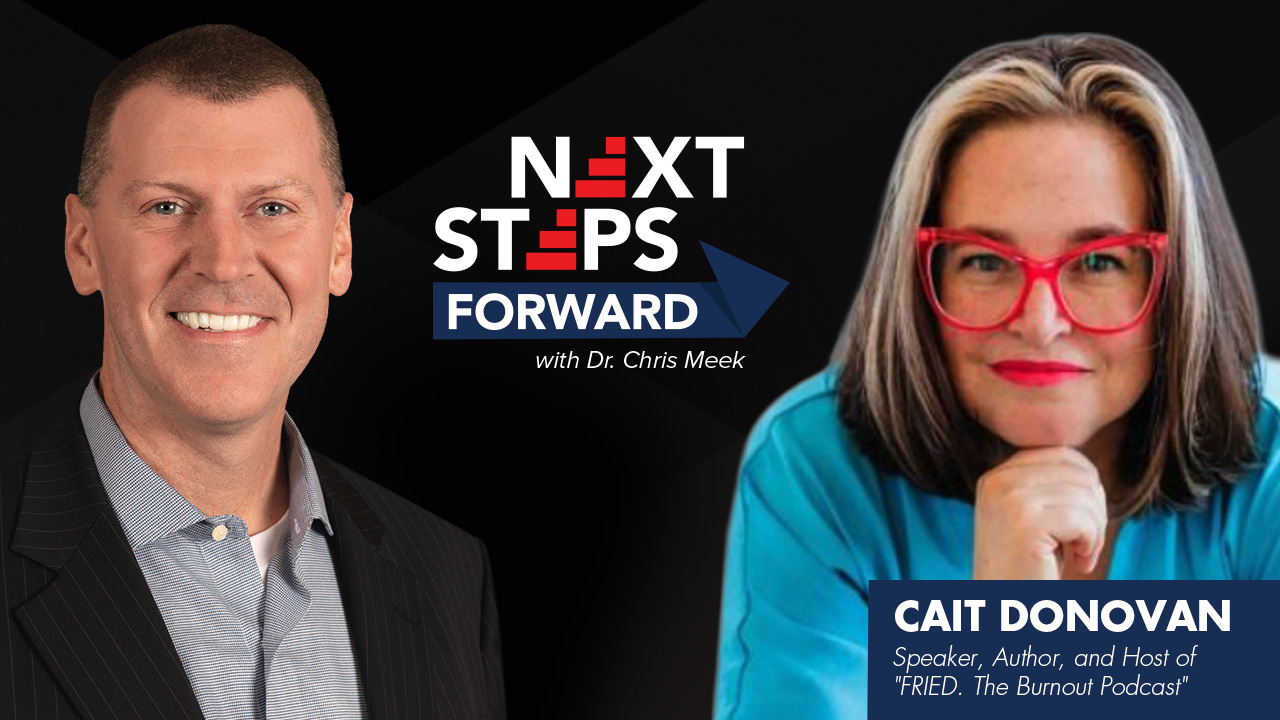


This week on Next Steps Forward, Dr. Chris Meek sits down with Cait Donovan, an internationally recognized expert in burnout and resilience. Cait's career began as a practicing acupuncturist with a master’s degree in Chinese medicine, but after experiencing burnout herself, she shifted focus to study biobehavioral health. Today, she’s an in-demand speaker, the host of Fried – The Burnout Podcast, and the author of The Bouncebackability Factor: End Burnout, Gain Resilience, and Change the World. In this enlightening conversation, Cait delves deep into the causes and signs of burnout, explaining how chronic stress affects the brain, body, and emotions. She shares research on the six workplace factors that contribute to burnout, how trauma plays a role, and why certain people become apathetic while others are highly reactive. She also explores burnout recovery—what habits and routines can help restore energy, repair the brain, and rebuild resilience. Whether you’re struggling with burnout yourself or looking for ways to support others, this episode is packed with insights that will help you take the next step forward in your journey of healing and empowerment.
About Cait Donovan: Cait Donovan, a global burnout expert and resilience advocate, has spent years helping leaders and teams break free from burnout culture. With a background in Traditional Chinese Medicine and over 250 podcast episodes exploring burnout recovery, she’s developed a proven framework for success. After years of running her own clinics and working with high-level professionals, Cait channeled her expertise into keynotes, workshops, and her top 1% podcast, FRIED: The Burnout Podcast. Now, she’s on a mission to #endburnoutculture, empowering organizations to create sustainable success with emotional intelligence at the core.
0:00 Speaker 1: There are few things that make people successful. Taking a step forward to change their lives is one successful trait, but it takes some time to get there. How do you move forward to greet the success that awaits you? Welcome to Next Steps Forward with host Chris Meek. Each week, Chris brings on another guest who has successfully taken the next steps forward. Speaker 2: Now here is Chris Meek. Hello. You tuned to this week's episode of Next Steps Forward, and I'm your host, Chris Meek. As always, it's a pleasure to have you with us. Our focus is on personal empowerment, a commitment to wellbeing, the motivation to achieve more than you ever thought possible, and we have another outstanding guest this week. Kate Donovan was a practicing acupuncturist for 15 years with a master's degree in Chinese medicine when she experienced burnout. She then pursued a degree in biobehavioral health to understand what stress does to our bodies. These days, she's an internationally known and sought-after speaker, host of FRIED, the burnout podcast, and author of the book, The Bounce Back Ability Factor, End Burnout, Gain Resilience, and Change the World. She's obsessed with the intersection of mindset, physiology, biology, neuroscience, genetics, generational trauma, and stress. Man, that's a mouthful. She also works with organizations, companies, and leaders who know that they have a burnout problem and are ready to address it. Kate Donovan, welcome to Next Steps Forward.
1:28 Speaker 3: Chris, thanks for having me. Can't wait to have this convo. Speaker 2: Oh, I've been looking forward to it, and I apologize in advance. I'm recovering from a combination of COVID and a cold, so bear with my voice, I apologize. Speaker 3: It's been a rough go. Speaker 2: It has been. I didn't think COVID was still a thing, and it is. I guess it is. All right, back to you, the important things here. You met your future husband while traveling through Argentina, got engaged within six weeks, and moved to Europe to start your lives together. You were the first acupuncturist to work in a fertility center in Poland, and your first solo practice after leaving the fertility center was a huge success. What an exciting and adventurous life you had so far. I mean, this is unbelievable. We're just getting to the tip of the iceberg here. How could someone with a resume that impressive and eclectic experience burnout and undertake the sort of internal reckoning that would lead you to study biobehavioral health?
2:17 Speaker 3: When I was reading through our prep work, I thought, oh, wow, they really did their research folks. And I'll say that I have always been a brave person, which means I have lived most of my life afraid. And I think people miss that part, that if you're brave and you're bold and you've done all these big things, it's because you're courageous, but you can't be courageous without fear. So I did a lot of these things I was doing in the face of fear, and a lot of my drive for creating a success in the business and for being really stubborn about learning the languages of the countries that I was living in, doing all of that, the underneath of it was this, I'm never going to be good enough no matter what I do, and I have this huge student loan to pay in the United States, which, you know, when you charge for an acupuncture treatment in Poland, you're not quite getting the same amount that you would get if you were charging for an acupuncture treatment in New York City. The prices are a little different. So I was paying back the student loan with a currency that was much weaker than my own. And I just had this massive push to prove that I could, you know, move past the place that I grew up and prove that I could be successful in spite of humble beginnings. Yeah, I just pushed a little too hard.
3:47 Speaker 2: Can't be courageous without fear. I love that. It's a bumper sticker. Speaker 3: It is. Speaker 1: All right. Speaker 2: Well, let's start with the definition of burnout. How can we tell the difference between just being tired and actually being burned out? Speaker 3: So when I talk about the definition of burnout, I always go to the World Health Organization definition first so that we're all talking about the same thing. Speaker 1: Right. Speaker 3: So the World Health Organization says burnout has three components. They are emotional and physical exhaustion, cynicism and detachment. And the last one is a lack of productivity or a lack of feeling impact and meaning of your work. And all three of those things have to be present for an undetermined amount of time, but simultaneously. Now, if you are just tired or you are experiencing stress that's chronic but hasn't burnt you out yet, you'll know the difference because short term recoveries will bring you back to life. So if you are really, really tired on a Friday, but you sleep for the weekend and maybe go and see your friends and get a little bit of fuel from people and get a little bit of fuel from rest and on Monday you're ready to go again, it's not burnout. But if you keep trying to rest more and fuel better and you still can't quite get back to yourself, your body battery, like Garmin measures a body battery, your body battery just is not hitting over the 50% mark no matter what you do. You cannot fill back up. This is what burnout is like.
5:23 Speaker 2: Start with the World Health Organization. Everyone speaks the same language that way. Speaker 3: I think this is one of the big problems in the world of buzzwords. A lot of people will say, oh, I'm just so burnt out, but what are we actually talking about? Let's be clear. Speaker 2: Sure. Fair point. So what happens to the brain when someone's experiencing burnout? Does chronic stress or burnout affect our memory, decision making, or other functions? Speaker 3: Yes, yes, and yes. The tricky thing about chronic stress is that it will decrease the volume of various areas of your brain. So it decreases the volume of your prefrontal cortex, which sits in your forehead area, for those of you who don't know, and that's responsible for executive functioning, decision making, motivation, planning, emotional connection, emotional regulation, all sorts of things. And so if you've lost neurons in that area, if you don't have as much capacity physically, you probably don't have as much capability either. So a lot of people explain that they can't find the drive to do things, they are exploding on people even when they don't mean to. All of these symptoms are really closely related to what's happening in the brain.
6:35 Speaker 2: We just talked about a few different symptoms there. I understand some people experience burnout become apathetic, while others become much more sensitive and reactive. How does burnout affect the way we regulate our emotions, and why do some people become apathetic while others become more sensitive and reactive? Speaker 3: So if you look at the nervous system's reaction to stress, it typically, when we talk about it, we say, oh, fight or flight. But fight and flight is just the beginning of the responses that are available to us. There's also freeze, and then there's fawn, which is an even deeper freezing, kind of. And then on top of those, there's something called tend and befriend. That's really not often talked about. If we look at those functions, if we're looking at the fight, then that's going to be something where we have a lot of anxiety, we have a lot of drive to sort of, you know, we are actually fighting against something. If we go all the way over to freeze, well, you're frozen, you're apathetic, you're unable to react. So these are all just various ways that the nervous system responds to stress, and a lot of that is dependent on either some sort of genetic predisposition, some sort of learned mechanism that you learned to do this during your life because you either had a parent who did it, or you started doing it as a child and it was successful for you, kept you safe somehow, so you repeated it. So it could be, this is why when you said, you know, I love the intersection of all these things, and you were like, that's a lot of things. It is a lot of things. But when you put them all together is when they make the most sense. So how somebody's physical body responds to stress, how their particular body reacts in the face of stress is because of genetics and biology and nature and nurture and environment. And it is because of all of those things.
8:25 Speaker 2: So those are just the ingredients to make us all one person. Speaker 3: Exactly. Speaker 2: Going farther down that road, is there a connection between burnout and anxiety or depression? And does burnout lead to depression or anxiety? Speaker 3: I think that it's the opposite way around. So if you have a tendency toward anxiety or depression, you are more likely to burn out. And when you burn out, that thing that you already have a tendency toward will be exacerbated. Speaker 2: And you've emphasized that burnout isn't just about overworking. And that research suggests there are six workplace factors that can increase vulnerability to burnout. What are some of the factors that people often overlook? Speaker 3: One of the big ones in the workplace that's overlooked is a lack of praise and recognition. And it's the easiest and cheapest one to fix. This is the research behind the six workplace factors has been done for almost 40 years or a little over 40 years, actually. They know this stuff cold. This is not, this shouldn't surprise anybody. Everyone that talks about burnout talks about these same things. And we are still unable, I talk about this in workplace from the leadership perspective and the team member perspective, because we do have to meet in the middle. Leaders need to learn different ways of praise and recognition. And people, individuals, need to learn how to take it. We don't do well with accepting praise and recognition. Every time I'm in a room with 500 people and I say, who's really good at accepting praise for their work? There's like two meek hands that go up and the rest of the room is sitting there crossing their arms. Well, so we can teach leaders all day how to give good positive feedback so that people feel recognized and seen and valued. But we also have to teach people how to absorb that kind of positive feedback and allow it in despite the internal messaging that you're not enough or you're not this or whatever is going on in your head, that inner gremlin that's doing all the damage.
10:27 Speaker 2: What do you think it is that people have such a difficult time accepting recognition, even though you know, deep down, they want it? Speaker 3: Oh, Chris, I think when we are molded into people, most of the things that we are taught are ways to curb ourselves. Wait in line, color in the lines, wait your turn, follow the rules. Don't use that tone. Raise your hand to use the bathroom. Don't hit your brother. We could go on and on and on. But almost everything that we're taught is how to curb ourselves in order to function well in society. And I'm not saying that that's necessarily bad, but we are not often told from a young age that our natural inclinations are good. So we don't have anything to hang that praise on.
11:32 Speaker 2: Makes sense. How much does burnout tie to our self-worth, especially if our self-worth is based on our productivity? Speaker 3: If your self-worth is based on your productivity, you're probably going to burn out no matter what. So a lot. How much is it based on that? A lot. And I think that there's underneath the self-worth, there's this need to understand that most of the time we're not aware of our self-worth because of self-abandonment. And that self-abandonment is often taught. Like I just mentioned, we're often taught to curb ourselves. So we learn to act different. We learn to be different. We learn to show up properly. We learn to, and then we forget who we are and we get into the world and we get to a place where maybe we're making enough money and we're doing a good job. And everyone's like, live your purpose, be authentic. And you're like, wait, what? I have been told my whole entire life to pull back. So I don't know how we, I don't know how people avoid having self-worth issues. A few people have managed it, but most of us have some sort of question in there. Am I deserving enough? Am I good enough? Am I doing enough? And when those questions go unanswered, we are going to try to produce more, to prove more, to show more. And if we get the results that we want, sometimes we can avoid burnout. But if we don't learn how to take in that appreciation and that recognition and that praise, then we're never actually getting to the goal. So we're going to keep striving and keep striving and keep striving.
13:27 Speaker 2: You talk about resentment as an early warning sign of burnout. What fuels that resentment and how can people recognize and address it before they hit a breaking point? Speaker 3: I don't believe in not hitting a breaking point when it comes to burnout, if I'm frank. So I'm going to start with that part of the question. Most people that end up burnt out have a lower level of a particular neuroskill called interoception, which basically just means internal sensing. So your chronic stress goes unanswered, unresponded to, unnoticed, and goes wild because you don't actually notice it. So I don't believe that once you're getting to the point of high levels of resentment, you're likely already burnt out. And if you have burnt out and you're listening to this and you've felt at fault on some level for it, please know that you were very unlikely to be able to feel the things that you needed to feel in order to respond differently along the way. If you burnt out, you were probably always going to end up burnt out sooner or later. That is not your fault. It is a construct of all those seven or eight or nine things that you said earlier that I love. But resentment, when you're seeing it pop up, resentment teaches you two critical things in a burn out noticing and burn out recovery journey. And those two things are, number one, where your boundaries have been crossed. Unfortunately, most of the time it's you crossing your own boundaries and not other people. So that can be a little complicated to sort of make friends with. The other thing it teaches you is every single place in your life where you have engaged in self abandonment and self neglect.
15:09 Speaker 2: That's a lot to digest. Speaker 3: I know. And you have more questions on that paper, but we can take a left turn, Chris, I'm ready for anything. Speaker 2: We'll go wherever you want to go. It's your show. I'm just a guy asking questions. So does past trauma make someone more vulnerable to burn out? Yes. Speaker 3: The easy answer to that question is yes, because most of the time when we have a certain level of trauma, there's a measure called ACEs, adverse childhood experiences. And if somebody has a high score on the ACEs scale, which is typically four or above on 10, the whole thing needs to be sort of updated, but this is what we've got so far. You are more likely to have already had some of the brain changes that come with chronic stress before having the chronic stress. So you are already predisposed to those same symptoms. In addition, you are more likely to engage in less healthy behaviors. You are less likely to engage in health promoting behaviors. So you end up, this is like the classic idea of someone had trauma growing up and they didn't have anything to buffer it. They didn't have the grandmother that really believed in them. They didn't have the teacher that really, you know, whatever it happened to be, they didn't have enough buffer, which is called positive childhood experiences. And they grow up and they end up in this environment where they have a really crappy boss and this boss is brutal to them, but they don't know that that's not okay. They know it's not okay, but not enough to say, I shouldn't work at a place where I get treated like this. They say, well, this is the world, this is the job I have, I have to put up with it. So they get stuck in situations more commonly because they're less likely to make a move that's aligned with what they need because they don't have enough awareness around what their needs are.
17:02 Speaker 2: So let's talk about that ACEs test a little bit more. How would someone A, know about it and B, know when they need to take it and C, can you do it online? Do you go see a therapist? Speaker 3: Yeah, you can do it online. It's available. It's an ACE in big letters and a small S, ACEs exam. They're available all over the place. And they are being done more and more now in doctor's offices during childhood to determine people's predispositions for health problems later on, because you're more likely to develop diabetes. You're more likely to develop an addiction issue. You're more likely to develop all sorts of problems if your ACEs levels are high. So it's something that's much more popular and done now in a child's situation, not so much done with adults, but it's available to be done. And the questions are, there's only 10 questions and it's like, have you experienced this or have you not? Did you feel fully supported and listened to as a child is the sort of lighter questions. And then the harder questions are, did you have an incarcerated parent or a parent who was an addict or et cetera, et cetera. Were you physically or emotionally abused? Were you physically or emotionally neglected? There's bigger questions and smaller questions, but they all sort of toe the same level in this questionnaire.
18:31 Speaker 2: Well, it's great to hear they're becoming more mainstream, but when the pediatrician or maybe a child psychiatrist, whoever it may be, are they going to ask these questions? Would there be an adult in the room? Speaker 3: So I am not involved in how this happens in that world. So I don't have really clear answers for that, but I would assume that it would be separate. Yes, I would assume it would be separate and or if there was a safe adult that was known to be a safe adult, then the safe adult would be either in the room and or answering the questions. I don't know that my child suffered abuse at the hands of whoever. Speaker 2: Perfect. Again, that's capital A-C-E lowercase s.
19:14 Speaker 3: Yes. Speaker 2: Perfect. Thank you. Are there any signs that tell us if someone's burnout is likely unresolved trauma rather than something else? Speaker 3: Here's one of the big things that I think we need to get straight about burnout. It is death by a thousand cuts. There are always 87 layers involved. There is something that I like to talk about that's called the web of causative factors. The workplace factors that we talked about earlier, that's just one bucket in the web and that's all related to the workplace. But if you don't have any of the other buckets, if you grew up in a great family and you felt protected and you created a secure relationship and you have a culture that supports personal actualization and you live in an environment that you love and you take care of nurturing, you use nature and you feel nurtured and you eat well and you exercise well and all, you could have a shitty job, excuse my French, and still be fine. So we have to understand that burnout is a much, much bigger picture and all of those things that I love have to overlap in some way, shape or form in order to create what I call a vulnerability to burning out. I never say cause. First because we can't test that. We can do correlative studies, but we can't do causative studies in this case because it would be immoral, unethical, first of all, right? So we can only do correlative studies and on top of that, I don't think that we should be when we're talking about the nervous system and people's responses and we cannot eliminate any portion of a person's life because the nervous system responds to everything. It doesn't just respond to your parent. It also responds to the color of your walls.
20:59 Speaker 2: How long can burnout last? I mean, it must just run its course, right? Speaker 3: No, it does not run its course. If you do not address it, address the behaviors that add to it, address the risk factors that add to it, address the protective factors that can help you come out of it. If you do not address it directly, it will just continue to last until it turns into another chronic illness. Most commonly stroke, heart disease, diabetes type two, et cetera. So I don't know. You have to actually address it for it to go away. Speaker 2: What are some of the early warning signs? I mean, stroke is pretty serious. All of those are very serious outcomes. Speaker 3: Yeah, but chronic stress is a very serious problem. And the warning signs, this is the thing about the warning signs that I mentioned before. If you are someone who doesn't have the skill to notice what's really happening in your body, we could talk about the warning signs all day. You're not going to listen to this episode because you think it's for other people. You won't tune in. It won't even matter. So I have a big sort of bone to pick in the world where so many people are talking about burnout prevention. That's just stress management, folks. But the people that are already in burnout, they need a recovery process. Those preventative measures, that's like giving somebody who has cancer broccoli and being like, greens help. No, Sharon, no, thank you. So I think that yes, we should be building awareness where we can. But most of the warning signs are a sense of discontent in your life, some sort of disenchantment with what's going on around you, tight jaw, tight shoulders, headaches, like these little things that people are never going to put together in a picture that says, oh, maybe I'm burning out.
22:54 Speaker 2: How does the recovery process differ when we're mildly burned out versus those in complete exhaustion? Speaker 3: Those in complete exhaustion typically need more time in just pure stillness before they have the energy to actually engage in some of the practices that they need in order to recover. So one needs an additional phase of rest. But the process after that, what they need to work through, a lot of the things will be similar. Where's your self-worth coming from? What is your definition of success? How can we teach your body how to feel safer when it's in a safe place? What does that feel like? What are the somatic practices? So there's all sorts of different physical, mental, and emotional tools we can use. But which ones we'll use in every different case? This is where I think my background in Chinese medicine is useful. Because five people could come in with a migraine to an acupuncturist and get five completely different treatment plans. Because a diagnosis of a migraine is not a diagnosis in Chinese medicine. It's either something that we would call blood stagnation, or it's wind, or it's liver blood deficiency, or it's something else. So based on what the true diagnosis of this particular person is, then we will have a treatment plan. So the world of recovering from burnout and the length of time it takes varies widely. What you need to do and how long it takes varies widely. But most commonly, we see people recover within a 12 to 18-month range.
24:28 Speaker 2: Here's the million-dollar question for the day. What's the first thing someone experiencing burnout should do to start their recovery? Speaker 3: I think you have one of two options. Step one is get really curious and interested about your resentments. Because those are taking up a lot of your energy. And if we can fix those and prune them and sort of adjust the things in your life that are really using that resentment energy, you'll get enough energy back to deal with the rest of the problems. So I think that that can be step one. If you're not ready to tackle it in that angle, the next step is what we call in my practice foundational self-care. And foundational self-care is, the hashtag of my podcast is, Pee When You Need to Pee. Drink when you're thirsty. Eat when you're hungry. Rest when you're tired. Move when you're antsy. People always think about the slowing down parts and the fueling parts, but never the when you've got ants in your pants, get up and move, sister. So move when you're antsy. Express when you are having an emotional experience. And kind of relearning that skill that I mentioned at the beginning, interoception. Because you can retrain that as a skill. It will rebuild the part of your brain that's responsible for you being able to feel it. That will improve your emotional regulation by default. And then you'll have an easier time doing everything else. So people always joke that that foundational self-care is too small to make a difference. But my experience and thousands and thousands of people tell me that it's exactly the way forward.
26:11 Speaker 2: You mentioned ways to repair the brain. Is it something as simple as just more sleep, eating better, doing mindfulness, exercise? So the most basic things to do. Speaker 3: Unfortunately. Isn't that annoying? Speaker 2: Yeah. There's no pill? Like Ozempic or something? Speaker 3: You just take care of- Wouldn't that be nice? Speaker 2: We should work on that. Speaker 3: We should. Yoga nidra in particular. So yoga nidra is the same as a body scan meditation is the same as non-sleep deep rest, which is what Andrew Huberman talks about. They're all basically the same practice. They're free on YouTube or Insight Timer or the Calm app or wherever you want to get them. I'm not paid by any of those people. So do what you want. That has been shown to regrow the parts of the brain that are affected by chronic stress. And we know that for sure. So doing that for 11 minutes a day for at least a month will help your brain to regrow. In addition to, but you have to still sleep and eat and get the right electrolytes and, and, and, and, and move, et cetera.
27:16 Speaker 2: You've written that boundaries play a role in preventing burnout. What's a simple way to set better boundaries without feeling guilty? Speaker 3: I think that you have to understand that you probably are going to feel guilty when you set boundaries and that that's okay. And to build up a bigger resilience for guilt. I think this, people keep saying that boundaries without guilt, what you're probably not going to be able to do that. If you're 45 years old and you haven't set good boundaries your whole life, the chances that you'll be able to ask for what you need and proclaim your desires to other people without feeling weird about it are like close to nothing. So why don't we instead increase your resilience to the guilt so that you know that you can manage it, that you can handle it, that it's okay. It's okay for you to say what you need and feel a little awkward or guilty about it. That's number one. Number two is I always ask people to start really small. So when you're going through your resentments, if you're finding some boundaries that are off and like out of place and not quite right, you pick the smallest one that seems innocuous and you work on that first. So say you're annoyed because every time you go in the kitchen to get a glass of water, you ask your partner if they want a glass of water too. And they almost always say yes. And you get two glasses of water and you come back to the room. But your partner, when they go to the refrigerator to get a glass of water, does not ask you if you want a glass of water and they come back with one glass of water. And every time you're like, oh, why can't, you're not seeing me. You're not noticing me. You're not paying attention to me. Your job, this is a boundary. People don't like think of this as a boundary, but this is also a boundary. Your job is to start asking for that water repeatedly until it becomes a habit. And you're doing two things when you do this. One of them is you're training your nervous system that you can ask for things that you need and people won't hate you immediately. And the more times your nervous system experiences this, that you can ask for these small things and get feedback that it's okay, the easier it will be to make a bigger ask later. So we have to start with these really small things. The other thing this does is I had a guest on my podcast, her name is Heather Hansen, and she talks about creating an evidence journal. If you're an evidence person, you write this down like data. I asked for X and I got it, or I asked for X and I didn't get it, but I still feel okay. I asked for this and I felt guilty, but I got it and I think I can do it again. And you start to literally gather the evidence so that when you're having a day where you feel like you can't do it, you can read through it and be like, no, no, no, I can. I can do it. I've got, I've got the proof.
29:58 Speaker 2: You know that once someone has recovered from burnout, how can we prevent it from happening again? Speaker 3: This is a, this is resentment all the way that my biggest tool and my favorite thing when you have already recovered from burnout, resentment is your guide for life. Every time it starts to build up, you think, oh, this isn't actually what I want. I've been tricking myself. So this is how I plan my business. This is how I decide how much I charge. This is how I decide which podcasts I'll be on and which things I'll show up to and which things I will not. If the thing that I'm saying yes to interferes with a natural sense of generosity that I enjoy having, if I'm feeling like I have to hold back a little bit, or if I feel like I'm doing someone a favor, which is a bad reason to do things, or if I, if that resentment starts to creep up, like I feel like I'm being used in some way. That's a no for me. And I still make mistakes, but then I say, oh, you know what? I knew I was going to be resentful over this. I didn't change it. And now I'm going to have to decide next time to pay closer attention. So to me, once you've burnt out and you're on the other side, resentment is your guide.
31:13 Speaker 2: As you work with organizations and individuals, you make two points I think would surprise a lot of people. The first is that burnout can be leveraged for good, and the second is that burnout can be used as the key to unlock everything an organization needs to thrive. How can such a negative situation as burnout be leveraged for good, but help an organization thrive? Speaker 3: Oh, this is my favorite. If we don't use it for good, what the heck are we doing, first of all? But the thing about burnout is the same way that resentment shows us all these things that we want to do, ways that we could innovate in a company when those resentments pile up. It's usually because there's some sort of redundancy happening that can show us where the redundancies are, can make work more efficient. It shows us where the relationships are not quite working. So we can switch team members. We can change people, move people around to where they fit better. If we just pay attention to where it's happening, oftentimes it's spreading through one team and then becoming contagious. Well, let's have a look at that leader and their top person. What's happening in that relationship, and how can we adjust that to make it easier for everybody else? If you just follow it, it will show you where all the problems are, and then you can fix them.
32:32 Speaker 2: Again, simple as that. Speaker 3: Simple as that. Just pay attention to it. Allow it to be a guide. Say, well, it's happening mostly in this team over here. I was working with somebody recently, and their innovation team was really struggling. They had recently changed the bonus structure, and the bonus structure was now what used to be everybody got the same bonus company-wide. Now it was based on KPIs, and so you need to meet your KPIs during a calendar year or whatever their year was, and then you'll get your bonuses. Well, the innovation team doesn't really have yearly KPIs. Sometimes it takes three years to innovate a new product. They didn't have any way of really knowing whether or not they were on track.
33:20 Speaker 2: How did they overcome that? Speaker 3: Well, we figured out a system. We said, well, we have to learn how to measure this a little bit differently for this team. What kind of tools and tricks can we use to measure their particular outcome so that they can meet KPIs at the end of their year so that they can get their bonuses, even if they didn't produce a new product that's out right now within the last 12 months? Because that's not a good measure for it, but they just hadn't come up with a measure, so I put them to work. I said, innovate a measure, but let's figure out how we can do this because this whole entire team is falling apart. You're losing all of your creativity, and that's spreading because they have to talk to every single other department in the company, and so they are disgruntled, they are resentful, they are unhappy, and every time they talk to finance and marketing and HR, they are disgruntled and unhappy, and that is contagious. So let's follow the burnout. Let's look at what it's telling us, and then let's make the changes we need to make to thrive. It makes things so much easier.
34:28 Speaker 2: Something else you've said that is surprising is that, quote, gratitude is useful, but not when you're in the depths of burnout. Why not? Speaker 3: So there's a lot of studies on gratitude that show how useful it is, but you can't, there's no control. So people that are engaging in a gratitude practice know that they are engaging in a gratitude practice, and the knowledge that you're engaging in a gratitude practice is likely to improve outcomes regardless. So it's a hard thing to study well, first of all, from a research perspective. That's number one. In order for what I've learned over time is, in order for gratitude or awe or joy or, you know, appreciation to fuel you in some way, shape, or form, you can't just think it. You have to actually feel it. You know that moment. I have a window in my office, and there's a moment, the sun sets on this side, where I'll look out, I'll glance outside in the winter, because in the summer I'm not here when the sun sets, to be clear, folks. In the winter, when the sun sets, and I catch a glimpse of that pink and purple and gorgeousness outside my window, it stops you for a moment. And you have that gratitude, that awe, that appreciation, and it floods your whole system. You feel it physically. Everybody knows what that moment feels like. When that happens, your body is being fueled by gratitude. And it's useful and beneficial and does all sorts of good, positive things for you. When you are burnt out, you do not feel that. And when someone tells you to start writing a gratitude journal, and you start writing it out, but you don't actually feel the emotion attached to the words that you're writing, it doesn't have any beneficial effect. And then you start judging yourself for having so much and not being able to appreciate it, and you spiral down, and it makes things worse. So I love a gratitude journal. Sometimes.
36:44 Speaker 2: Sometimes. Yeah. Well, you know, we're both here in the Northeast. It's been gray and rainy the last several days, and so I'm going to take your advice and take advantage of the sunset tonight, because we can actually see some blue up in the sky today. Speaker 4: Yeah. Speaker 2: You've also made a point of saying that burnout recovery, quote, isn't about feeling great all the time. And you tell people to give themselves permission to live by former Olympic runner Lexi Pappas's rule of thirds. What is the rule of thirds, and how does it apply beyond athletics? Speaker 3: So the rule of thirds, if I remember all of it correctly, is like, you should be really killing your goals like a third of the time, like smashing your times and really going for it. And a third of the time, you should be like sort of on target-ish, like kind of more neutral, like having a decent day, but not shattering any records. And a third of the time, you should basically be failing, because that means that you're working towards your goal. You cannot get to a goal without failing at it a couple times along the way. You don't learn and grow without setback. That's just not how life happens. And in burnout recovery, because people get so sensitive to their lack of emotional regulation and their fatigue, I know people that are recovered for a couple of years, and they have a day or two that they're tired, and they're like, it's a mini burnout, I'm burnt out again. And I'm like, Susan, relax, you're not. You're not burnt out again. If you can rest this weekend and feel good by Monday, like I said in the beginning, it's not burnout. It's you're just tired, because you're a human living a human life. And like you said, maybe it's been raining all week, and you haven't moved outside or breathed any fresh air because you've been stuck inside or underneath an umbrella, and it's not been fun. Or maybe your child ended up in the emergency room for something and is fine, but the stress of that takes it out of you, and you didn't take any time off work. So now you're tired at the end of the week because you had a big week. That's okay, you're allowed to be tired. I think people get afraid, once they've burnt out, they get afraid of being tired. But tired is, some days are just tired. And that's okay.
38:55 Speaker 2: Pre-COVID, I used to commute to the city every day, and it was roughly three hours to go 40 miles each way. And the unwritten rule in the house was on Fridays, dad wants pizza and a bottle of wine, and then we don't go out. We rarely go out on a Friday, just because it's like, get up at four o'clock every day, four fifteen. And so I totally appreciate and understand that. I guess the next question I have is a follow-up to that. Can the rule of thirds be used proactively to set realistic expectations to recover from burnout? Speaker 3: Yes, I think it should be. I think it should be. I think you should know along the way that you're going to have days that you're like, I cannot engage in another thought exercise or stress-reducing thing, and you just need a break from it all. You're allowed, not only are you allowed to take those days, you have to. That doesn't mean you're going backwards. It's just part of it.
39:52 Speaker 2: And maybe as a follow-up to that, can leaders and bosses apply the rule of thirds to better support employees? Speaker 3: I wish they would. I wish they, actually, to be honest, I've had some incredible leadership examples in my world with family members and with leaders that I've worked with. I know someone who unfortunately went through a miscarriage and went to work the next day, and their leader sent them home. And she was like, well, but I have to work. And this was a male leader, and he said to her, my daughter just went through this. You take the time you need. Do not put yourself on disability. I'm sure when you feel ready, you'll be back. And she worked sort of like half-ish part-time for quite a few weeks. And he just let her. You know where she still works?
40:51 Speaker 2: For him. Speaker 3: Exactly. Speaker 2: All it takes is a little grace and being human and kind. Speaker 3: All it takes. And I know that sometimes there are goals to meet and KPIs to meet and all of those things. But if people understand that they're allowed to be human as part of their jobs, you will have a percentage of people that will take advantage of that, a percentage of people that won't ever take advantage of that when they should. And then you'll have a grand chunk in the middle that will just feel more human for it. Speaker 2: No question. Completely agree with that mindset for leadership. Let's talk about your book. I love this word. Your book focuses on bounce back ability. It's like strategery. When did you come up with that term and what does it mean to you?
41:43 Speaker 3: I came up with it when I was talking to my best friend in Poland and I thought I was really clever. And I wrote the whole book and I titled it and now no one can say it. Every time I'm somewhere, you said it correctly, but most of the time people are like the bounce back factor, the bounce ability, something. And so it's a bad name. I shouldn't have used it. Speaker 2: I've been practicing all morning. Speaker 3: Yeah. It was not a good choice. I won't be so clever next time. I'll call the next book Pee When You Need to Pee. Everyone will remember it. It will be easy. Right. But I thought I came up with it. I found out that it was first used, I think, in 1973 by somebody named Max, whatever. But to me, it was this idea that was bigger than resilience. To me, it was this idea that resilience is almost always focused on strength, which first of all is false because resilience is about resources and not about strength. And I didn't think that that was enough. Because bounce back ability requires, yes, that you have access to resources. It also requires that you lean in to be able to use them. So for instance, I was doing a puzzle. I do. I do a lot of jigsaw puzzles, too, because if you can tell, my brain is a little busy. I have ADHD. I go off on tangents. So I do puzzles to give myself time to sort through like thought issues, thought problems. And so I was doing this crossword puzzle and the back of it had letters on it for the section of the puzzle that the puzzle piece belonged to. And I refused to use them because I thought it was cheating. I refused until I got to like the last maybe hundred pieces of this thousand piece puzzle. And I was getting really annoyed because I couldn't figure some of them out. And then I was like, why am I not using the letters? But this is part of the reason I ended up burnt out is because I think that using my available resources somehow makes me weak or makes it that I'm cheating. When like literally the puzzle company put them there, I didn't ask them to be. I mean, I didn't ask for that. So I think that we have to have the resources. And then part of bounce back ability is resilience, grit, trust and surrender. Those four words. So part of it is the resilience, having access to the resources. Part of it is surrendering into using those resources. Part of it is trusting that you're allowed to use those resources. And then part of it is just straight up grit. I'm a fall river girl. I mean, that's kind of how we roll.
44:12 Speaker 2: I have some French in there. That's absolutely how you roll. What are the biggest misconceptions about burnout recovery? Speaker 3: That it should be faster. That it is the same as burnout prevention. That it is mental health recovery. A lot of people focus on burnout as a mental health issue, not realizing that there's all these physiological attachments to it. In addition to the brain stuff we talked about, there's gut bacteria issues. There's muscle atrophy. There's all sorts of other things that happen physically to your body that need support. That it is doable on your own. I don't actually believe in that at all. Not simply because I help people through it and I have a company that helps. Of course, it behooves me to say that you need support. But also, when you are stressed for an extended period of time, you put on horse blinders and you actually lose some of your peripheral vision physically due to chronic stress. You just actually literally have horse blinders on. How are you supposed to understand what's possible for you and other perspectives on your problem and other ways out if you can only see here? You actually need to borrow someone else's brain and possibilities so that you can start to create a different picture than the one that's stuck in front of you.
45:38 Speaker 2: Back to your book, The Bounce Back Ability Factor, Find Burnout, Gain Resilience, and Change the World has a special focus on female entrepreneurs. Why do you single them out for attention? Speaker 3: I did because when I went through burnout myself and my husband was doing a post-grad degree at Cambridge at the time. I downloaded everything that was available from the university website and I read through it. It took me about a year. I'm an Uber nerd. For anybody that hasn't caught on to the fact that I'm an Uber nerd, I'm just going to give to that to you, that information. I downloaded all this information and I read through it. I got stuck because I couldn't find myself represented fully in the research. There were healthcare practitioners, so I was in that bucket. There were women, so I was in that bucket. But almost everybody was a doctor, nurse, teacher, or corporate worker. They were like, and bosses are 80% of the problem, which I don't actually think is true, but that was the research at the time. And I thought, but I'm the boss, so...
46:47 Speaker 2: You're the problem. Speaker 3: Well, yeah. Hey, hi, like I Taylor Swifted myself. I'm the problem. It's me. So I had to figure out, well, if that wasn't it, if these things still apply and this is where burnout comes from, then what happened to me? And this is where the web of causative factors came from. This is where the more holistic view came from because I kept digging and finding new things that create that vulnerability to burnout over time. But it took me like eight years of digging and another degree because overachiever. Speaker 2: That's what you do. Speaker 3: Yeah. Speaker 2: What are the biggest expectations that contribute to burnout for each gender?
47:30 Speaker 3: Well, I think this goes down to a cultural thing. So for women, the mental load and the making sure everybody in the house is always emotionally taken care of and prepared for everything in their worlds and, and, and. And for men, I think a largely disregarded reason is the fact that based on our culture, you are meant to be responsible for the financial and physical safety of everyone in your household. And I think people forget what a big role that is. We have done a lot of focus on, on the extra mental load that women hold and it's been, it's researched to the hilt and it's true. And I think we are forgetting that the responsibility that we've given men, I know that there are women that pay all the bills and I know that there are different relationships and I know, and I'm here for all of it. And if we're talking about just a very typical scenario, typical gender roles, typical everything, then I think that those are the problems that we're facing. Women, the mental load and the communal support of everybody and everything all the time and men that like physical and financial foundation that they're supposed to provide for their whole family, safety that they're supposed to provide for everybody.
48:54 Speaker 2: Let's take that maybe a step further. Some people argue there's a double standard that hurts men in terms of burnout and self-care. If a woman says she needs a mental health day, no one doubts or questions that. But if a man says he needs a mental health day, people think he's weak or a whiner. First is there a double standard? And second, if there is, how can men address that issue? Speaker 3: I think that there is a double standard, but I also think that not too many people have an easy time saying they need a mental health day in general of any gender. I do think men catch more flack for it. And I think the only way through it is to have more men say it on a more consistent basis so that it becomes more normal. There's a man named Jim Young who's a burnout professional who I adore. He's been on my podcast a couple of times that talks about these issues a lot. And his response to it is that men need more intimacy in the form of friendship and support, but they can't get that until they ask for it. So we're back in this sort of praise and recognition phase. You can't get it if nobody knows that you need it. And so I think that, unfortunately, just like the onus has been on women to speak up about the mental load and sort of try to solve this issue, the onus out here is on men to start speaking up and saying, but I do need a mental health day, and you all can screw off with how you feel about it.
50:15 Speaker 2: That's hard. Have you seen a change in that perception post-COVID? Because I've been saying for the last couple of years, the one positive thing of COVID was to put a spotlight on mental health, and people are a lot more open about it now. Speaker 3: Yeah. Speaker 2: What are your thoughts on that? Speaker 3: I think that it helped temporarily, and I think now people are contracting again into old habits. But I do think that there was a temporary, during, gosh, it must've been like year two and a half, three, post-shutdown, that I was seeing a lot of men's communities pop up and a lot. And then I think it's sort of faltered, which is a shame because I think it's necessary.
51:03 Speaker 2: Well, absolutely agree. So I saw that you and your husband went on a hut-to-hut cross-country skiing trip in Northern Finland years ago. You've written that the second day was one of the most miserable days of your lives, but you had one rule to follow to make it through that blinding snow, and it's a rule you continue to follow today. First, tell us what possessed you to want to make a cross-country winter trek in Northern Finland? And second, would you share the rule that you learned and why you think that rule is important for all of us to follow? Speaker 3: Yeah. So we did this trip. We were big-time cross-country skiers. We were living in Prague at the time, and cross-country skiing in the Czech Republic is done in elementary schools. It's a normal part of physical education, so everybody knows how to do it. The trails are free, groomed and free. You have to pay for parking, and the parking fees are absolutely minimal. So we would ski very frequently every other weekend, if not every weekend. So we decided to do this bigger trip just to see how it was and spend some time without phones out in the middle of nowhere. It was fabulous, except for that second day, which was just brutally cold and windy, and the snow. I don't even know if it was snowing or if it was just moving the snow around or what was. It was just brutal. And our only rule for that day, based on the guide that we were with, was don't lose the person in front of you, don't lose the person behind you. Don't lose the person in front of you, don't lose the person behind you. If we all maintain that one rule, then we stay together and we stay safe. And I think that so often in this world, when we start to get stressed, we pull ourselves away from the person in front of us and the person behind us because we don't want to feel responsible to them or for them. But then we don't give anybody the opportunity to be responsible for us or with us. And we need that desperately.
52:57 Speaker 2: We've got about 90 seconds left, Kate. Tell us how people can find your book and follow your podcast. Speaker 3: Best place to go is the podcast, Fried the Burnout Podcast. Everywhere you listen to podcasts, it's all over the place. And from there, you'll get the links to everything that you never wanted anyway. Speaker 2: And how can we get in touch with you for instance, having you speak? Speaker 3: That is Kate at katedunovan.com. Super simple. Speaker 2: And it's C-A-I-T-K-A-T-E. Speaker 3: Yes. Speaker 2: I'm Kate Donovan, host of Fried the Burnout Podcast and author of the book, The Bounce Back Ability Factor. Thank you so much for being with us today. Speaker 3: Thanks for having me, Chris. Speaker 2: It's an absolute pleasure. I'm Chris Meek. We're out of time. I've got one special announcement. My second book today titled Everyday Triumph can be purchased on Amazon. Get your Kindle version for 99 cents. We'll see you next week. Same time, same place. Until then, stay safe and keep taking your next steps forward.