Leadernomics: How Economics Can Teach Us to Lead with Integrity w/ Lt. Col. Seung Paik

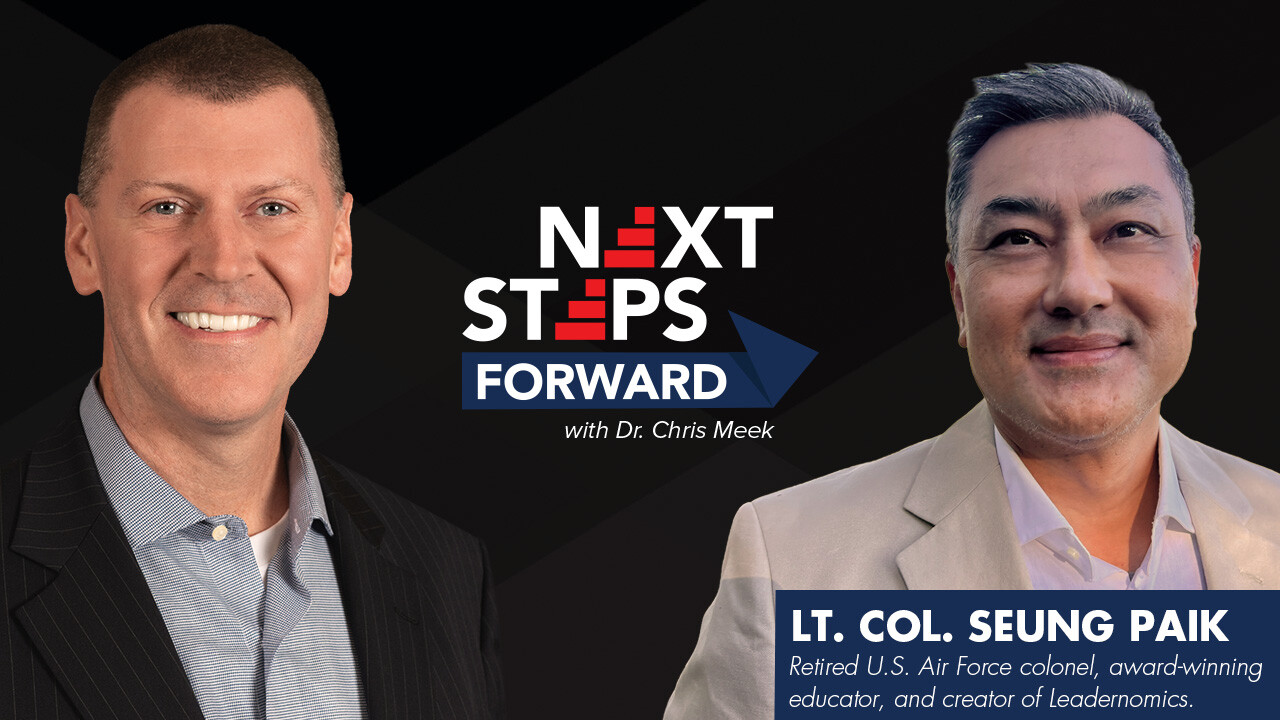


What can economics teach us about leadership, resilience, and character? This week on Next Steps Forward, host Dr. Chris Meek welcomes Seung Paik, a retired U.S. Air Force colonel, award-winning educator, and creator of Leadernomics, for a thought-provoking conversation on leadership in today’s complex world.
After 25 years of distinguished service, including deployments to Iraq and Afghanistan and leadership roles across the globe, Paik transitioned from military command to the classroom - where he combined his passion for leadership and economics into a groundbreaking framework: Leadernomics. Described as “the 101 course everyone wishes they had,” Leadernomics explores the intersection of economic principles and leadership behaviors to help individuals and organizations move from “what is” to “what should be.”
About Lt. Col. Seung Paik: Seung Paik retired from the United States Air Force at the rank of colonel after 25 years of distinguished service. He has led award-winning organizations at various levels, specializing in resource and financial management, and has served in operations across the globe from Korea, Japan and Germany to deployments in Iraq and Afghanistan. He received his master’s degree from Penn State University and has been an instructor at both the University of Colorado, Colorado Springs and the United States Air Force Academy where he was awarded the Outstanding Academy Educator. As a dedicated educator, Seung Paik has taught micro and macroeconomics, law and economics and developed a seminar on the economics of sports. While teaching at the Academy, Seung’s passion for leadership and economics came together in the creation of Leadernomics, which he describes as the 101 everyone wishes they had.
0:00 There are few things that make people successful. Taking a step forward to change their lives is one successful trait, but it takes some time to get there. How do you move forward to greet the success that awaits you? Welcome to Next Steps Forward with host Chris Meek. Each week, Chris brings on another guest who has successfully taken the next steps forward. Now here is Chris Meek. Hello. You've tuned to this week's episode of Next Steps Forward, and I'm your host, Chris Meek. As always, it's a pleasure to have you with us. Next Step Forward is committed to helping others achieve more than ever while experiencing greater personal empowerment and wellbeing.
0:45 Our guest today is Sung Pak. Sung retired to the United States Air Force at the rank of colonel after 25 years of distinguished service. He has led award-winning organizations at various levels, specializing in rescue and financial management, and has served in operations across the globe from Korea, Japan, and Germany to deployments in Iraq and Afghanistan. He received his master's degree from Penn State University and has been an instructor at both the University of Colorado at Colorado Springs and the United States Air Force Academy, where he was awarded the Outstanding Academy Educator. As a dedicated educator, Sung has taught micro and macroeconomics, law and economics, and developed a seminar on the economics of sports, which I'd love to get into more because that's all about Moneyball these days.
1:28 While teaching at the academy, Sung's passion for leadership and economics came together in the creation of Leadernomics. He describes it as the one-on-one everyone wishes they had. Sung Pak, welcome to Next Steps Forward. Chris, thank you so much for having me. Before we kick off, I just want to say, first of all, what an honor and a privilege it is to be here today. I know your audience knows you. My audience may not know you. The way I came across Chris Meek was through a mutual connection on LinkedIn by the name of Chad Hennings. Chad Hennings, a graduate from the Air Force Academy, right when I was getting to the Air Force Academy, and he was already a legend before his time because he was a famed All-American football player, should have been heading to the NFL, but instead went into the Air Force to serve his nation, and he was an Outland Trophy winner.
2:19 We had this high level of admiration and esteem for this person named Chad Hennings. Here we are. Fast forward, I don't know how many years later, I'm connected with him on LinkedIn simply because I admire what he's doing in life and leadership and character development. I see your name popping up in some of the comments and some of the dialogue, and so I'm like, who is this Chris Meek all about? I go out to your platform, and I'm just absolutely blown away by what you have done in your life of service and philanthropy, thinking that that's your full-time job and realizing that's not even your full-time job. So Chris, it's an honor. It's a privilege for me to be here talking with you, having this conversation, and for what you do for our society, for our veterans, it speaks volumes about who you are as a person.
3:08 So thank you so much for having me. No, I appreciate that song, especially coming from someone like you, and the check is in the mail for you, so thanks for that promo trailer there. And just a shout out to Chad, to your point, incredible American, and my listeners know that I'm a die-hard, die-hard Cowboys fan, and again, I say it every year, this is our year, so let's go. Wait, how does that happen, you being from the East Coast? So I'm from upstate New York, in a little town, East Chipmunk, basically, and back when I was a kid growing up, you didn't have satellite and all these things, and if your team didn't sell out at the stadium, the game wasn't shown on TV. So at any given time, the Bills, Jets, and Giants, two of the three were lousy, but we always had the Steelers at one o'clock, and the Dallas Cowboys at four o'clock.
3:53 And being a young, impressionable man, when those four o'clock Dallas cheerleaders came on, that sold me to an early age. Gotcha, makes sense, it's all coming together. I mean, I should say Randy White was my favorite player as a kid, but I kind of have to go that way just because, you know, to keep it truthful here. Son, you had a remarkable career in the U.S. Air Force, and first, thank you for your service. Before we get into why you joined the Air Force, for those who are listening, not viewing, you're wearing a West Point Army shirt. For an Air Force guy, what's going on? So first of all, to my Air Force brethren and colleagues, don't disconnect from me on LinkedIn.
4:35 I did this as a shout-out to a young man, his name's Matthew Joe, he's someone I recently mentored. He is in his first six weeks of basic training at West Point, and I just wanted to wear this so that when he gets to see this, he knows I'm supporting him, that his parents know that I'm supporting him, and that this is what it's all about. And by the way, we're a joint force, so I know my Air Force folks will be okay with this. Well, I appreciate that, and the family is very lucky to have someone like you involved in their life and as a mentor, and so congratulations to all those involved. But now back to your Falcons. What initially inspired you to join the Air Force, and what kept you in it for a full career?
5:16 So, Chris, I stumbled into the Air Force, I stumbled into the military. I like to say that I joined for all the wrong reasons, and when I say wrong, wrong for me, but I stayed for all the right ones. And when I was graduating high school, I was a gymnast. My desire was to be a Division I gymnast, and I was in the state of Illinois. And it was back during the time when you can't shotgun out 20 applications or 50 applications nowadays to the world. You basically had money to send maybe three or four applications. And behind my back, my gymnastics coach thought that I might be a good fit for one of the service academies, West Point Naval Academy and the Air Force Academy being the three that he sent a video clip of my gymnastics performance to those schools.
6:09 And sure enough, the Air Force Academy was the first to reach out. And so before I got any responses back from some of the civilian institutions that I was applying to, and quite honestly, I was a bit of a long shot to do gymnastics there, the Air Force Academy invited me out and said, hey, how about doing gymnastics for the Air Force? Went out there, and they did the dog and pony show. It was beautiful. Being from Illinois in the suburbs where you're surrounded by flat strip malls, all of a sudden I'm in the foothills of the Rocky Mountains in Colorado Springs, Colorado. It's a glorious day. I'm seeing the mountains for the first time in my life. Go onto this campus, and I see deer roaming, turkeys are all over the place.
6:50 And I'm like, what kind of place? And then I hear bugles blowing. I see jets flying. I see people marching. And I thought, what kind of strange utopia is this? And as we were leaving, my dad said, what do you think? And I said, sure, let's give it a try. And it was a good school. It was going to let me do Division I gymnastics. And I was the youngest of three kids. And my parents were knee-deep in finances, because my two sisters were in college. And so for all of the practical reasons, it was a no-brainer to go to this place called the Air Force Academy, even though I had no inclination, no clue about anything related to the Air Force or to the military.
7:36 The other thing that actually kind of boosted me, too, was it just so happened to be the summer after Top Gun came out. So everybody wanted to be the next Maverick, except for me. And so off I went into the wild blue yonder. And it didn't take very long before I realized that this government-paid free education wasn't really free. And so that's where I went. And just to kind of give you a sense of how much of a culture shock it was, the first two years I was there, it was quite the crisis, being welcomed into this military culture that I had no clue what I was going into.
8:21 And so it's in my book, but I just want to clarify here is that the Air Force at that time, the academies had a program, because they knew they were receiving 17-year-old, 18-year-old kids, and our commitment wasn't just four years at the Air Force Academy. It was five years after. So I don't know how many marriages last nine years, but they were asking these 17-year-olds to make a nine-year commitment. And when I started really thinking about it and wrestling with it, I wasn't quite sure that was the path I wanted to go in. And so after two years, they offered this program. It was kind of like a gap year, no strings attached.
9:02 You want to leave the Air Force Academy for a full year and do whatever else you want to do, as long as you don't get into legal problems or get married, you can come back after a year. But if you choose not to come back, no strings attached. And so I left. I ran. And I want to see just how green grass was on the other side. And it was at that time that, like I said, for me, I joined and I came in for the wrong reasons. But it was during that year where I did a lot of soul searching. And strangely enough, constantly pricking at my conscience was that otherworldly place in Colorado where there were peers and students that had a purpose and a vision beyond themselves.
9:48 And I kept thinking to myself, man, there's something special about that. And it was also during that year when my dad, who is a man of very few words, started sharing with me a lot more about his journey as a Korean immigrant, a product of the Korean War, and who at a very young age became a refugee, left his family from North Korea, came into a refugee camp in South Korea. And it was there that he was first introduced to the American GI, who approached him as almost a heroic figure, bringing him some candy. And he still tells us to this day the story of how he was introduced to the American military and the picture that he had and the hope that was conveyed through these people in uniform.
10:41 And he made it very clear to me that, hey, son, to whatever extent you have it in your heart, mom and dad are so proud of you being at the Air Force Academy and you being in the service because you being there, it's in many ways, it's our payback. It's our payback for the freedoms that we're enjoying in this country. And so that's, I think, Chris, the first time when it really struck me that his story was my story, too. And it's the story of everyone in my generation and in the Pack family. And so, yeah, some people like to say you pay it forward. I like to think of the good reasons of why I stayed was paying it back and understanding that our family were recipients and beneficiaries of many lives lost, many American lives lost, suffering for our freedoms.
11:35 So we're going to get into your book later on, but we just talked about sounds like a potential another book. Do you want to tell that story? You know, it's funny you say that because as soon as I was sighing some relief as I was nearing the end of this book, I had an editor, I had several editors, but there was one editor that actually wrote me and said, we think there's another book in you. And I just about died because when you're finishing a book, that's about the last thing you want to hear. But I think there may be another book coming. Love to hear that. Love to hear that. What were the most formative leadership lessons you learned during your time in service and at what stages of your service did they happen?
12:17 It happened pretty early. I think for me, when I joined the military, I had two double whammies at the Air Force. And this is also part of the reason why I wasn't quite sure why I was there. But I went to the Air Force Academy and as you can see, I've always had bad vision and I'm one of those guys that gets air sick on a commercial flight. So imagine being surrounded by 99% of fellow students who all want to be the next Maverick. My roommate was of the Honduran Air Force. He was a descendant of the Honduran Air Force, his father flew jets in the Honduran Air Force.
12:59 And I remember the first time he asked me, hey son, what jet do you want to fly? And I said, I don't really want to fly. And if you could just see how deflated he was in my hand. But so for me, it became pretty early where I felt like I'm liking this place if for any other reason, because of the leadership laboratory that it is. And so my mind was never on jets. My mind was never around aeronautical engineering, astronautical engineering. My mind was always on leadership development. And so that was kind of, I think, a strange, maybe a unique aspect of just myself, how keen I was on leadership from the very beginning. And so I had a crisis when I was getting ready to graduate.
13:44 And here I am maybe about 30 days before I'm about to graduate and it just hit me. In 30 days, you're going to take an oath to the nation and to the constitution. And before you know it, you're going to have a bunch of people underneath your leadership, underneath your care, and they're going to expect you to lead. And even though we have four years of this development and training, there was something where it just hit me so hard of almost like this imposter syndrome of who am I? Who am I as a 21, 22-year-old graduate to be undertaking these priceless national treasures under my care, who will follow my directives and my orders to their potential harm?
14:39 Who am I to do this? And so that was a crisis of both humility to recognize that, are we ever prepared to undertake that type of responsibility? So feeling a tremendous amount of humility, and then also sensing a complete recognition of dependence. I'm going to need to approach this leadership world as a young lieutenant, as a young officer, depending on those who've been there and who've done that. And for me as a young lieutenant, I was incredibly thankful to be in a leadership position where immediately I met incredible young enlisted members and COs, what I consider the backbone of our nation's service.
15:30 And so just a quick story, 1997, I'm a young officer, and I'm still in this mindset of the Air Force is definitely a 24-7 military world, but you get kind of plugged into your eight to five role every day. And then New Year's Eve, 1996, turning into 1997 happens, I'm stationed at Beale Air Force Base, California. And we had probably one of the most torrential 1997 Northern California floods. It was storming like you wouldn't believe, the dikes had broken, water was everywhere. And in that part of Northern California, it's near a town called Linda, Yuba City in Marysville.
16:15 Linda was known at that time as the lowest income per capita city in all of California. I receive a phone call from my boss, my commander, and he said, and he lived off base, I lived on base. And he says, hey, son, we've got a crisis. We're about to bring in 7,000 local citizens who are flooded out of their homes. And we're going to use Beale Air Force Base as an area of shelter indefinitely. And I need you to go down there because you're on base, I need to go down there and be the shelter manager at one of the hangars. It was about one in the morning. I said, yes, sir.
16:55 Got it, boss. Got off the phone. Next thing I know, heading to the hangar, and I forgot to ask him which hangar. And so there I am running around with my head cut off trying to find out which hangar I'm going to. And I get to this hangar, Chris, and standing there as we're waiting for the busloads of citizens to come onto this base, there's about 15 other airmen. And they're all enlisted. And as soon as I walked into that hangar, they're all looking at me for guidance and direction. I've never been a part of a humanitarian crisis up until that point. I had never led in that kind of a scenario.
17:36 And I'm staring out into 15 folks who are waiting for this young officer to say, this is what we need to do. And I didn't know what to do. And so I did what any good leader should do, turn to one of the NCOs and said, hey, have any of you guys been through something like this before? And two of them raised their hand and said, yes, sir, we have. And I said, what do we do? Tell me right now. Give me the list. Let's make it happen. And next thing I knew, we were getting cots. We were laying out shelter areas. We were getting medicine. We were getting food supplies. And they were making it happen. And about two hours later, we started seeing hundreds of busloads of folks coming out to the base.
18:19 And because it was the lowest income per capita part of California, you can imagine, they weren't the upper middle class of society. There were quite a few Laotian, Cambodian, Hmong folks that were living in that area coming on, some of them not speaking English. And I stood on the backs of these NCOs for three days straight, 72 hours, as we ran this humanitarian operation on base. And it was just such a good, quick lesson for this young officer to recognize that, hey, my leadership is dependent on the strength and the backbone of the enlisted corps.
19:00 And I have never, ever forgotten that. And that has what's carried me through my entire military life. And to your point, for the listeners who aren't familiar with the military, NCOs is a non-commissioned officer and they are, to your point, the strength and the backbone of any branch of service because they just get shit done. They're amazing. And here's the thing too, it's funny because the Air Force demographics are really funny. The operators, unlike the other services, the operators in the Air Force, if you want to talk about pilots, pilots, right, they are whom we support. They're the ones that are going to go out there, they're going to drop the bombs, they're going to defy the jets and do their thing.
19:44 And we love them and the Air Force loves them. But they're about this small, those who can't see me, I guess, on TV, I've got two fingers that are just minuscule in terms of who the operators are in the Air Force. There's like this small percentage that the rest of us support. And when I break down the Air Force, and this is why it's so important for me and I'm so passionate about the NCO Corps, when I break down the Air Force, the active duty Air Force in its entirety is 330,000 members. It's been that way for about 20 years, 15 to 20 years, 330,000 members, 270 of that 330 are enlisted.
20:27 Of that enlisted, of that 270,000 that are enlisted, there is one rank that affects 90% of that enlisted Corps, one rank, one singular rank. It's this rank called the E5. In the Air Force, we call them the Staff Sergeant. And you know what age they are? You would think that this one rank that is the center, the hub, the center of gravity for the enlisted force that affects on a daily basis, 90% of the enlisted force, you would think, oh, they must be seasoned and experienced. Well, they are seasoned, they are experienced, but their average age is like 24, 25 years old. They're young.
21:08 And they're making things happen. And so I like to tell people in the Air Force, especially I like to tell senior leaders, hey, if those E5s ever got together and went on strike, we'd be screwed, right? The greatest Air Force the world has ever known would no longer be the greatest Air Force the world has ever known. And we have to remember that if there's a center of gravity in the United States Air Force, and I think a center of gravity in our United States military, and what makes us so great is that we've got a great junior NCO Corps, and we invest in that aspect of our military. And so long as we do that, we will continue to be great. So sorry to go in that soapbox, but I just want to let the world know just the importance of the enlisted force, and in particular, our NCOs.
21:53 No, I think it's extremely important, and especially because we're now 51, I think, years of the all-volunteer force, and so people don't realize that. And we've been seeing the military numbers starting to creep up again, thankfully. You talked about the Air Force being 330,000 people. I think it was the early 90s was pretty much cut in half with budget cuts. And so I appreciate you sharing it and giving that background for us lay civilians out here. You talked earlier about your father and your Korean heritage, and that's my dog Zeke, if you can hear him. And yes, he's named after Zeke Elliot. I like Zeke. I've got a dog, too, named Lulu. So if I get a package today, you're going to hear Lulu. Yep, that's UPS or Amazon right now.
22:35 So your heritage, did your identity as a Korean American in a high-ranking military role influence your leadership style, or others responded to your leadership? That's a great question. I think, Chris, quite honestly, I think it's affected my leadership style outside of the military far more than it did in the military. And the reason why I say that is in the military, and of all the services, interestingly enough, the Air Force has demographically the least Asian Americans. I think we make up 4% of that 330,000.
23:17 Slightly over 4% of that 330,000 are Asian American. And so you quickly realize as a percentage minority, and when I was at the Air Force Academy, I think I could have counted on both hands the number of Asian Americans at the Air Force Academy when I was there. And so it's just something I think because I was there in that perspective so early in my life, it didn't really phase me, and it never really kind of phased me throughout my entire Air Force career in leadership. But outside of the Air Force, especially as what I consider myself as a 1.5 generation Korean immigrants, I had a scenario which I think kind of encapsulates it a little bit.
24:03 I was a part of a men's group when I was in Washington, D.C. stationed at the Pentagon. And this men's group was about, there was about 20 or 30 of us. We're all probably in our late 20s, early 30s. And for anybody who's been to Washington, D.C. and you're among a crowd of late 20s, early 30s, and in particular, if you're among a crowd of Asian Americans and Korean Americans, probably 30 of those 35 guys are either a doctor, a lawyer, an engineer, or an accountant, or a professor, right? So they're somewhere in that category. And I will never forget one of the Harvard lawyers who had came up to me after he got to know me a little bit, and he wasn't misintended, but I think this conveys some of the ignorance even among the Korean American culture at that time.
25:02 And he came up to me and he said to me, hey, son, I thought you said you went to college. And I said, I did. And he said, and didn't I hear you say you went to grad school? And I said, I did. And he just looked kind of surprised. And he said, so why are you still in the military? Again, I didn't take his comments to be demeaning or cruel, but so many of us in the Asian American community and in the Korean American community, they come as immigrants. The parents maybe have left a war-torn society and culture.
25:43 The last thing the parents want is their child to go into the military when they came from a land that was submersed in perhaps a war. And so I get it. So much of my generation Korean Americans were encouraged, not military, military was not spoken of in the home. They were encouraged education, hard work, become a doctor, become a professor, become a lawyer. And if you can't make it to any of those things, then maybe consider the military, right? But it just dawned on me that, boy, this is a significant area of ignorance, I think, within my own heritage and within my own ethnicity.
26:28 And so the way that conversation ended was when he asked me, so why are you still in the military? And I didn't mean it as a cruel response either, but I just looked at him straight in the face and said, how come you're not? And I pulled him aside and I said, hey, you know, I think your parents came from the same country my parents just came from. And I think the fact that you got a Harvard Law degree and got to enjoy all the benefits of your education and got to enjoy all the things you're getting to enjoy now, I got a feeling there's a history behind that. And you wouldn't be here if it wasn't for the fact that you had 37,000 Americans give their lives in defense of your birthland, your homeland.
27:16 And so the question I have for you is, how come you never thought about it, right? And so, Chris, to answer your question, how has my heritage affected my leadership or influenced my leadership? I think it's done it a lot more outside of the military than inside. And then, like I said, today I'm wearing this shirt in honor of a young man I've had the privilege to walk alongside and mentor on his roadway to West Point. He is a Korean-American 17-year-old who has signed up to commit to the United States military. And the last several years I've had the privilege of walking the young man to the Corps at Virginia Tech, another young man to the Naval Academy, and another one to West Point and to the Air Force Academy.
28:03 And so it's been a joy for me as a Korean-American to remind my generation and the next generations, why not you? And don't you forget where you came from and that you are a beneficiary of wearing that, of the people that have worn this uniform. And so before you go think about all these things that are going to fill your pocketbooks one day, why don't you think about serving your nation? So that's been my privilege. Never expected an answer like that. So thank you for sharing that. I started the show off by saying thank you for your service. Even though you're retired, thank you still for your service because you're still serving, leading our youth and our future heroes.
28:48 So thank you for that. I appreciate that, Chris. Are there any lessons about leadership, discipline, decision-making, or accountability that only the military could have taught you? You know, I will tell you this. We live and die by our core values. Everybody takes the oath. Everybody signs up for something that's in defense of our nation. But the core values, I think across all the services, and again, I don't want to speak on behalf of all of civilian society because that isn't my area of expertise.
29:30 I've only been retired for about seven, eight years. And so in the military, I mean, core values, if we don't have that internalized, if that isn't our North Star, if that isn't our compass, if that isn't our unified purpose, then we're in trouble. Then we're in significant trouble. So you learn pretty quickly, I think, in the military that core values aren't just words. They're not just a banner that you put up. They really need to be something that's deeply internalized, communicated repetitively, redundantly, preached and lived out. And it's a part of our DNA and what we breathe. And at the end of the day, right, you think about, and we'll get probably a little bit more into my specialty, but as an economist and as a leader, you're always thinking about how do I incentivize my people?
30:25 How do I motivate my people to go above and beyond, to do amazing things? Because it's in them and they want to do it. Just how do I bring it out of them? How do I motivate and inspire, incentivize them? And I will tell you, in the private sector, you often do it with a bonus. You do it with 10% pay raise or an added increase or a couple extra dollars or a paid vacation. In the military, we don't have that at our disposal. Leaders don't have that at their disposal. So how am I going to energize and motivate and inspire and get people to do things above and beyond what they think they're able to do? It has to, it can't be money.
31:05 So it has to go back to something far deeper. And that's where we have to go back to resonating to things of aligning with purpose, core values, vision, and our mission. And if they don't get that, and if we don't get that as leaders, then there's just no way that we're going to get them to go above and beyond, to knock down walls and to go into harm's way willingly. I can't give you a hundred bucks. Military won't let me do that. But what I can give you is I can give you me. I can give you me and I can give you the core values. I can remind you of that. And I can remind you of the things that we signed up for and why they're so important.
31:45 That I can give you and remind you of. Oh, before I forget too, I do want to say one other thing about, I think that's very unique to the military leadership, which I think is pretty distinct from the civilian leadership I learned pretty quickly too is, you know, we like to say that it's, I'm the leader, right? But as you grow in leadership positions and platforms, anyone who is going alone, and I specifically mean this compartmentalization thing of, yeah, my family is not a part of this. I'm the one wearing the uniform. But I think that's, I think that's a false assessment.
32:27 In the military, the more the family is bought in and understands those same core values and the same purpose and the same oath, the more your spouse gets that, the more your kids get that. It all of a sudden becomes not sung pack leader, it becomes team pack leader. And I have experienced firsthand that my success in the military and as a military leader was when the whole pack family could come and join me in the fight. And people just don't realize, I hope they realize, but they may not realize the military spouse in the military, they are a force multiplier.
33:12 When spouses join in the fight with their respective spouse leader in the military, it's a game changer. And so I know in the private sector and civilian world, it's very much one of, hey, you don't ever have to ask about the spouse, even, you don't even have to know how many kids they have. Families are not a part of this, right? You're the one that's here working and giving of yourself and doing your nine to five job. But in the military, we also try to create some space for that. But I will tell you, you don't go super long in the military without realizing that it is a full team family effort. And when the family engages, that is a force multiplier in the military that I think people outside the military don't understand that the military spouse, the ones who are part of your family, they are a force multiplier in our service.
34:05 So we mentioned that you're out of the Air Force and retired now. Is there anything about military life that you miss these days? Anything you're glad to have left behind? I miss my NCOs. I miss my junior officers. I miss those wide-eyed, brand new lieutenants coming out of the service academies and ROTC and OTS and looking at me for the first time for guidance. I love that. I love grabbing them and caring for them and shepherding them and mentoring them to become better leaders. I love NCOs because of what they've done for me throughout my whole life and because of their backbone. And I just love engaging with them.
34:45 I like to talk to them. I like to have this speech to enlisted members where I say that the speech is called, Look in the Mirror, because I always want them to remember who they are when they look in the mirror, who I see when I look at them. And so I miss that tremendously. I miss that fellowship. I miss that mentorship and I miss that engagement. I miss their youth, their youthful energy. I'll tell you one thing I don't miss. I don't miss moving. Yeah, I think packing bags, unpacking bags, taking down pictures, putting back up pictures. If you see any gray hair on my head, and there's a lot of it, and you see any wrinkles around my eyes, I think it's primarily from the moves, 14 plus moves in 24 plus years.
35:34 It's just a lot of packing and unpacking. You know, you got a problem when you've got like 20 different knife sets and fork and spoon sets. Yeah. Some new friends have come into my life. The husband's a retired Marine, the wife is retired Air Force and spoke with them a few weeks ago. And they, you know, many, obviously same thing moves over 20 plus years. And the husband said, the next home I'm in is a funeral home. I'm done. That's it. I know. I can understand what you're talking about. I mean, but that's pretty good. I'm going to use that. So let's talk about what you mentioned before your specialty.
36:18 During your time in the service, you created Leadernomics. What are the core components or principles of Leadernomics? So economics is my background. It's what I studied in undergrad and also in grad school. And the key is, I guess if I could narrow it down into a nutshell, and it comes out in the title, it's called Life and Leadership Lessons from My Mentor Economics. And people would say, mentor, isn't economics a discipline, isn't it a class? And don't you have a ton of other mentors in the military? And if you recall, I was telling you, Chris, I had a crisis when I was at the Air Force Academy.
37:02 And part of that crisis centered around the fact that when I look to my left and when I look to my right, I was surrounded by a bunch of people that had wanted to be there since they were like eight years old. They wanted to fly since their youth. They wanted to be in the military and wear that uniform since their youth. And I got there a fish out of water, shining shoes and folding laundry and ironing clothes and making hospital corners. And I'm like, what in the world am I doing? And so I was looking for a little bit of compassion and empathy. And I'd look to my left and look to my right, and the only thing I'd see is everybody marching to the same tune. And so as I'm going through this crisis, I'm thinking to myself, I need a mentor. And so then I'd call home and I'd say, hey, Mom, Dad, I'm having a little bit of this crisis.
37:45 And the only thing I'd hear from them is, we're so proud of you. We're so glad you're there. And I thought, oh, man, where am I going to find this wisdom that can give me some level of objectivity that can kind of search my heart and where I'm at? And strangely enough, it happened when I walked into this thing called Econ 101. And I had this crazy professor who started the class, first day of class, and he was a military professor. So he's in uniform, we're all in uniform, and he starts doing this crazy flailing dance with his arms and with his body and all these contortions, and he's moving around like this.
38:29 And then he says to us, what's the purpose of economics? It's dead silent. And he's like, come on, nobody, nobody knows the purpose of economics. And we don't want to say the wrong thing, so nobody's saying anything. And then he goes up to the grease board and he starts doing the same thing, except he does it with a grease marker, drawing this roller coaster all over the grease board. Comes to the end, and then he says, guys, what's the purpose of econ? And we said, what? And he goes, finally, I know you guys have all had calculus because calculus is a prerequisite to this class.
39:12 So what is the purpose of first derivative calculus? Oh, well, all of our hands go up because we're all mathematical tech geeks, and so we all raise our hands. We're like, sir, we know what the purpose of first derivative calculus is. It's finding a slope at a point on a curve. And so then he goes back up to the grease board, puts a dot on that roller coaster curve, and then puts a straight line through the dot, just hitting that curve. And he says, guys, just like first derivative calculus, this is the purpose of econ. It is to take your crazy, confusing roller coaster up and down, chaotic, uncertain life, focus on a point, and give you a straightforward, linear path so that you can move on.
40:13 Boom. Drop, drop, just do it, professor. Just do it. Just drop it. And standing before me that day, I saw my mentor. And I wasn't talking about the crazy professor. I was talking about this thing called econ. And lesson by lesson, principle by principle unfolded. And it was like this relationship where this discipline was somehow able to show me my blind spots. It was somehow able to probe into my preferences, my particularities, my intentions, and my motives.
40:53 How does this discipline do that? And that's the kind of stuff that a great mentor does, right? A great mentor asks great, deep, probing questions. And a great mentor knows how to listen and then knows how to speak into that. And this discipline, econ, was doing that for me. And so it's there that I started this relationship with econ of, hey, if I can't find a human mentor, maybe I've got this discipline, this universal discipline called econ. And by principle, by principle, it's kind of laying it out for me. And so I viewed that as a framework, as a mentor guiding this young adult.
41:37 Neuroscience economics is a human character before, and I was an econ major, so I can relate to that. How important is emotional intelligence in leaderonomics, and how do you train for that? That's a big thing nowadays, right, Chris? You always see EQ next to IQ now. It's never just about IQ. And I think the more we get into the world of AI, I think more we're beginning to understand that the importance of emotional intelligence being coupled with artificial intelligence. And so leaderonomics and economics, the way I have learned it and the way I like to think about it is the last time I checked, we're in America, and America, one of its great aspects of the United States is that we are a market economy.
42:34 And in any market economy, the first thing you recognize about a market is that a market only functions based on relationships. You don't have producers without consumers. You don't have supply without demand. You don't have employers without employees. And so everything in a market economy is relationship-based. And so when you think about economics, and in particular, leaderonomics, leadership combined with economics, the market economy tells us right there, economics is a relationship-based human endeavor. Leadership, you don't have leaders without followers. It's a relationship-based calling.
43:14 And so the two are very much synergized in terms of their human endeavor. And so the way economics speaks into leadership is it speaks into the human elements, the human decision-making, the human thought process. And so it's all about EQ. It's got to be about EQ. You got to have an understanding of what incentivizes a human, what motivates a human, what inspires a human. And it's in that relationship, it's in that context that you have great leadership. And it's also the context by which you have great market economy. And so the two, to me, just perfectly blend together.
43:58 It's not, there's no reach there. It's just these completely overlap. And EQ, if you don't have EQ, then I will tell you, no great economist, no one who truly claims to understand economics can possibly claim so without understanding the absolute foundational human endeavor, emotional intelligence level of economics. If you don't, then you're probably one of those folks that are sitting up in the high tower still writing journal articles that have nothing but 90% math and equations, and you've forgotten the complete human element of why econ exists. What feedback have you received from leaders who have adopted your approach?
44:38 Comprehensive but mobilizing. That's one. It's a lot of stuff, son. This framework is deep. It kind of covers everything, but I'm not left paralyzed. As a matter of fact, I'm given an energy and a mobilization to move out because the framework and the comprehensiveness of it is so human centered that it's already in us. It just needs to get pulled out. It just needs to get reminded of us. There's nothing new under the leadership sun, but there are fresh ways of looking at things under the leadership sun.
45:20 I think economics for a long time has been under the clouds. What this is trying to do is it's trying to bring it back into the light, show everybody, hey, this was the econ 101 that you wish you had. Now that you've got it, it's just bringing out what you have heard before, what you know innately, and now you're able to be mobilized because you see it firsthand very clearly. It's told in story form. Therefore, they can see very clearly how it was mobilized within me. There's no excuse. I've heard comprehensive, but mobilized. I've also heard this notion when it comes to leaderonomics is that it takes this notion of market value and begins to transform me toward inherent value.
46:15 It takes this notion of input to production called labor and instead of commodifying input to production, it begins once again to humanize that input to production. This is the shift. Economics as a human endeavor was always meant to guide us in this relationship as leader and follower to always first and foremost see the inherent value, the priceless value, the eternal worth of the people that we are leading. That is the best way we're going to run this market, this relationship as leader and follower.
46:58 It's also meant to guide us comprehensively, but not to paralyze us, to just move out what's already within us because it's a human endeavor. I'd like to brag that Next Steps Forward is a show of firsts. I think I can safely say that you're the first Server's Academy graduate economist that we've had on here. We can put that on your byline next time you're on here. Fantastic. What do you hope readers feel when they finish that last chapter? I want them to feel like that they have just wined and dined at a Michelin star restaurant. They've had seven, eight courses of just amazing, amazing food.
47:44 They're sitting back, they're pondering, they're thinking about it, they're talking about it, and then they even want to revisit it. That's what I want them to have when they finish this book. Chris, I poured my heart into this book. I don't say that from a standpoint of platitudes or cliches. If you ask anybody that knows me, what was supposed to have been about an 18-month project because I've been speaking on this for a long time. I actually thought taking what I do in terms of speaking, putting it on paper and making a book of it, I thought it was actually going to be kind of easy.
48:32 Probably the biggest self-lie I ever endured. But conveying Leaderonomics in a book that can actually convey to my audience this human element of economics, it required everything in me to put it on paper. Because even right now, right, as you and I are communicating, you're communicating to me with your body language, with your head nods, your eyes, your smile, your body language. There's so many forms of communication that I, as a speaker for 20 years, I relied upon and I didn't realize to what extent I was relying upon the multitude of forms of communication that I use in speaking.
49:14 And then all of a sudden, I'm going to take that and put it into one mode called the written language. And I know you've written a book, and so you also know the ordeal of what it means to try to communicate everything you want to communicate, everything that's emotive about what you're writing, and then putting it on paper. And so I'll tell you, I had last four years, it was a PhD in English. I have never gone through the rigors of English like that. And so I put everything into it. Like I like to say in sports, I laid it all on the field. I put it all on the court. It's all out there. Every part of my effort, including my heart, it's in that book.
49:56 And so that's why I say, like a great Michelin star chef, their only desire is that when that person has finished that meal, they can go out, look at the restaurant, see that person just kicking back and just saying, whoa, that was something else. And that is my desire for every reader is to have that sensation when they finish the epilogue and you got to get through the epilogue. Don't stop at the last chapter, get through the epilogue. So we've gone from calling you Colonel Song to now Chef Song. I'll take it. Song, we've got about 90 seconds left. How can people get in touch with you? You can find me on LinkedIn. You can find me also on my website, www.leadernomics.org, not com, org, leadernomics.org.
50:44 And then you can also email me directly at leadernomics at gmail.com. Song Pak, creator of Leaderonomics and author of the soon to be released book, Leaderonomics, Life and Leadership Lessons from my mentor, Economics. Thank you so much for being here. It's an absolute pleasure and honor, sir. Really appreciate your time and all you've done. Chris, thank you. I really appreciate you and I appreciate your work. It's been a pleasure. Thank you. And thanks to our listeners and followers. I'm Chris Meek. We're out of time. We'll see you next week. Same time, same place. Until then, stay safe and keep taking your next steps forward.
51:25 Thanks for tuning in to Next Steps Forward. Be sure to join Chris Meek for another great show next Tuesday at 10 a.m. Pacific time and 1 p.m. Eastern time on the Voice America Empowerment Channel. Next week, make things happen in your life.