Serving Those Who Serve w/ Lt. Randy Sutton

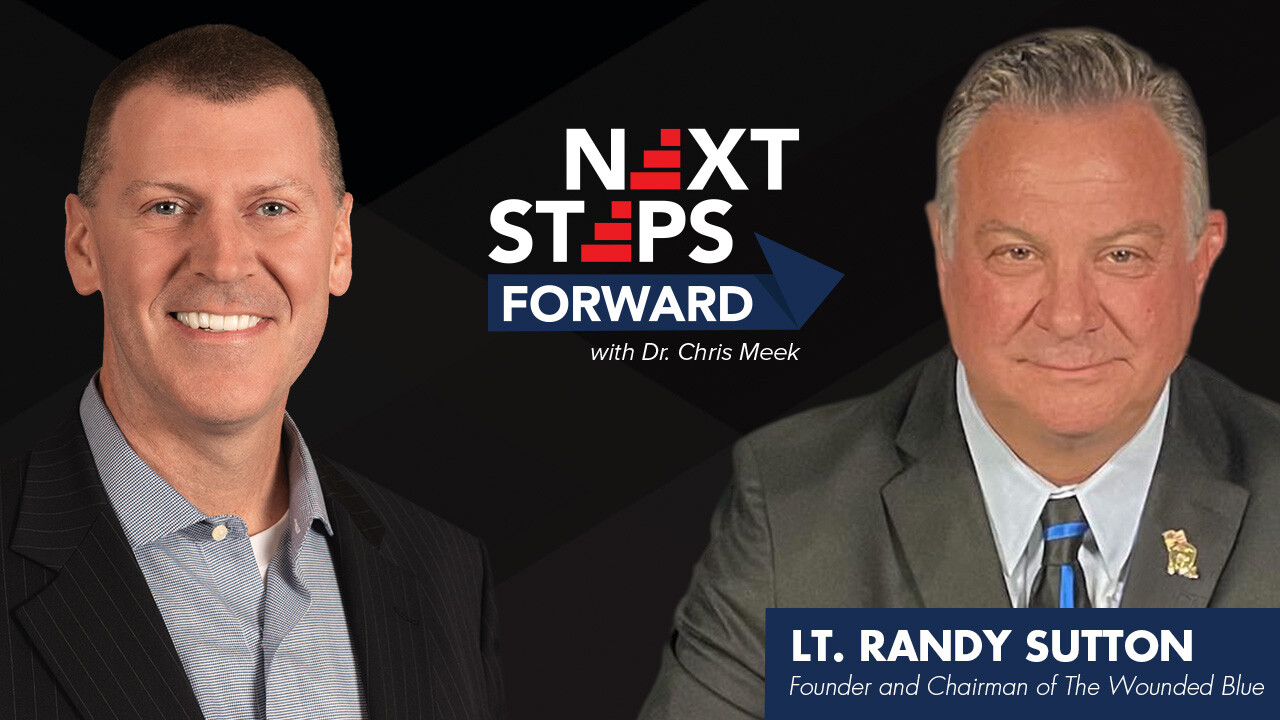


What happens when the protectors need protection? This week on Next Steps Forward, host Dr. Chris Meek sits down with Lieutenant Randy Sutton (Ret.), a 34-year law enforcement veteran, national media voice, and founder of The Wounded Blue, the only nationwide organization dedicated to helping injured and disabled law enforcement officers.
During his decades of service, Randy Sutton witnessed firsthand the physical, emotional, and financial toll of the job - especially when officers are injured in the line of duty. Out of that experience, he created The Wounded Blue, a nonprofit that provides critical support, advocacy, and peer counseling to officers and their families when they need it most.
In this powerful conversation, Sutton shares:
✔ The real challenges faced by law enforcement officers when tragedy strikes.
✔ How The Wounded Blue is changing lives - and why the need for its mission is greater than ever.
✔ His perspective on the state of policing in America today.
✔ Personal stories from a remarkable 34-year career that earned him the reputation as the “voice of American law enforcement.”
If you care about public safety, resilience, and supporting our nation’s heroes, this is a conversation you can’t afford to miss.
About Randy Sutton: Lieutenant Randy Sutton (Ret.) is a distinguished figure in the law enforcement community. With over 34 years of service, he brings a wealth of expertise to the table. Sutton founded The Wounded Blue as a means to support injured and disabled law enforcement officers. As the Chair of the Board of Directors, he leads initiatives aimed at providing assistance and resources to those who have sacrificed for the safety of others. In addition to his contributions in law enforcement, Sutton is a prolific author, and his insights have earned him appearances in movies and TV shows, solidifying his reputation as the “voice of American law enforcement.”
0:00 There are few things that make people successful. Taking a step forward to change their lives is one successful trait, but it takes some time to get there. How do you move forward to greet the success that awaits you? Welcome to Next Steps Forward with host Chris Meek. Each week, Chris brings on another guest who has successfully taken the next steps forward. Now here is Chris Meek. Hello. Welcome to this week's episode of Next Steps Forward, and I'm your host, Chris Meek. As always, it's an honor to have you with us. Next Steps Forward is committed to helping others achieve more than ever while experiencing greater personal empowerment and wellbeing.
0:45 Our guest today is Randy Sutton. Randy is a retired Las Vegas Metropolitan Police Lieutenant, a nationally known commentator on law enforcement issues, a sought after speaker, a television and movie actor, and the bestselling author of, yes, because he doesn't do enough, five, count them, five books, including The Power of Legacy, Three Books About Policing, and the most recent Rescuing 9-1-1, The Fight for America's Safety, which was an Amazon number one bestseller. He also founded the nonprofit The Wounded Blue to improve the lives of wounded and disabled law enforcement officers through support, education, assistance, and legislative advocacy. Thank you, Sutton. Welcome to Next Steps Forward. It is a pleasure to be here. You missed one thing. What'd I miss?
1:26 The host of A Cop's Life, my podcast. Okay, Eric, my producer, I know you're listening, you're fired, so I apologize for that. We usually do pretty good on our homework, but we are human. I forgive you. I forgive you. And where can people find that podcast? On Spotify, all the regular avenues for podcasting. Beautiful. Before we start, Randy, right before the show, we're quickly chatting, and I like to brag that this is a show of firsts. And for those of you viewing, not watching, Randy is the first guest we've had on here smoking a cigar. So kick back, give me a fun 52 minutes for everybody. So grab a cup of coffee or a beer and a cigar, and let's have some fun.
2:07 I do have a bottle of whiskey right behind me. We are broadcasting out of my cigar bar. Well, it's afternoon here on the East Coast, and it's six o'clock in London, so hey, five o'clock somewhere, we know that song. So Randy, like I always do, let's start at the beginning. You grew up in New Jersey. What inspired you to pursue a career in law enforcement? I consider myself very fortunate, Chris, because from a very young age, I knew what I was going to be. What are you going to be when you grow up? Well, I'm going to be a cop, and that's exactly what I had envisioned for myself. So having that direction early on, I just channeled my life to move forward in that direction and wound up becoming the youngest police officer in the state of New Jersey at the time, hired at the ripe old age of 19.
2:57 Now when I look back on being a 19-year-old cop and some of the decisions I made as a 19-year-old cop, I got to tell you, I kind of shudder sometimes because the world was very black and white then. Not so much these days? Not so much. Not so much. I mean, I was, you know, as a 19-year-old cop, you're not even fully formed as a human being yet. And here I am, I'm making life and death decisions. I am, you know, going to domestic disputes with, and by the way, it was in Princeton, my hometown that I was a cop.
3:38 And so I was arresting people I was in school with, their parents. I was writing tickets to moms and dads. I mean, I wasn't a very popular person in my own hometown, I can tell you that. But I did 10 years there, six as a patrol officer and four as a detective before I made the big move and came to Las Vegas. And we're going to get to that. You mentioned being 19 years old, right out of high school, wet behind the ears, still pretty green. Did they give you any reason to reconsider your decision? No. No, I was, I loved being a cop.
4:18 I even loved being a cop in my small community. I was, the only problem there, I was bored. That was the issue. But I loved, I loved the work. I loved the, I loved being a protector. Even from an early age, I was a protector. I was the guy that stood up to the bullies on behalf of other kids in the class. I got my ass kicked a few times. And it's got a lesson taught to me every now and then, but no good deed goes unpunished. But still, it was innate in me. And service is, sometimes you got to go with what your calling is, what your nature is.
5:02 And I'm a huge believer in service and giving back, and probably in the ensuing years from those till now, that's even been more pronounced. I'm a huge believer in service and patriotism and community. So that's just your DNA. It is. It is. Yeah. Not many more people like that. So before we get to Vegas, how'd your time in Princeton, New Jersey shape the kind of police officer and man that you became? So I was very fortunate, once again, in the fact that I had a fantastic family life. I literally had the beaver cleaver life.
5:43 You know, Princeton's a pretty affluent community. My parents weren't rich, but they weren't poor. You know, we were middle class. And I was born in, you know, in a beautiful community. My parents, you know, raised me with love, you know, literally till the day they died, we had a very, very close relationship. And so I was, you know, I think we don't even realize how fortunate we are in our young years with the gifts that are given to us. But I actually was. I saw, and I was kind of a student of life, even as a kid.
6:26 I saw, you know, disruptive families. I saw parents that didn't give a damn about their kids. I saw their kids, you know, how they grew up with, you know, parents that didn't give a damn. And I always realized how fortunate I was that I had parents that cared about me. And so I never went through that, you know, sometimes the teenage years are a little rough. I never went through that because I respected my parents and I just, I never had, I never had those issues. So that kind of base is critical for, you know, forming yourself as a human being.
7:10 You know, my father was not the wise sage, you know, orator, but I do remember a couple of times. I remember one time when I was about 10 years old and I was very sickly as a child. I spent much of my young years in and out of hospitals and I couldn't play with the other kids a lot. I couldn't play sports because I was sick all the time and they couldn't figure out what was wrong with me. I spent like two months in Philadelphia Children's Hospital undergoing every test imaginable. And I was bedridden for much of my very young years, you know, seven, eight, nine.
7:57 And my, you know, my parents of course were worried to death. And after not getting any satisfaction from going to all these, you know, modern doctors, they heard about a doctor, this, this, a naturopath who saved the life of one of their friends who was given a terminal cancer diagnosis. And after she went to this naturopath, she went on with a normal life. So out of desperation, my parents take me to this doctor. Now here's how crazy he was. He marched to the beat of his own drummer. He only had office appointments from 12 midnight till four in the morning because that's where his rhythm was, right?
8:39 So my parents wake me up at midnight to take me to the doctor. And even as a 10 year old, I know that if my parents are taking me to the doctor at midnight, I am really screwed up, right? So they take me to this, to Trenton, New Jersey, and we knock on the door of this old brownstone house and this little bird like man opens the door, Dr. Samuel Gatlin. I'll never forget him. And he was, he was ancient, ancient. And he ushered us into his, into his waiting room. And now I'm used to, you know, the most modern hospital facilities. This is a cramped little office with national geographics from the forties and faded photographs of, I mean, it was, it was, uh, it was almost comical.
9:28 And he said, I'm going to take a urine sample and a blood sample, and then I'm going to go back to my lab and I'll be right back with you. He's going back to his lab. So my parents and I are in the waiting room and I look at his, I look at his, his medical certificate is from the twenties, right? He's from the twenties. This guy is old, old, old. And my parents, I can see they're looking at each other going like, what are we doing here? Right. And he comes in and he ushers us into his, into his exam room. He doesn't ask me any of my symptoms. He tells me every single one of my symptoms. He says, you can't get out of bed. You're tired all the time.
10:08 You, you, you gain weight, you lose weight, you're depressed. He went through everything that I was experiencing. And my parents were like, yeah, yeah. And then he looked at my parents and he said, well, first he said, I know what you're having. I know what you eat. You eat cheeseburgers. You have ice cream. You do this chocolate, you know, count Chocula, that kind of, yeah. And he turned to my parents and he said, you're starving your son to death. And they looked at him. He said, what? He says, your son is malnourished and he, and he has hypoglycemia, which I never had heard of. Of course, as a kid, it's the opposite of, uh, of diabetes.
10:48 He said, you're, you are literally starving your, your child to death. He has no nutrients in his body. And there he says, from now on, there will be no sugar. There will be no white flour. There will be none of this. There'll be none of that. He changed. Now we, we were conscious of this, right? But back in the sixties, we weren't. And he gave me 72 vitamins a day to take. I'm 10 years old. I'm taking 72 vitamins a day, which I did for years. And it changed. He cured me. He cured me. Nutrition cured me. So today when I see what's going on in our world with, with nutrition, and finally we're actually addressing it, it is absolutely, to me, it saved my life.
11:42 Literally saved my life. And then Dr. Samuel Gettlund was mugged and murdered shortly afterwards. The world lost a great gift to crime. Do you feel that that particular incident also helped you shape your, your path to being a police officer? I do. I do. I do. It was here, this kind, gentle soul who had the ability to help so many people was taken from us because of violence. Yeah. Yeah. It, it's to this day, I think about it all the time.
12:22 And you remember every detail about it. So it clearly left a good end. Yeah. Yeah. So shifting gears a little bit, New York city where I've spent 25 years of my career is the city that never sleeps. But Las Vegas is unlike any other city, any other city. How does police work in Las Vegas different from other parts of the country? And even though you were a cop in Princeton for a decade, did it fully prepare you for Las Vegas offered? Great question. And it, it, it is I was not, I was not ready for, for, for this change.
13:05 I thought I was now, like I said, I, you know, I was an experienced police officer, 10 years on the jobs a long time. In fact, when I made the decision to leave all my, my, you know, friends and compatriots and comrades were saying, Randy, you're almost halfway to retirement. Are you out of your mind? I was at the top of my pay scale and my family is there. It was a tough decision, but I just wasn't being challenged and I needed the challenge. So I actually researched different agencies and Las Vegas Metro PD had a fantastic stellar reputation in the law enforcement community. And so I came out here. I had to start all over again.
13:46 I had to take the police test, had to get hired, had to go through the Academy, had to go through field training and literally become a rookie again. And uh, but, but here, here is the, here's the quintessential reminder of, of, of a change like this. So I was, you know, some people said, Randy, you gotta go to the Academy again. I'm glad I did because policing in Vegas, I'll illustrate it with this, with this story of the cop in New Jersey. If I even drew my gun, it was a highly unusual set of circumstances. I was still on probation when I was in my first shooting here.
14:29 When a 15 year old gang member tried to kill me, I was, uh, I was chasing a stolen car. I was in a gang infested area. It's two 30 in the morning, the, uh, car full of gang bangers, they crashed. I ran after the driver. My partner ran after one of the passengers as two 30 in the morning, I go around the corner of a, of a building and he is, I was, I was pretty close to him, but when I came around the corner, he was waiting for me to shoot me. And I came around looking down the barrel of a weapon and I had my gun in my hand and I fired around and the round zipped right by his ear and hit the building behind him and a piece of stucco broke off and hit him in the head and he thought he was shot.
15:19 He couldn't drop that gun fast enough. So thank God I didn't have to kill this 15 year old, but you're not in Kansas anymore, and, and that was, that was the reality moment for me that, um, you're in the big city now and it's a dangerous, dangerous place to be. And the police work is entirely, I mean, the basics are the same, but police work is entirely different. You have to, you have to act differently as a cop in a, in an urban environment than you do. We call her in Princeton, we called ourselves grin and wave cops. I, Mrs. Jones in Vegas, um, you better be a warrior.
16:02 You better have that warrior spirit. Um, and it saved my life on more than one occasion. You just went through one memorable call. What's the most memorable call or case you responded to in your career? That's um, there's actually several, but I'm going to, I'm, I'm going to, I'm going to go to the positive one this time. Um, every cop goes through life changing moments, an incident that will alter their life. Um, whether you're, whether you're in a big city or a small town, I had some in Princeton too. Um, but, but one in particular that, uh, that to this day, um, is very much on the forefront of my mind is, uh, I was a patrol Sergeant and, um, I was in a semi right off the Las Vegas strip.
16:56 And as I came around the corner, I saw a car up on the side of the road and, and it was people running around screaming. And so I radioed for a backup and I'd be out with an unknown trouble and it was Bedlam. I get out of the car and as I'm approaching this vehicle, there's people running around screaming and then I see bullet holes all over the car. And then somebody screamed, Oh my God, the baby's been shot. And I looked down and there in a little baby infancy is a one month old baby who'd been shot in the face. And it was a drive by shooting turned out to be a gang initiation.
17:37 Mom and dad, innocent people, immigrants from El Salvador with their little baby in the back. I just pulled up alongside of them for no reason whatsoever and opened fire on the car. And the one of the bullets hit the baby in the face. And our protocol is this, you call for an ambulance and you turn them over to the medical people. Right. But when I checked this baby, I knew that if I didn't get into the hospital, she was going to die. Now just think of the scene. You got mom and dad there, their baby's been shot. It's a wild scene. There's people running around screaming. I don't know.
18:18 I don't know what just happened. I don't know if the shooter's still there. So I'm looking all over. But then I focused on the baby. First patrol car that got there to back me up. I scooped the little baby up and I said, get to the hospital. And what had happened was when the bullet hit her face, she's just a little thing, you know, that her head is the size of a softball and the bullet took off a big chunk of her face and a bunch of the tissue and stuff went down her throat and choked her. Well, I was able to scoop that out of her mouth and give her mouth, bring her back. And because I was there within minutes, there was no brain damage. We got to the hospital.
18:59 I handed the little baby off and she's my goddaughter now. That is amazing. So that story, that story changed my life. And I'll tell you how that night was was so vivid to me. I went home that night and I lived up in the mountains outside of Vegas at the time. And me and a bottle of Johnny Walker wrote the story about that called Her Name Was Jackie. I didn't have anything to do with it. I didn't have any plans for it. I just felt like I needed to write it.
19:41 So I got the yellow pad out, you know, the way we used to do in the old days and my ballpoint pen and I wrote the story and it, and it just felt cathartic to do. And I put it in a drawer and it sat there for years and it literally sat there until the world trade center was attacked. And of course that was the deadliest day in law enforcement history. And I was so frustrated at not being able to help. And I thought, wait a minute, hold on a second. I've got that story sitting in that drawer and every cop I know has a story like that. I'm going to ask them to write that story and I'm going to put it in a book and I'm going to donate all of the royalties to the families of those police officers who died.
20:27 And that's exactly what I did. And that was my first book called True Blue, police stories by those who have lived them. And it sold very well. It was published by a major publisher and started my writing career. The editor in chief in St. Martin said, Randy, I like your, I like your style. I like the way you write. I want your next book to be all of your own stories. And that book is called a cop slice and that's still available to this day on Amazon and probably is my best book about, but it's very dark too. Very dark. At the time I was writing it, my father was dying and I was by his bedside a lot of that time and I was writing, you know, I was dredging up my memories to write the book.
21:14 And because of the, I was in a dark place anyway, it seemed that most of the stories were pretty, pretty dark. And it's a very, it's an emotional book. But I, I'm, I'm really glad I wrote it and I'll tell you why it, I started getting letters from people from cops that read it and they said, thank you for writing this book because I thought I was alone in my feelings. And that was the first time I understood, which later became really consequential to what I do now, that all of these men and women self isolated and felt alone.
22:00 Really was, that was a huge moment for me to understand that. And that's why it was, it was really important that that book came out and still to this day I still get letters from cops from all over the nation. Well, as someone who was at Ground Zero 9-11, I want to thank you for that. And I understand in terms of the proceeds, I'm also working with some spouses of victims who've been underpaid from the Victim's Compensation Fund. Yeah. So I'm working to try and rectify that. Apologies to all the lawyers out there, but they're using it for their own annuity and it's not going to those people who, who need it and certainly deserve it.
22:41 And Randy, again, being a show first. So thank you for that story about your goddaughter. That is an unbelievable story. So I appreciate you sharing that. I'm going to go way off script here, which I normally don't do and Eric's going to get mad at me, but sorry, I already fight him early in the show. So it's okay. It doesn't matter anymore. You know, I got my doctorate about a year or so ago and it was focused on the barriers for police officers seeking mental health treatment. And you talked about your book in terms of writing your dark story and then inviting other police officers to write their stories. And you said, quote, I thought I was alone in my feelings. You had dozens and dozens and dozens of police officers tell you that, but I'm not gonna say it's the same job, but you're all police officers.
23:22 You all face the same risks. Obviously Princeton's going to be different than Las Vegas. Stanford's going to be different than Los Angeles. Why is it you think that police officers will just bury that stuff versus going and seeking help and finding treatment is a big, I mean, the word I always heard was stigma, right? In my dissertation. Are we still at that point today or have things changed in this newer, more open society and generation? We are seeing changes. We are seeing changes. Now, remember, this is my world now. I, you know, as the founder of the Wounded Blue, I live and breathe this every single day. I, I work seven days a week, 24 seven. I am on call all the time if needed by officers.
24:06 It is changing for the better. There is still stigma. There is still a reluctance to talk about the things that are bothering you. There's still isolation, but it's getting a whole lot better. It was, it was almost impossible to go ask for help 20 years ago. Now, that's really changed a lot because there is a much greater understanding of mental health. And so I'm, we're, we're definitely not where we need to be, but we're traveling the road to get there.
24:50 What I, you know, what I do now is with the Wounded Blue is we help injured and disabled officers across the country. We're a nationwide charity. And I started it because of what happened to me because I, I became disabled in the line of duty. I suffered a stroke in my police car and it was the most frightening moment of my life. And I've had some frightening moments as you might well imagine, but laying there on the, on the pavement, right in front of a lot of a Bally's hotel, unable to speak, unable to move completely helpless as tourists walked by and took my picture.
25:35 It's a memory that I'll live with forever, but what had, and, and once again, my, my guardian angel, that angel has been on my shoulder my entire career was with me again. And I survived it and the clot went through my brain, but it ended my police career. And um, and I loved being a cop. I did not expect that this was going to be my end. And then what happened next was truly life-changing as well. And that's my own department turned its back on me. It said, we're not paying your medical bills. We're not giving you your benefits, have a nice life. And I go, wait a minute. You can't, you can't do that to me. It's the law.
26:15 You have to pay my medical bills. It's a worker's compensation injury. It's very clear in the, in the law. I said, yeah, well, uh, make us. And it was such a betrayal. It was so shocking to me. I go to, I went to go see the sheriff who I'd served with for 24 years. And I said, how do you treat me like this? And he said, Randy, this isn't personal, man. It's just business. I'll never forget those words. He was telling me the truth. See I was no longer an asset to my department. I was now a liability, a financial liability.
26:57 Now they knew they were legally obligated to pay for my, my treatment. They knew they were legally obligated to giving my benefits, but they also knew that the process would take a year and a half going through the court system, et cetera, and so forth. I had to get an attorney. I had to fight them every step of the way. They spent tens of thousands of dollars of taxpayers' money to fight me. And I'm trying to figure out why. And talk about feeling isolated, feeling betrayed. Well, you see, they were betting that I, they were hoping that I would die in the meantime and they wouldn't have to pay.
27:39 That's a very, very bitter pill to swallow, especially as a cop. When you think that the blue family is there for you, like you hear at the beginning of your career, we're one big family. Yeah, well, we're a dysfunctional family. So I won. And then because of being so visible in the law enforcement community, you know, from being on the TV show Cops and being in movies and writing books and being a police trainer, cops started reaching out to me. Not because I could do anything, but only because I was visible in the law enforcement community.
28:19 They reached out and I kept on getting these messages, Randy, I know you don't know me, but I was shot in the line of duty and my chief never even visited me in the hospital and they're not paying my medical bills. Randy, I was paralyzed when a drunk hit my police car. They thrown me away from all over the country, all ending the same way. I feel betrayed. I feel isolated. I feel alone. And then the worst ones were I wish I'd never survived. And I realized that there, this is a national need and there's no resource for these men and women. So I created it and we are the Wounded Blue and we have helped more than 15,000 police officers in the last six years.
29:02 And we recognize injuries as either being physical or emotional and psychological, but we probably deal with more PTS issues than I do even physical injuries. But it is an incredible journey, one that I never thought I would be on. But there's a philosophical phrase that I created and I live by this phrase, and that is that you cannot choose your destiny, but you can create your legacy. And I choose to create the legacy of the Wounded Blue and dedicating my life to the service of these men and women who are so deeply in need.
29:51 And man, we've got some great success stories, some terrible, terrible, believe me, I can tell you heartbreaking story after heartbreaking story, but I can also tell you some absolutely amazing heartwarming stories that we've had success in giving lives back to officers who had no hope. No hope. Would you be willing to share a story with us so our listeners know the great work the Wounded Blue does? Absolutely. I'm going to tell you, I'm going to tell you a success story. I'm going to tell you, I got so many on the opposite side of the track, but I've got some great ones.
30:34 And, and, and I got, so I'm going to tell you, I'm going to tell you the backstory first because this is incredible. I fully believe that most Americans believe in and trust their police. Despite what a lot of the media says, despite what we went through under the George Floyd insanity, defunding, demoralizing, dehumanizing, most Americans believe in their police. And I was, I was on Fox news during the height of that insanity talking about injured officers, as a matter of fact, and I got a phone call, Randy, I just saw you on Fox news.
31:22 I support law enforcement. I want to know more about your charity. And it was very clear that this man was very savvy in the charity space. And when he asked me for my nine nineties, which are my tax shows how you spend your money for a charity, I knew this guy, you know, was, was, he was in that charity world. So I sent him my nine nineties and he called me back and he says, I'm going to make it a happy. It was just right at Christmas time. So I'm going to make it a happy new year for you. He sent me a hundred thousand dollars. I've never received anything like that ever. And I spent that money visiting police officers who'd been shot or severely injured, giving their families some money for babysitting and things like that.
32:12 That began a relationship that continues to this day. And I don't know who this man is. And as of today, we've in the last year and a half, I've given out more than a million dollars to save police officers lives. He is literally the voice on the phone, an angel. So he and I were having a conversation. I have, there's a police officer I know who's actually part of my team, who, when he was 35 years old, this is six years ago, was severely injured in the line of duty, guys in the best shape of his life, young father, triathlete gets in a fight with a 16 year old meth head.
33:05 During the fight, they fall, his spine hits the curb and he loses all sensation from the waist down. He's literally in a fight for his life. Luckily his backup got there, got the guy in custody. They get him to the hospital and they say, you need spinal surgery, but we don't have a surgeon that has the capability here. So instead of putting him in an ambulance and taking them to Dallas, which was two and a half hours away, they told him to go home, go home, find your own doctor. And that began the nightmare. Workers comp said, well, if they sent you home, you don't need surgery.
33:48 And for the next six years, he has declined to the point where six months ago he was in a wheelchair. He couldn't come back to work full duty, so they fired him. No pension, no benefits. Oh, you can't come back to work? See ya, have a nice life. Luckily, the sheriff in the county knew he was a talented investigator on human trafficking. And so brought him on to the sheriff's department, where he is to this day and supports him. Because that police chief in his first department, I wouldn't urinate on him if he was on fire.
34:29 The sheriff that he's working for now, we gave him a leadership award because he is compassionate and empathetic and the kind of police leader we need in this country. So this officer has now undergone 11 surgeries that they have botched. They gave him surgeons that didn't have the skill level to fix him, budget surgeons. He's literally in so much pain that he can't do anything. He can only walk very short periods of time. We bought him a wheelchair. So this is the backdrop.
35:14 Several months ago, I'm having a conversation with the voice on the phone. He's telling me about a Green Beret who was told he would never walk again. After 20 years of service to his country, his back was so badly injured that he was in chronic pain, addicted to painkillers, suicidal. And this guy was a warrior. Well, the voice on the phone knew one of the greatest spinal surgeons in this nation and sent this Green Beret to him.
36:00 And today he's walking five miles a day and he's telling me this story. And I said, wait a minute. I have a guy and I said, it sounds like he said, OK, tell you what? Send me all his medical records. I'm going to send him to this doctor. Now, this officer lives in Texas, his doctor's in right outside of D.C. We send him all the medical records. And he says, I need to see this man. Send him to me. So we sent this officer and his wife to this doctor for a week of intensive testing.
36:44 And this doctor said, I can significantly help him. Now, workers' comp said, we're not paying anything. We're not paying for this. We paid close to three hundred thousand dollars in medical care. And this officer is walking and will be dancing with his daughter at her wedding in September. This is the Wounded Blue. And this is this is and the and the message is, we're not paying for this, we're not paying and this is this is and the and the message from my voice on the phone was to tell him that Americans care about him.
37:28 That's the opposite side of the spectrum from what you hear. But because. This man is such a believer in in empathy and compassion, and he is my angel, he is my angel on the phone. So that's a hell of a story, isn't it? That's beyond the hell of a story. Thank you for sharing that. And let's see if we can get you another angel on the phone. Where can people learn more about the Wounded Blue? The Wounded Blue dot org is our website. People can contact me directly, Randy at the Wounded Blue dot org. It's Randy at the Wounded Blue dot org.
38:09 And and we've just instituted something, you know, raising money is a real problem for every charity. Right. There's just, you know, everybody is got their hand out and it sucks, man. I hate asking people for money. It's it is. But I I have no choice if I'm going to help others. I have to ask for help. And while it goes against my inner being. This is the nature of what I have to do. Well, we recently. We recently came across a really novel way of raising money through a a company that that does credit card processing company, credit card processing.
38:56 But what they do, they have a charitable foundation attached to them. And this is amazing. Any anybody that takes credit cards, that is a business that takes credit cards. If you give me 10 minutes of your time, I can explain how you can support the Wounded Blue, save your company money, and you get a tax deduction as a result of it. We now have a couple of companies. This just happened recently. I know in this last week have two companies that have that have signed on to this program where they're saving money for their company. They get a tax deduction and they are supporting the Wounded Blue through credit card processing fees that this company donates to the Wounded Blue.
39:41 So any of your listeners that have businesses where they take credit cards, if you want to support the Wounded Blue, I can show you a way that will take any money out of your pocket and you can change the life of a police officer. You may save the life of a police officer simply by giving me 10 minutes of your time. And again, what's your website address? The website is thewoundedblue.org, and I am randyatthewoundedblue.org. Got to give you the plugs when I can. I appreciate it, man. Listen, it is through podcasts. It is through media that people understand and learn about my organization.
40:23 Without having a forum like this, no one will know about the plight of these men and women. No one will give a damn because they don't know. So that's why I am absolutely thankful to you for giving me the opportunity to be on your show, which, by the way, is a fantastic show. You do a great job with what you do. And believe me, I've been on hundreds. I'm probably approaching over 1,000 podcasts that I've been on. And being on with a consummate professional like yourself is really something that I enjoy.
41:06 No, I appreciate that. And I should be thanking you for your service and your sacrifice and all that you've done for us. And again, being a chauffeur, I've completely blown up my script. And so we're going to go off script today. You know, I'm just looking at my notes. You know, you mentioned a few minutes ago about the Blue Family. You know, we're there to the end. We've got your back. You know, you hear that about police, fire, EMT, military slash veterans. These stories you're telling me are shocking. They're disturbing. They're troublesome. And, you know, I've got a bunch of friends that are cops. And they say, you know, there used to be a talent pool.
41:46 Now it's a talent puddle. And if you hear stories like that, well, who the hell's going to want to be a cop? You know, and I'm glad you brought that up. I mean, the reason I wrote my latest book, Rescuing 911, The Fight for America's Safety, is to address these issues. We are in a crisis. We are in a law enforcement crisis right now. We're in the midst of it. And it began years ago, but it was exacerbated by the George Floyd madness. It really started in Ferguson with the greatest lie and misinformation campaign ever told about police. Hands up, don't shoot.
42:31 We now are facing a crisis of cops. There's not enough of us. Not enough cops in America. You have chronic shortages in the biggest cities in this nation. Add to that, you just asked the question, who the hell would want to be a cop? That's what we're facing. So the pool of police, of potential police officers, has diminished demonstrably. Because of what we, of what society has done to policing. The politicians, the media, have demonized law enforcement for years, creating an environment of distrust, of hate, of discontent.
43:20 And now we're reaping the rewards of that. And it is startling. And this is a generational issue that you don't even hear talked about. Well, I talk about it in my book, because I talk about how we're going to get through this. Because I talk about how we got here and what we need to do to get out of it. And that is to unify as a country. That is for unity between the people and the police. You know, the father of modern policing, Sir Robert Peel, created the London Metropolitan Police Department. The father of modern policing. He spoke these, I'm going to paraphrase, the people are the police and the police are the people.
44:02 Those are truer words have never been spoken, and yet we've gotten away from that concept. But that is true. Your cops are the people that live in your community. They're your neighbors. They're your friends. They're people that care. Right now, I was asked about this, about how do we get out of this crisis? And here's one of the ways that we need to do it. You know, when the United States military became an all-volunteer military, they couldn't fill the ranks, right? So they started incentives.
44:44 We're going to pay for your college. We're going to give you this. We're going to give you that. We're going to, you know. Well, they still couldn't fill their ranks except for one branch, the United States Marine Corps. Because what they said was the few, the proud, the Marines. Law enforcement needs to take a page out of that book. Because the reality is this. There is no more noble profession than to be a police officer in the United States of America. And we need to celebrate those men and women. We need to encourage those men and women. We need to shout from the mountaintops that to be a cop in America is to be a hero.
45:33 And that is where we have fallen. And this is why I hear stories of heroism every single day. Every single day. I can tell you stories that would just blow your mind. But nobody hears about them because they don't make the news. You know, we only hear the garbage. And yet, policing in America is still the most noble profession in this country. So we're in a crisis. It's going to take a generation to get out of it. And I don't know that policing will ever be the same. But there will always be what we call the sheepdogs, the protectors of the flock.
46:20 And that's a call to action. If you are looking for a career, I'm talking to young men and young women who are listening to this right now, if you want a career that can provide you with some of the most incredible moments of your life, where you can be of service, where you can play a role in the lives of others, you can save the lives of others. Don't listen to the garbage. Find yourself a home in a police agency that you can be proud of and join us.
47:02 Those are my words. Those are great and powerful words. So thank you for sharing those. You know, if you play your cards right, you can smoke a cigar and drink a whiskey with me someday. I'm going to take you up on that one. You know, we talked about 9-11 briefly a little bit here. And, you know, I'm doing some work for the 25th commemoration next year. And everyone I'm talking to as part of the project talks about how unified the country was right after that. You know, you walk through New York City where I was working and living at the time, and instead of the neighborhoods having their heritage flags, whether it be, you know, Mexico, Venezuela, whatever it may be, there was nothing but American flags.
47:47 We were never more unified than that moment in time. We are now 24 years later, and we've forgotten what that was like. It's a full generation or two on that. And you just mentioned, I wrote down, media and politics have demonized law enforcement. It's a generational issue. How do we become unified again? Or can't we? Because the people on the far left and the far right have the bullhorn, and they're the ones screaming from the top of the mountain, and the rest of us are putting our head down and just trying not to listen, but it's hard not to. And that's why we have to do, we have to look at this in the long perspective. We have to look at this that it is not going to change overnight.
48:30 The media is not going to suddenly become our friend. We have to stay the course and persevere through honor, through integrity, through compassion, through empathy, and by continuing on the course, sometime it will change. You know, it's like, it's the old starfish analogy. You know, well, you know, look at all those hundreds and thousands of starfishes. Can't save them all. Yeah, well, you can save that one. And I fully believe in that concept. We cannot be demoralized.
49:11 And it's easy to become demoralized. It's easy to take that road and say, well, screw them. Yeah, they're not going to, they're not going to appreciate me. Hell with them. And I've seen it. I felt it myself. And until I talked to myself and said, hey, you know what? This is exactly what the left wants. They want to demoralize us. Instead, we need to keep our head down, see where we're going, be proud of who we are, be proud of the people around us. There are heroes among us, heroes.
49:54 And realize that this too shall pass. I mean, like Reagan said, we need to be that bright, shining light on a hill. Mm-hmm. And we're not. Well, you know what? In reality, we are. We are that bright, shining light. When I say we are, I'm talking about the law enforcement profession. We are that, we are that bright, shining light. We are, you know, I, I always, I love Joe Wambaugh. Do you remember Joe Wambaugh, the writer? Yep. He was an LA cop. He wrote, he wrote a book called The Blue Night.
50:34 And it was a movie and it was, I believe, a TV show as well. And, and I always, I always think about that. You know, what does a knight represent? They represent honesty, integrity, courage, all of the good things, the protectors. And that's what police officers are. And it's really important for cops to understand that, to understand that you are the protector. You are doing, you're doing God's work. And, and it's easy to get demoralized. It's easy to become disillusioned.
51:16 And, um, keeping your eye on the realities of, of the heroics of the job. And I don't mean heroics in the sense of, Hey, you got to run into a burning building every day, right? The heroics are going to work every day. The heroics are doing this job compassionately of, of not allowing the negativity to erase what you joined the job for maintaining your own integrity, maintaining your own sense of empathy and compassion that brought you to this job to begin with.
51:59 There's nobody gets on this job to get rich, you know, salaries now are a lot better than they used to be. Well, I say that I'm dealing with a police officer right now. This is one of the not so happy endings yet, but we're working on it. Female police officer ambushed, walking up on a, on a domestic dispute was hit with a rifle bullet in the hip. It bounced into her abdomen, did terrible, terrible damage. She is now paralyzed in one of her legs. She is fighting to get the treatment that she needs.
52:40 We're helping her with that. You know what her pay is, but her pay is $2,200 a month. That's what they're paying her $2,200 a month. That's what they're paying her $2,200 a month. That is a salary for a police officer in certain communities. That's an outrage, an absolute outrage. So we are working with this officer doing everything we can to get her medically taken care of whether she'll ever get the use of that leg back. We don't know, but we're dealing with the traumas that she's been dealing with and getting her the help that she needs.
53:26 Randy Sutton, the founder of the wounded blue.org. Again, it's the wounded blue.org. Thank you so much for being with us today and sharing your story and the great, great work you do. Thank you. It's an honor. I appreciate it. Thank you, Chris. Thanks for having me. No, of course. And thanks to our listeners. I'm Chris Meek. We're out of time. We'll see you next week. Same time, same place. Until then, stay safe and keep taking your next steps forward. Thanks for tuning in to Next Steps Forward. Be sure to join Chris Meek for another great show next Tuesday at 10 a.m. Pacific time and 1 p.m. Eastern time on the Voice America Empowerment Channel. This week, make things happen in your life.