Puppy Justice Wins! -- Beagle Rescuers NOT GUILTY
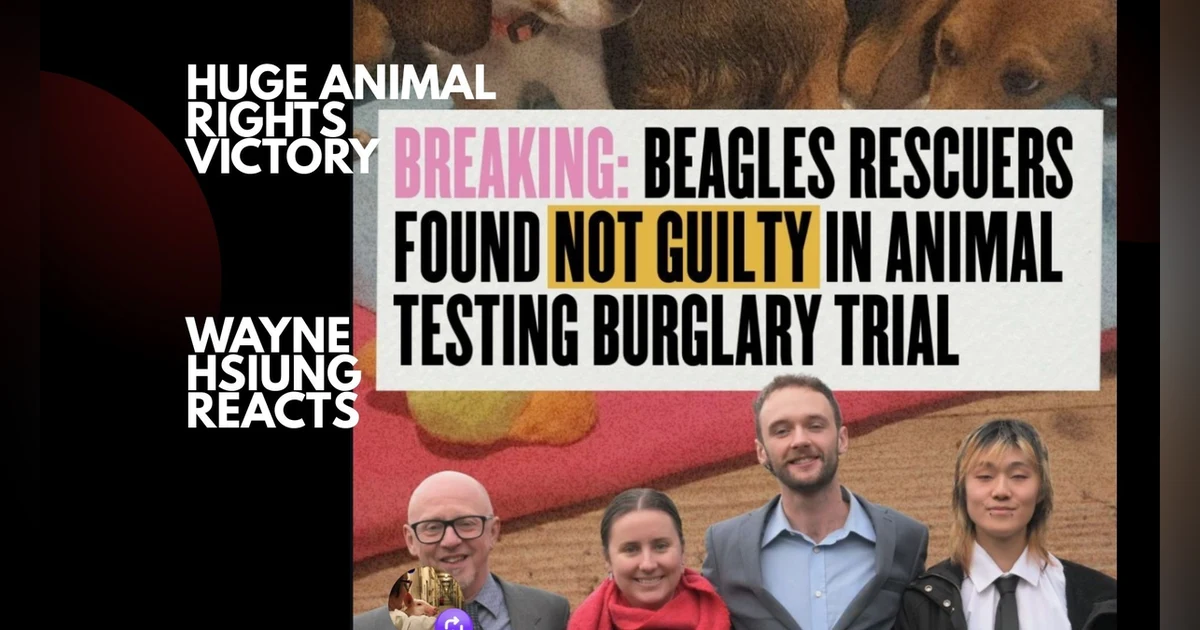


In a stunning and historic development for the global animal rights movement, the defendants in the second Animal Rising beagle rescue trial in Cambridgeshire, England, have been found NOT GUILTY. The verdict marks a dramatic reversal from the first trial connected to the same campaign, where a separate group of activists were convicted—sending shockwaves through advocacy communities worldwide.
This case centered on the rescue of beagles from a breeding facility supplying animals for laboratory experimentation. Beagles, known for their gentle temperament and trust in humans, are among the most commonly used dogs in animal testing. For years, campaigners have argued that these facilities operate behind closed doors, shielded from public scrutiny, while animals endure lifelong confinement and suffering.
The acquittal is being hailed as a major victory for animal rights, not only because it frees the defendants, but because it sends a powerful signal: juries are increasingly willing to scrutinize the moral and ethical dimensions of laws that criminalize compassion while protecting institutional cruelty. The contrast between the guilty verdicts in the first trial and today's not-guilty outcome underscores a growing public unease with the criminalization of nonviolent rescue efforts.
Now, we are bringing you LIVE analysis and insight from one of the most influential figures in the modern animal rights movement—attorney Wayne Hsiung, founder of Simple Heart and co-founder of Direct Action Everywhere. Wayne is widely regarded as the founder of the Open Rescue movement, a strategy rooted in transparency, nonviolence, and the moral conviction that rescuing suffering animals is not a crime, but a duty.
Wayne Hsiung brings a rare and deeply informed perspective to this moment. In the United States, he was convicted and served time in connection with open rescue actions—cases that helped ignite international debate over animal protection laws, whistleblower suppression, and the legitimacy of civil disobedience on behalf of animals. His legal battles have shaped the movement and forced courts, lawmakers, and the public to confront an uncomfortable question: when laws protect cruelty, is breaking them an act of justice?
As the world watches the implications of this UK verdict ripple outward, we are honored to speak with Wayne Hsiung LIVE about what this decision means—for the defendants, for future animal rescue actions, and for the rapidly evolving legal and moral landscape of animal rights worldwide.
This is not just a court ruling.
It is a turning point.
For more, visit: https://www.animalrising.org/
0:00 of England, the Animal Rising Trial. And we are live with Wayne Chung, who's considered the founder of the Open Rescue Movement, talking about this not guilty verdict that has just come in. There you see the four defendants. This is a huge animal rights victory, and it concerns basically a series of trials which formed the first open rescue trials in the United Kingdom. This is all happening near Cambridge University. You can see they're probably 50 minutes or less from London, England. The first group of defendants, there's so many, 18, that they did several trials.
0:46 The first trial resulted in guilty verdicts, but now we're learning that the newest trial, the latest trial has resulted in not guilty verdicts. Wayne Chung, you were in court. Tell us the entire thing. I mean, this is huge, huge news for the animal rights movement. Yeah, Jane, it was a complete rollercoaster because frankly, the prosecutor's pretty effective, and he made arguments about how the entire society was gonna break down, social order would break down, that there would be anarchy on the streets if the jury quit it. He did everything he could to paint these people as extremists, and frankly, I think the judge was on his side. There was a point where the judge indicated to the jury that everything MBR did was legal, which I thought was biased and just frankly incorrect, legally and factually.
1:35 MBR does lots of illegal things. MBR is the vivisection facility at issue in this case, but the lawyers did just an extraordinary job of breaking down the legal arguments and arguing effectively that the defendants all acted honestly, which is one of the elements of a theft charge or a burglary charge in the United Kingdom, and then the self-representative defendant just knocked out of the park. There were tears in everyone's eyes when he gave his statement, and I think the key moment for him was when he directly challenged the prosecution's argument that the dogs were similar to a can of beans. That's literally what the prosecutor said, just like you can't steal a can of beans, you cannot steal a dog from a vivisection facility, and Tom stated very directly, I just do not agree with that, and I don't think you do either, because dogs are not cans of beans.
2:20 They're living beings who deserve love, and so many of us said just tears in our eyes at the end of his statement, and honestly, I felt like even though the prosecutor was pretty effective, even though the judge was biased against us, when I looked at the jury's faces, I thought we were gonna win, and that's exactly what happened. Well, you're looking at video of some of the beagles who were rescued. There they are. You see the feces. You see the, just, well, the innocence of these animals. Approximately 20 beagles were rescued from this breeding facility. Two were, you might say, recaptured by authorities, and 18 rescuers went on trial. This is the first open rescue group of trials in the United Kingdom, and what's very interesting is that the first trial resulted in guilty verdicts, and people were devastated.
3:13 The second trial, which just ended, resulted in not guilty verdicts, so what was the difference between the two cases where one is guilty and the other, the jury facing, well, the same situation, they're dealing with the same rescue, finds not guilty? Yeah, I think there were two big things, and for the record, I was not there at all in the first trial, and the second trial, I was only there for one day, closing argument, but I have been very much in touch with the support team, some of the lawyers. We did a big debrief after the first animal rising trial, and I think the first big factor, frankly, was the judge just came to his senses a little bit. In the first trial, the judge literally shouted down some of the defendants, and shouted down and cut off one of the attorneys during closing argument, because they were trying to appeal to people's emotions.
4:00 They were trying to, I think the line that actually led to the judge shutting down and closing argument was one of the attorneys said, imagine you had lived for 18 weeks of your life in conditions like this, and frankly, the defense should have been entitled to make that argument, but instead, the judge told the jury to leave the room, screamed at the attorney, threatened him, and said, you're not allowed to appeal to emotion at all, and which is just not true as a legal matter, and more importantly, one of the elements of the case is dishonesty, and for any of the defense lawyers, or the defendants themselves to make the case that they were acting honestly on the day of this rescue, they had to describe the reason for being there. They had to describe their concern about the abuses that were being inflicted on the MBR dogs, and so my perspective is the judge got this wrong, and frankly, the judge may have realized that himself, because in this case, he gave the defendants a little bit of a longer leash in terms of what they're allowed to say about the conditions at MBR, the experimentation that happened to these beagles, and some of the stuff that happens is just evil.
4:59 You know, basically bleeding out these beagles to every last drop of blood, slowly taking all the blood away for experiments, so using this blood for various things, and then harvesting all their organs, bio-harvesting all their organs for various experiments, so just bleeding these dogs out, then selling the dog's organs to all sorts of experimentation facilities. So that's one big factor. The judge kind of came to his senses and realized, look, I have to give these people the right to defend themselves, which includes talking about the reasons for being there, but the other big factor is I think that there was a lot more personal storytelling, that in the first case, it was too logical, too rational, and you and I know in the persuasion business, in the media business, in any sort of communications business, it's all about emotions and stories, and frankly, I think one of the reasons they relied on just reasons and abstract arguments in the first trial is because the judge was so hardcore about not allowing any emotion in the case, but in this case, it was extremely interesting.
5:52 The prosecutor said at one point, there's no room for sympathy in the courtroom. He literally said those words, and I was kind of shocked because it's the sort of thing that you think of a villain from some movie, like an action movie villain would say, there's no room for sympathy in this courtroom. There's no room for, because sympathy is a good emotion. It's a good thing for our legal system to have, to imagine what it's like to be in someone else's shoes, but the defendants themselves did an extraordinary job of generating sympathy, not like directly appealing to sympathy, but just describing why they were there, describing how they felt, describing their backgrounds in a way that I think really moved the jury to very quickly render a verdict of not guilty. And I want to say, this is like a record verdict. I mean, I've been a lawyer for almost 20 years now.
6:33 Actually, it's over 20 years now. I've never seen a verdict come out this fast, and it came out this fast because the defendants did a good job of storytelling. You mentioned something that I thought was really interesting, that the prosecutor compared these dogs to a can of beans, and you, despite being a constitutional law professor and the founder or the inspiration of the open rescue movement in the United States, we are getting some comments, and people say, well, somebody was doing it in Australia. Absolutely, it's a joint team effort, but certainly you've been arrested and served time for involving open rescues in the United States.
7:15 And one of the acquittals that you won involved a prosecutor using the same argument when it came to the rescue of little pigs from the Smithfield factory farm. Let's hear that prosecutor make that same comparing animals to inanimate objects argument in court. Analyze for just a moment the reasoning being demonstrated here tonight. I think it's clear that the pigs were stolen, they were taken, and they were not returned. In fact, Mr. Shum stated he didn't want to return them.
7:57 That's that. Imagine the use of the word rescue in some other context. Suppose you were in the grocery store, and you saw a can with dents in it, and you thought to yourself, oh my goodness, that can has a dent, it has the potential of going bad. I better rescue that can, put it in my purse, take it out of the store. Or imagine your DQ, you see a dripping ice cream cone up there, the clerk just put it on the counter, oh dear, that cone is dripping off the side. I better take it so that it doesn't make a mess on the floor. So that was the argument that was used by the prosecutor against you. You won that case, and the British prosecutors used the can metaphor analogy again, and they lost.
8:47 So what's your takeaway there? The first thing is my jaw just dropped. I couldn't believe what I was hearing. It was like deja vu all over again, because I thought it was such a terrible comparison to make in our trial. We actually talked to all the jurors in that case, which no one thought were gonna win. My attorney in Utah thought this case is hopeless. This is like 90% Trump County. One third of the people in the entire county work for Smithfield Foods, the company that we had quote unquote stolen the pigs from. And I think one of the reasons we won is because the absurdity of the industry's position becomes apparent once you actually are forced to deliberate about it. And the reality is for them to actually effectively accuse any animal rights activists who rescue animals of theft, they have to compare these animals to property, including a dented can.
9:31 And that's what the prosecutor did today. He said, well, look, you might not agree with this industry. And I'll know this industry does treat animals like commodities, kind of like a can of beans. And I think he was trying to basically preview the personification we're gonna try and do and say, look, no, don't buy this idea that this is the same relationship that you have with your dog or cat at home. This is more like the way a company would see a can of beans. But the jury just revolted against it. And I actually was taking notes during the closing argument. I noted a number of the juries kind of like looked away and it wasn't as obvious as in my case. In my case, I think when Von Christensen, the prosecutor you just saw made that argument, I could just see the jury's eyes roll. And I was like, all right, I mean, I don't think we should be able to win this case, but I think they just kind of had an own goal.
10:14 They just shot themselves in the foot. But in this case, it wasn't quite as obvious, but a number of the jurors were like rolling their eyes, looking away, just clearly not that engaged with the prosecutor's argument and went down that direction. And this has much bigger implications than two acquittals, because the idea behind this comparison is that animals are property. In contrast, what the animal rights movement believes is animals are persons. And this shows time and time again, that when jurors are actually forced to deliberate, they sided those who see the animals as persons and not property. So there's a couple more trials coming up. And I don't know if we're allowed to mention that you have a personal relationship with one of the defendants. You're married to one of the defendants.
10:56 Is that okay to mention? Yeah, the best part, yeah, no, for sure. Yeah, and they have talked about how, well, what's at stake with this trial? Again, this is the first set of open rescue trials in the United Kingdom. So I'm gonna queue up when they're talking and let them talk for a little bit, because I think that there was a lot of optimism and shock after the first verdict. First optimism, yes, this is a no brainer. We had the best of intentions. We weren't going to steal property.
11:37 We were going to rescue animals. And then there was shock when that didn't happen. But now there's a resurgence of optimism, I would hope. So let's listen to Ben Newman, the co -founder of Animal Rising and Rose Patterson. Both of them, Ben was, they're both part of this case. This is the first open rescue trial ever in the UK. So it's a historic event. And yeah, just a huge moment for the animal movement to draw more attention to animal testing and hopefully see the closure of NBR Acres very soon as the first step in ending all animal testing. And we're calling for the facility to be closed, long story short, and put animal testing, originally the concept of animal testing on trial, because we actually, I did it once in June, 2022, with three of us who did it accountably.
12:24 And then the Crown Prosecution dropped the charges. They said, huge lack of evidence. So then we went back again in December, 2022. And so what we're hoping is that we'll be found, obviously it's not guaranteed, but hoping we'll be found not guilty by a jury. And then, yeah, and that will significantly, hopefully undermine the animal testing industry in the UK. So there's 20 of us going on trial over a period of about three or four months. So yeah, Ben's in the first trial that starts on the 1st of December. And we've been split into groups of four or five and mine's the fourth trial. So my trial's in February. I'm not too worried about it at the moment, to be honest, I'm quite hopeful. It seems so common sense. Yeah, in 2022, there was the opportunity to go into MBR Acres and do this.
13:11 And yeah, of course, to save those individuals that we did, those 23 puppies, I think that in and of itself is a really, really good thing. But also we did this openly and accountably, and we wanted it to go to trial to raise awareness about what's happening to beagles in animal testing labs still in the UK. I guess we're just got muted there. So I'll unmute both of us, but that is your wife, Rose Patterson. Her trial hasn't happened yet. Ben Newman, the gentleman who was speaking was convicted, I believe in the first trial. So where does that leave the other trials and where does it leave the appeal?
13:54 Yeah, I mean, I think, okay, so a couple of things. One is, again, the first trial was done under such extraordinary circumstances where the defendants are getting interrupted in their closing argument. Lawyers are getting yelled at for just citing basic facts. There was such extreme bias. I don't think you can say much about that first trial in terms of what that represents for the future. The second thing is I think the animal rights team is just learning. I think there was a lot of debriefing, a lot of skillsharing, a lot of conversations that were had, including across the Atlantic Ocean. And we had some of the top lawyers in the United States meeting with some of the top lawyers in the United Kingdom and some of the defendants in the United Kingdom to make sure we understood how to tell the story of animal rescue. And the primary line they've been using, I just think fell flat in this case.
14:38 This is the argument that, one, that there's gonna be some sort of social breakdown if we don't kill animals. I mean, it's kind of silly, especially when it comes to dogs and experiments. You really think our entire society is gonna collapse. And those of us who are vegan who know this, because we've talked to our non -vegan friends and they say, oftentimes, this could be one of the little silly things about the future of veganism and what veganism would do to threaten the food supply, to threaten our way of life. It's actually not that bad. Eating tofu instead of beef is just not that big of a deal. But the second argument they used over and over again was this idea, this is just a publicity stunt. It's all just crazy, deranged activists who are trying to tell you what to do. And I thought the counter that was used this time, which frankly is just the truth about who we are, was humility.
15:23 The activists did a just extraordinary job of showing vulnerability and showing, we're not trying to tell you what to do. We're not saying we're better than you. We just wanted to help some dogs. And the reason we needed this publicity wasn't because we're narcissists who just want attention. It's because we knew the only way we could convince the public that something has to be done for these dogs is to show you the truth. The government's not willing to tell you the truth. The industry certainly isn't willing to tell you the truth. We will tell you the truth. And that made the jury feel like we're all on the same side here. And I thought it was extraordinarily effective. It's one of the reasons we got the not guilty verdict we got today. The good thing is in the longterm, that is the way all these trials are gonna run. I don't think the prosecution has any way to counter that because when one side is all about transparency and truth, the other side is all about, no, no, no, no.
16:05 You can't hear anything about the experiments. You can't even hear about the defendant's motivations for what they did. Then the side that's transparent is gonna win in the longterm. Just wanna ask you, of course, as this is going on, we also have Zoe Rosenberg, you're seeing here, who is a Berkeley University graduate, a straight A student, and she rescued four chickens. You can see the rescue in an open rescue because this was distributed to the public, this footage. She was convicted and she did less than a month in physical jail, but now she is under house arrest or maybe it technically is not the start of house arrest, but it'll start soon.
16:52 Suffice it to say, she's not able to go out and about her business. So how does the UK Beagle Rescue Trial, not guilty verdicts affect the animal rights movement in the United States? I think that this is going to set off a chain reaction against vivisection because the reality is in many ways, the facts of this case are not ideal. For example, the UK government has said over and over again that the facility is legal and the reality is that the audits suggest that the facility actually did comply with the law. In contrast, in the United States, almost all the vivisection facilities that issue, whether it's Ridgeland or MBR, because MBR is actually a company in the United States.
17:37 They actually have a massively larger facility in upstate New York. There are lots of violations that have been documented against vivisectors in the United States. At all the facilities, we might want to target with an open rescue. A second factor is just the evidence of the condition of the specific animals. In Ridgeland, we had extensive evidence that the individual animals we saved, including Julie, this psychotic beagle who had been trapped in a two foot by four foot cage. I mean, these conditions are horrible and awful, but frankly, compared to American vivisection, UK vivisection is almost like a luxury house, right? Because these animals aren't caged in individual cages. They're not trapped in two foot by four foot metal wire flooring where they have to live for seven, eight years of their life. And yet in the UK, they've proven you can show people conditions like this, which they're not great, but they're not as awful and just psychotic and terrifying as the conditions in US vivisection facilities, and you can still win.
18:27 So I think what this is going to do is it's going to set a precedent. Frankly, this is not just theoretical. There are already plans being made to go back to Ridgeland to take all 3,000 dogs out. This case is going to light a fire into the movement and inspire more people to get out to Ridgeland because if they can win at MBR, we can win at Ridgeland again. We need to get people out there and start taking the dogs out. And for those who do not have any information about Ridgeland, this is in Dane County, Minnesota, I believe. Is it Minnesota? Wisconsin, Wisconsin. Sorry, I used to live in Minnesota for a couple of years. And so it's the next state over, Wisconsin. And there's a very large dog breeding facility there.
19:10 And you actually went in there. I wish I had the video to show, but you documented the conditions and you were charged. Then they dropped the charges. And instead of you sort of saying, whoo, that was a close one. I don't have to worry about being criminally charged. You went back to that county and you managed to get a special prosecutor appointed to investigate the facility. Will you just give us the update on that? Because that is something that I believe is still ongoing in a certain manner of speaking. And it was a huge victory. You got that special prosecutor.
19:50 Yeah, not only did we get the special prosecutor, but recently Ridgeland announced that they had reached an agreement with the special prosecutor to shut down the breeding facility by July 1st, 2026 in exchange for the prosecutor not filing any felony charges against him. And the special prosecutor simultaneously released a report indicating what was just obvious, which is that Ridgeland has committed hundreds of felony acts of animal abuse against innocent defenseless dogs, including things like mutilating dogs, and surgical procedures that were done by non-vets without any anesthesia. Imagine performing a surgery on a living, conscious being without anesthesia by a non-vet. All those steps of the process are totally illegal.
20:32 So the downside is- And by the way, I just want to say that Unchained TV was the pool camera and had a camera in court. And we were there as somebody took the stand and testified that they themselves saw it. It's not you just saying that you heard this, that there were people who were there who testified in court to that effect. There were people who were part of those procedures. Matt Reich and Scott Gilbertson both testified that we were employees. We didn't know what we were doing. We didn't know it was illegal, but we were forced to do this as a matter of employment. And they told even more horrible stories. Matt Reich told a story about seeing a newborn puppy who was kind of sick, just thrown into a freezer bag, being sent into the landfill, right? This is a living puppy that was sent into a garbage can. And he said, what are we doing?
21:12 Don't we have to do something about this puppy? But because the puppy was sick and they didn't want to waste money on trying to care for this animal because it's a business and every $100, $200 they're spending cuts into their bottom line, they literally just threw an animal away into a landfill. And they did prosecute us initially for exposing this facility and rescuing some animals. We turned the tables on them, mostly because of you. I mean, not literally you, Shane, but you and all your audience and all the other animal advocates around the world who came out to Wisconsin and said, this is not okay. You can't cover up animal abuse for decades, attack the people who expose it, and then prosecute them for rescuing a blind beagle puppy from a cage. And partly because of the outcry, the court not only had to drop charges against us, but appointed this special prosecutor who has said now they're going to shut down by July 1st.
21:57 Now, the wrinkle that is a very bad one for us is twofold. One is technically Ridgeland can continue to sell and torture and kill dogs until July 1st, which means all the thousands of dogs there may end up dead, even though the government has now acknowledged there are victims of felony animal abuse. That makes no sense. If this were an animal cruelty case involving anyone other than a big, powerful, wealthy industry the dogs would have been confiscated a year ago, right? But the second piece of this is extremely problematic is when we first got a copy of the stipulation, the agreement with the prosecutor, we wrote back to him and said, look, this doesn't stop the company from just rebranding under different entities' names. They can reincorporate a new entity, could be exactly the same one, and just shift the entire facility to this new ownership.
22:42 And he completely blew us off. I can tell you as a corporate lawyer, this is exactly what evil corporations do. That's what they do all the time. Because I sued corporations because of this sort of thing. I know a lot about this. And he completely ignored the email. And initially I thought, honestly, it was just laziness and incompetence. But after we got a filing a couple of weeks ago, and we looked at it very carefully, that indicated what the basis of his declining filing of felony charges against Ridgeland was, what the basis was for him deciding not to seize the dogs. We realized he has unlawfully been collaborating with the industry this entire time. He should have had no context with the industry, no context with anyone who was adversarial to the interests of the victims of this case, the dogs. And instead, while he was denying us the opportunity to share our facts, he didn't even talk to the employees who saw this abuse.
23:25 He didn't talk to our expert veterinarians who opined on this abuse. He had been spending all this time talking to factory farming interests in Wisconsin. That is illegal, that is unconstitutional. And so our ask now to the government is, get all of those dogs out or we will. Well, I know I've worked with other organizations like Beagle Freedom Project that has actually gotten dogs that have been taken from labs, adopted. So there are people out there who will adopt these dogs. Indeed, Beagle Freedom Project got Meghan Markle and Prince Harry to adopt a dog that had been experimented on or in a laboratory breeding facility for laboratory dogs.
24:10 So I just wanna thank you, Wayne. I know you're a very busy person. I know it's very late in London. Final thoughts. Here we are sort of maybe back on our heels a little bit as a movement. You have the new food pyramid that emphasizes meat and dairy that came out of nowhere with a lot of meat industry influence. You have a media war against veganism going on with a master's in beef advocacy where they're churning out these social media influencers to pump up meat. You have the fact that the first Animal Rising group was convicted and poor Zoe Rosenberg is in, she's lost her freedom and had to wear an ankle monitor.
24:54 Given all of that, I know you're a person who sees big picture long-term. How strong is our animal rights movement? The movement is stronger than it's ever been. And not just because of this verdict. Frankly, even the things that we see as defeats like Zoe's case, there's a boomerang effect where you pull back and suddenly when the industry pulls back too far and we realize that the public is actually not down for a lot of the industry practices. It's not down for lying to people about the health costs of red meat. It's not down for trying to lie to people about how cultivated meat or beyond meat is somehow dangerous. And it's certainly not down for putting animal rescuers in trial.
25:35 When they overreach and push back, the slingshot effect of that boomerang, that whiplash actually propels us forward. And I can say this as someone who's lived through that experience because back in 2009, 2010, I was a lawyer advocating for animals back then as I am today. And the entire movement felt like it was in collapse because of the ATA, all the actives who had gone to prison in the United States in the 2000s, because the Ag -Gag laws that are being passed across the country, veganism was in free fall. No one seemed to be doing anything successfully. And I told folks back then, and I'll tell folks again today, just you wait, because it's always darkest before the dawn. And in fact, sometimes the contrast of the vileness of the industry, the repression the industry is inflicting on ordinary people is precisely what propels us forward.
26:20 And I think that's what we're gonna see in this case. Well, from your mouth to God's ear, as the saying goes, it's so great to talk to you. Thank you for taking the time at this late hour, live from England, everybody. Wayne Chung talking about this incredible, incredible positive outcome in this trial, namely the acquittal of these four defendants. And we'll have to see what happens with the next case. We will stay on top of it. We will see you next time. And thank you for watching Unchained TV. Please support the Simple Heart, Wayne Chung's blog. It's an incredible blog. And go to Animal Rising's website.
27:01 Absolutely. And Animal Rising, we must support Animal Rising in the United Kingdom. See you next time. Awesome. So it's a vegan Netflix. Okay, that's the craziest thing I've ever heard. I love Unchained TV. Unchained, Unchained TV. Your life will change. It's just that easy. Unchained TV has all sorts of content for everybody. Unchained TV changed my life. Unchained TV is crushing it. I love Unchained TV. Unchained TV is my go-to. Unchained TV. Who knew? Unchained, baby, yay!