UnchainedTV: Let's End Cruel Primate Experimentation Now & Forever!
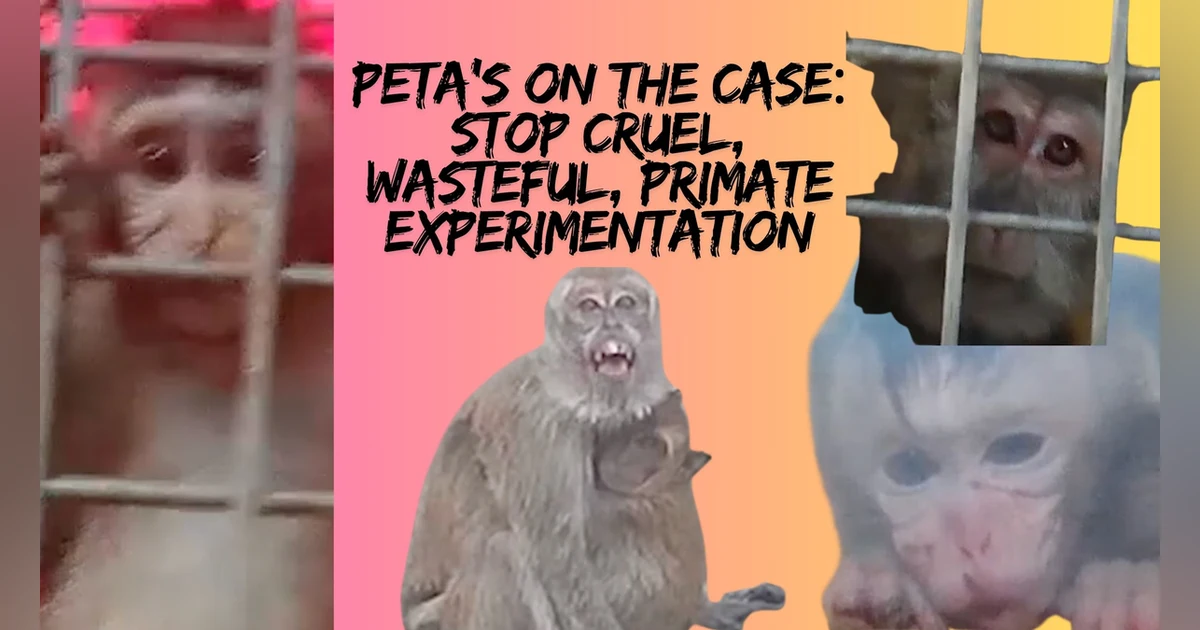


A pitched battle continues in a small Georgia town where residents have vowed to stop a wildly unpopular plan to house a massive monkey facility. More than 30-thousand monkeys, destined for laboratory experimentation, would be housed there and residents are up in arms. PETA, People for the Ethical Treatment of Animals, is on the frontlines helping residents in their quest to stop the controversial facility. Meanwhile, PETA will also bring us the latest on the fate of the 43 monkeys who escaped from a South Carolina research facility back in November of 2024. All have now been recaptured but monkey escapes are just one of the many hazards of housing primates in residential areas. Of course, in the 21st Century, there is no reason to experiment on monkeys or any other animals. So, could the massive cost-cutting currently going on at the National Institutes of Health, the largest funder of animal experimentation, signal a shift away from torturing monkeys, dogs, cats, rabbits and mice in outdated experiments? Let’s find out with our expert PETA panel. PETA’s Amy Meyer and Dr Lisa Jones-Engel join UnchainedTV’s Jane Velez-Mitchell.
0:03 We have breaking news for you on so many fronts. The battle against cruel, wasteful, unnecessary, expensive to the taxpayers. Primate experimentation is raging on many fronts. You are looking at images of just some of the primate victims of this completely wasteful, unnecessary industry. And we are talking with People for the Ethical Treatment of Animals, PETA, how to end primate experimentation now. And the breaking news is that PETA has just uncovered some really, really horrific, horrific information about what the government has done wrong when it comes to a story that we've all probably heard about.
0:57 And that story is the monkeys that escaped. You may have heard in November of 2024, 43 monkeys escaped from a South Carolina research facility. Let's take a look at one of the videos that PETA has provided showing really what's behind the horror of monkeys in research.
1:49 So, as we've said, and I'll have to say, unfortunately, all 43 research monkeys who escaped the South Carolina facility have been recaptured. Let's go straight out to Amy Meyer of People for the Ethical Treatment of Animals. You are PETA's primate experimentation associate director. What is the breaking news regarding these 43 monkeys? Well, so the breaking news is that PETA, through a records request, has received the USDA inspection report about this incident. And they did get cited with a violation for this, but it was only a non -critical violation.
2:35 And it's wild to us that 43 monkeys can escape your property, some of them being gone for months. And when they did this inspection, there were still four who were unaccounted for, and they still said not critical violation. So that's why we fired off a letter to the USDA saying, how can this not be a critical violation of these monkeys being on the loose, getting into who knows what? And probably, I mean, the temperatures during this time got so low, it's inconceivable that this is not a critical violation of the federal animal welfare laws that are meant to try to give these animals some basic protection.
3:18 It's absolutely crazy. And it's just part of the entire, what I would say, a lack of monitoring by the US government when it comes to all of these horrific animal experiments. Now, you've pointed out this lab in Columbia was funded by the National Institutes of Health. The monkeys were left in their waste. They died from their diseases and neglect. The NIH, the National Institutes of Health, never inspected this facility, and it is a hellhole.
3:58 And this is just one of the many foreign research labs that our government, our taxpayers, my tax dollars are forced to subsidise. And why? I mean, this is absolutely insane. I'd like to go to Dr. Lisa Jones Engel. You are also with People for the Ethical Treatment of Animals. You're their primate experimentation science advisor. Tell us, you know, why is it that there isn't more concern about the waste of money, the absolute waste of our tax dollars when it comes to these ridiculous experiments?
4:41 Well, I think there is growing concern because there's been growing transparency. You know, these 43 monkeys getting out of the Alpha Genesis facility, you know, the world had never really seen an escape like that before. They'd never seen monkeys who were supposed to have been kept in a cage kind of doing what the monkey thing that they're supposed to be doing. And I think that has really, that's caught people's attention. And the question of why, why is there outrage? Well, the failed science, the injuries to the animals, the endangered species that these animals, basically some of these species are being driven to extinction. People have heard about it now.
5:22 And once people hear, once people see, they cannot look away. And I think that is, that has been devastating to this industry who has banked on the idea, literally banked on the idea that no one gets to look at But we're looking very closely. That generated so many headlines, that monkey escape story, precisely because they found three one day for the other day. Every time they found a few more, they would do more news about it. And it's sad because PETA works so hard, so hard to get news about the heartbreaking stupidity of these experiments that do not help animals.
6:08 And yet it's hard to get the media to cover that. But then when some of these monkeys escape and you're looking at happy monkeys in the wild, they actually have an island, which I just learned recently, they have an island near the United States or part of the United States. Dr. Lisa, if you could explain where they take these happy monkeys who are living in families and they abduct them and they stick them in cages. Well, this is, I mean, one of the really horrific parts of this. This whole thing is bad. But these 43 who escaped, they were a part of a group of 50 of them that were taken from Morgan Island, which is about 40, 50 miles from the Smithsonian Embassy.
6:48 That island has had four generations of racist macaques whose grandparents and great grandparents were actually stolen from India and brought over. But those animals have lived on that island. They know everyone. Every single monkey on that island is either related or it's a brother, it's a sister, it's an aunt or an uncle. And so when those cage doors were left open and 43 of them ran out, you know why they stayed around and they just didn't immediately take off? It's because macaques are like marines. No monkey is left behind. So those seven who were still in there, every one of those animals would have known them.
7:29 It would have been someone to them that they, it could have been their mother, it could have been their sister. They stayed as long as they could to try to get them out, to be with them. And that is, that's horrifying to anyone who thinks about what these animals, they had, they were free, but they were not going to leave their friends behind. Well, McKenna Grace Fitcher says, this has to be stopped. How people cannot understand the sickening practise of torture and killing primates renders me sick. And that's how we all feel. And now there is an opportunity and I want to be careful.
8:09 Of course, this is breaking news. A lot is happening in Washington right now. And the first thing I want to say is that animal experimentation has long been a bipartisan problem. Okay. We're not talking politics right now. I can tell you the monkeys being tortured in these laboratories do not care whether the people who get them out are Democrats, Republicans, conservatives, liberals, libertarians, socialists, Green Party members, or what have you. They just want to get the electroids out of their brains. They want to get out of the cages. Now, because there is a massive move to cut federal budgets in Washington, D.C., we have what I would call a unique opportunity to get this message out and say, if you're going to cut, the first place that you should cut is these ridiculous experiments.
9:08 So you may have seen the headlines in recent days. National Institute of Health cuts billions of dollars in biomedical funding effectively immediately. National Institutes of Health has announced it's slashing funding for indirect research costs. The agency estimated that it could save $4 billion by capping indirect costs at 15%. Well, that I greeted as great news. The rest of the mainstream media did not greet it that way. Time magazine, I think, had the most alarmist headline of all, saying the NIH budget cuts are the apocalypse of American science, experts say.
9:53 And sure enough, a federal judge has just blocked the cuts to medical funding. Again, I want to say very clearly, we're not talking partisan politics. This has been a bipartisan catastrophe for decades. These monkeys have been subjected to the same research over and over again, you know, cut up, you know, blinded, addicted to cocaine, terrified under Republican administrations, Democrat administrations. It's been happening for decades. If there is a unique opportunity to end this, I say let's go for it.
10:34 Let's do a little roundtable. Amy, where are you on this? Well, I absolutely agree. And there's, you know, we are wasting billions and billions of dollars through the National Institutes of Health every year, doing these horrific experiments on monkeys, where they are addicted to drugs, they are, have electrodes implanted in their brains, all kinds of hideous experiments. And of course, they're all confined to these tiny metal cages. They never feel the warmth of the sun, they never get freedom, they never get to live with their families. And it's all with our taxpayer dollars. And what's interesting about this move now to target these indirect research costs, when you look at who some of the worst offenders are of having outrageously high indirect research costs, it's the National Primate Research Centres, the Washington National Primate Research Centre has 80% of its funding that gets from the NIH for these experiments on monkeys are in this indirect cost bucket, which means it's not the expenses for the needs of the research itself, it kind of covers the administration costs.
11:44 And it's, it's so high, because it costs a lot of money just to keep the lights on in a facility where you are housing these sensitive animals. And so PETA saying we need to be focussing on the worst offenders that are wasting the most amount of money, and are constantly breaking federal animal welfare laws, they're led by people who have been found to have research misconduct. These places are terrible for animals, they're not well run. And they're the most giant waste of money. So that's where we really want to focus the most of getting just this fraud taken care of. So where, where are we?
12:27 Again, getting back to what McKenna Grace Fitcher said, this has to be stopped. How people cannot understand the sickening practise of torture and killing done to these primates renders me sick. But I have to say, Amy, that every time you try to cut these budgets, people scream, Oh, my God, America is going to lose its place in science. Oh, my God, people are going to die, never really talking about the fact that at least 95% of the experiments on animals are completely useless when it comes to human beings. Because guess what, we don't have tails, we don't have paws. We don't have claws.
13:08 Dogs will die if they eat too much chocolate or grapes. That doesn't apply to people. So Dr. Lisa Jones Engel, what can we do in this unique opportunity where there is budget cutting going on in Washington, D.C. to make sure that these wasteful experiments are priority number one? You know what? I think that what we're seeing now is maybe an extinction level event for primate users, particularly in the National Primate Research Centres. But anyone who is experimenting on primates, it's the amount of money that's being spent and the amount, the consistent level of failures, everyone sees that now.
13:49 And I think this is going through and shutting down the National Primate Research Centres, these facilities. So keep in mind, when a monkey is in a cage, there's only one thing that they're thinking about, and that's how do I get out? And so these indirect costs are part of these are kind of measures to try to keep the animals in, to make sure that all the doors are secure, that the cages are strong, that the staff is there, that everything is in place. But the monkeys are consistently figuring it out. Alpha genesis monkeys leave, UW Primate Centre monkeys leave. Every single primate centre sees these animals escaping. And I think with that transparency and with the clear evidence that the science is failing, do we have an HIV vaccine?
14:33 No. Do we have a malaria vaccine? Do we have a TB vaccine? No. But for decades, every one of those vaccines have been developed and supposedly tested safe in monkeys in these facilities. And every single time that fails. And I think what has happened is that on both sides of the aisle, the politicians are saying enough, enough of wasting taxpayer dollars. If we want good science, there's better ways to get science, to get good results than to put a monkey in a cage and expect that animal that we have not shared a common ancestor with for 24 million years to give us any information, any reliable, translatable information about ourselves.
15:16 So I'm, I, I think this is it. This is the animal experimenters in institutions were always considered the rainmakers because they brought in multi-million dollar grants with these massive indirect costs attached to them that the institutions were like, yummy. I'll just, I'll eat, eat all of this up. But that, that tap is going to be turned off. And then the institutions, the, the harm benefit analysis, they're going to be forced to do, you know, the benefit of getting a lot of money from monkey studies versus the harm, which is, you know, the outrage, the, the uncertainness of the reliability of the research of the, of people suing them for, for their bad actions.
16:00 That's those harms really quickly outweighing the benefits. So, okay. What can we do with the backlash against the proposed cuts? Again, if you're just joining us, there's so much breaking news on this front right now, but the bottom line is that due to, again, this is a bipartisan issue. I'm not talking politics, partisan politics. I'm talking, get the monkeys out of the cages, get all these animals out of the cages. So due to a new administration wanting to slash federal funding, the National Institutes of Health cuts billions of dollars in biomedical funding effective immediately.
16:43 That's a headline. Okay. But what happened was just very recently there was a huge backlash. And for example, Time Magazine saying it's the apocalypse of American science and a federal judge has at least temporarily blocked the current administration from making these cuts to these research programmes. And so where does that leave us now, Amy? I mean, how can we get to the powers that be and make the point that, hey, and it doesn't matter whether you think a broken clock is right twice a day or the law of unintended consequences, however you want to analyse this in your mind, this particular cut is good.
17:32 We're wasting billions of dollars, torturing millions of animals and nothing to see from it. I'll just say 30 years ago, 30 years ago, I was asked by a very big organisation to lead a walk, okay, for a cure of some sort. I'm not going to identify the organisation, so don't take any hints from that. And we went to lunch and I started asking questions. I said, well, what are you doing with the money? I said, do you do animal experimentation? Before I left the restaurant, I got a message. You're off the hook. You don't have to lead that march anymore. We don't want you. See, when you start asking questions, they don't want you.
18:13 That was 30 years ago. So I tell people, ask questions, but what can we do at this particularly crucial juncture, Amy, to make sure that the folks who are, let's face it, they're laughing all the way to the bank with this money coming into the universities. How can we counteract that narrative? I mean, I think that it is important to keep sharing information. Go to PETA.org. You can learn about what is happening at the National Primate Research Centres like the one at the University of Washington. And you can take simple action steps, right, on those pages on PETA.org to encourage the National Institutes of Health to stop funding these primate research centres.
19:00 The judge has at least stalled right now this across-the-board cut that would impact other research too, not only experiments done on animals, but where we could at least find like the most easy cut, I think, is to stop funding these primate research centres that are not only wasting millions and millions of dollars every year. They are torturing thousands of monkeys. They have been found to violate Federal Animal Welfare Act dozens of times, including some really, really gross ones and just really heinous ones, like leaving a monkey in a cage when they put it through this high-pressure, high -heat cage washer killing them.
19:42 They are just a mess. And so go to PETA.org to take action or go beyond that and send an email to your member of Congress saying, I support cutting funding for these places. Let's have the National Institutes of Health cut funding to these experiments on monkeys. So many of them are now endangered monkeys. We are literally decimating the forests and their natural homes of these animals to be experimenting on them here. Let's put an end to all of this and save taxpayer money in the process. I mean, when you look at these animals in the wild, their innocence, their beauty, obviously they love their fellow monkeys.
20:30 They live in family groups. What we're doing is, I don't even have words for it, mediaeval, barbaric, psychotic. Yes, that's what it is. And again, these experiments are not accomplishing anything. We are in the 21st century. There are organs on a chip. We look at things from the molecular and the submolecular level. You don't need to be injecting cocaine into these monkeys. Just the number of experiments. Amy, can you give us a list of some of the most ridiculous, and they're all ridiculous in my book, but I know there was this one experiment where they would make the monkeys pregnant and then take the babies away and then scare the mama monkey with all sorts of rattlesnakes and then drug the mama monkey so the baby couldn't wake mama up.
21:28 I mean, it's something out of a horror movie. It's out of like The Exorcist or one of these slasher movies. That's really what's going on. I think these experimenters need to have psychological evaluations, in my opinion. Yeah. I mean, that one is particularly awful. There's no such thing as an illegal experiment on animals in this country. Whatever they can dream up, if they can get their committee friends to agree with it, it happens. You see all kinds of silly research going on. It's just clearly, why do we need to be doing this when we don't? There's so much just curiosity-driven experiments.
22:11 I know I live in Oregon, and the Oregon National Primate Research Centre, I remember reading a story about experimenters who were giving THC to monkeys and then attaching these electrodes to their penises to see what the sperm count level does with different amounts of THC in their system. It's just completely irrelevant to anything, to any type of cure that people are hoping for. And we have experimenters who are taking babies away from their mothers and then making it so that they never see a face, even a human face for the first year of their life to see how much that messes them up and their eyesight up.
22:53 These are terrible, awful experiments. What's really particularly tragic with primate experiments to me is that some of these monkeys are living in these conditions for decades. Some of these monkeys, we read a story recently of a University of Washington, who this monkey's life started in Madison in a laboratory. Then they went with this experimenter, Michelle Basso, to UCLA, and then she went to Seattle. And so this monkey was born in 1994 and was just killed a couple years ago. These monkeys can live so many years, and it's just every single day is horror beyond the experiments, beyond the terrible things happening in the experiment itself.
23:39 It's unconscionable to think of these highly social animals living alone in a stainless steel cage where the lights come on at the same time each day, they go off each time each day, and they have no control over their life at all. The only thing they can control is tearing out their own hair or eating their own fingers because they're driven so mad by these conditions. It just needs to end. It can end. It should end. Maybe we actually will be seeing this now that there is real talk of the funding being stopped. That's why this is all happening. It's all about the money.
24:20 If we target the money, I have hope that this is how we can start making a really serious impact on not having so many monkeys being tortured and killed in these places. Well, I agree. I don't care why you're trying to stop it. If you have an irrational reason for stopping, I don't care. Stop it. Let's stop it. I want to go to another breaking news story. There's so many breaking news stories on the primate experimentation front. PETA has led the way trying to stop an outrageous plan to put 30,000 monkeys in a small town in Georgia, and the people there are up in arms.
25:02 Let's watch a local news report that was very well done on the issue that we're going to discuss on the other side. A year later, Bainbridge neighbours are still voicing their concerns about a monkey facility project by pulling out all the stops. These are the cages that the monkeys will be transported in if we don't put a stop to this. Even county leaders who originally voted for the project but later rescinded their vote spoke out at a monkey expo Thursday night. And I said early on we made a mistake. As the fate of the primate facility hangs in the balance of the courts, Bainbridge residents say they're hopeful they can shut down the project.
25:44 We're standing that it's not going to come here. We don't want it here. Lena Allen, WALV, your hometown news source. Thank you for that report. We appreciate it. So, Amy, what's the latest on that breaking story? Yeah, well, I mean, that latest, that was a town hall. It was about a year after this fight started, and as you can see in the video, it's still packed. These local residents are not giving up in Bainbridge. They are fighters. They are set on keeping this terrible project that would be imprisoning 30,000 monkeys when it's at full capacity in their town, which only has like 9,000 humans in it.
26:27 So they're fighting so hard, and there are now four ongoing lawsuits related to this case to try to stop it. So there's lawsuits trying to get at the lack of transparency that was involved from city leaders in bringing this project to their community, and then there's also a lawsuit, a nuisance case talking about all the ways that this would create a nuisance for the people, especially right around where the proposed facility is taking place. And now we even see the state of Georgia stepping up and trying to undo some of this mess, too, and trying to appeal it to the Georgia Supreme Court to undo this terrible bond deal, which was like the sweetheart package of money to give this brand new company to bring this dreadful project to Bainbridge.
27:17 So I have to play the response given to that particular local news outlet from the folks who want to create this. Safer Human Medicine is excited to collaborate with the Development Authority to advance this project. Support for this project is growing, with many residents from Decatur County already expressing strong interest in job opportunities. What is your response to that? We'll start with Amy, then we'll go to Lisa. Well, I mean, even the locals who I met with there and who I continue to meet with it, it's hard to find anyone in Bainbridge who actually wants us there. I very much have doubts about their statement itself, and people just realise that this is not only a matter of cruelty to the animals.
28:00 For the people there, it threatens their water system because of how many monkeys would be in this monkey factory farm. It threatens their way of life. It threatens the potential disease outbreak in these facilities. It's just a complete mess, and I think that we're going to stop it. I fully think it is going to be stopped. These people are not backing down. They, like I said, they are fighters and they're not backing down. And how does the whole budget cut initiative in Washington dovetail with that? Because a lot of the experiments that these monkeys, these poor monkeys would be used in, would be taxpayer funded through the National Institutes of Health, which is the largest funder of animal experimentation in the world.
28:50 Lisa? Exactly. I mean, what, you know, Safer Human Medicine was supposed to have had their first monkey out the door for sale in December, and they haven't laid a single brick because this town is not going to let them do that. They're going to use every resource they have to stop this facility from coming to ground. And I think what Safer Human Medicine is also not being forthright about is that the use of primates in the pharmaceutical industry, which is who they would be selling these monkeys to, the clients are not using as many monkeys as they used to. The value, and I put that in big air quotes, of these monkeys has dropped precipitously.
29:30 This, you know, they thought this was going to be a massive moneymaker, and it's not going to be. The demand is drying up, the supply is changing, and the awareness that people have of alternatives is meaning that the scientific community themselves are saying, no, I'm not going to waste my time and money and resources on a monkey model. I'm going to use a human relevant model, and they are. And so, you know, Safer Human Medicine has lost this one here in Georgia. They're clinging on with their fingernails, but I don't see how they're ever going to be able to go forward with this. Well, I want to say we invite Safer Human Medicine or any of the experimenters on primates or other animals that have been mentioned on anytime.
30:16 I would love to dialogue with them. Now, let's talk about what PETA has done in terms of creating a roadmap for research modernisation. Again, newsflash to all those animal experimenters out there, we're in the 21st century, and there are plenty of more sophisticated and more modern methods of doing science than the mediaeval practise of torturing animals. You know, they've been breaking dog spinal cords since before Christ to see what happens, and they're still doing it. And nothing has changed in a lot of ways. It's so crazy that people buy this.
30:56 But let's check out PETA's plan for research modernisation. Did you know that 95% of new drugs fail in human trials? All had passed animal testing, but ended up being either harmful or useless for the people who needed them. We need to end this waste, and we need to do it now. Research Modernisation Now, a roadmap developed by scientists, will shift science away from pointless and cruel experiments on animals, and toward life-saving research that can really help humans. Discover three ways you can stop wasting lives and tax funds today. So tell us, Amy, about PETA's roadmap for research modernisation now.
31:38 Yeah, well, it's really the only comprehensive and common sense strategy for carefully replacing animal experiments with things like organs on a chip, artificial intelligence, sophisticated computer modelling. And what it really builds in is just some priorities of first stopping the experiments on animals where there is profound and expansive evidence that it is not working, where the numbers are even higher than that 95% failure of drugs rate. And then it also builds in a plan for training, of training new scientists in these better, more human-relevant models.
32:20 It's really a wonderful comprehensive plan, and this is something that is so easy for people to take action to support this effort. You can go to PETA.org, and it's really easy if you're a US citizen. You can take action to send a letter to your member of Congress to support this effort. It's really, it would encompass everything. It doesn't, it's not only just about research happening on universities, experiments on animals happening at universities, but it's also about just the whole picture and really changing our priorities, especially through the National Institutes of Health, like we've been talking about.
33:00 This would get at the big picture, start getting cures faster, and stop torturing animals in needless experiments. But you hit on a very important point. This is holding back life-saving research because it doesn't work. So doing it over and over again and torturing all these animals, some of these experiments have gone on for decades, doing the same exact thing over and over again, because as I understand it, Dr. Lisa, it's easy to come up with a project that involves killing animals. Like, well, we're going to find out whether, how long it takes 50% of these animals to die. It takes a lot more creativity to come up with something that is not just, oh, here's the death toll, and what might that or might not have that, have an impact on humans.
33:53 You know what, they call it science, but it's really, it's just monkey business. It is about the business of using primates. I'm a primatologist, so I speak mostly about the primates, but it's about how do you squeeze the most out of these monkeys to kind of prop up your business or to generate your next publication? It's not science, it's a business. And these monkeys have paid the price for this for more than a century, and it's going to stop. And I think when the taxpayer realises that they too are paying the price, they're paying for the monkey, they're paying for the infrastructure, they're paying these massive salaries for these experimenters and the administrators, they're going to say, no, that's not what I pay my taxes for.
34:45 I pay my taxes to do good research, to do sound research. And so I think that this move to really dramatically reduce the IDCs, it is going to hit the animal researchers the heaviest because they are the biggest consumers of these resources. And I think the scientific and the political community are done with that. Well, a very interesting point by Milofar Ashgarian, the animal experimental industrial complex has to fall. It is a complex. And I have to say being in the media, the media is part of the complex.
35:26 Again, if you look at the media coverage of the NIH proposed funding cuts, you'd think the sky was falling. Oh my God, it's the end of the world, an apocalypse, blah, blah, blah. But when you try to tell these same media organisations, right, that, hey, look at the stats, look at the outcomes, more than 95 % of these experiments do not work. Basically, you're ignored. I wish you weren't. But how are we going to do with the media coverage, Amy? I think that's a great question, Jane. I wish I knew the answer.
36:07 But it's interesting to me that you even see people who are defenders of the NIH, they recognise a lot of the problems that the NIH has, even the people who defend it. There is other issues beyond the animals being tortured that concern people. There is duplication happening across the country. There is research misconduct happening that people are being caught for. There's all kinds of issues. It should be, I think that it has been clear to a lot of people, even the most staunch supporters, that there needs to be some significant reforms at the NIH. And, you know, maybe just this kind of blanket sweep option is what has people so upset and afraid.
36:54 And it was so fast. And usually, government is very slow to do anything. So maybe that's part of why we're seeing the reaction we are. But yeah, it is just a challenge with media, Jane. And a lot of them, you know, rely on some of these very industries that are making a lot of money. These universities are really powerful with local media, with local politicians. And so it was not a surprise at all that we saw just the next business day, 22 states had joined this lawsuit to try to stop the cuts that are being proposed at the NIH. You know, they're fighting against it, which I wasn't really surprised to see, to be honest.
37:37 This is, it means a lot of money to basically every state. Well, also the media, if you look at the TV commercials, it's pharmaceuticals. There's a huge, huge pharmaceutical. I personally think it's crazy that we have advertising that says, ask your doctor for this pill. Hello? The doctors are supposed to assess what's wrong with you and make a recommendation. You're not supposed to go to the doctor like you're some drug addict looking for a drug pusher to give you your fix. You're supposed to go to a doctor and the doctor is supposed to say, okay, I think this is what's wrong with you. This is what you should do. But we've turned that on its head with these commercials.
38:19 And so of course, you're going to see the media reacting in the way it's reacting. Oh, the sky's falling, these budget cuts. It's all the pillars, all the pillars of government and our democracy have been overtaken by these industries. And it's the courts to a certain degree, we'll see what the courts do. It's the media, which is the fourth estate. And it's the members of Congress as well who get, I believe the pharmaceutical industry is the largest, has the largest number of lobbyists in Washington. Lisa?
39:01 I mean, one of the other things we haven't really touched on, but now that you brought up the pharmaceutical industry on this, now this industry has been bringing in tens of thousands of monkeys from Asia and Mauritius every year. And these animals have been arriving into the US infected with multiple strains of tuberculosis, with deadly diarrhoeal pathogens, with a tier one select agent. This industry is actually more likely to trigger the next pandemic than it is to provide meaningful improvements in human health. And trying to get the media to talk about that, that's been a real uphill battle as well. But that's the thing I think, and it's not just the pharmaceutical industry, within the primate centres themselves, we get reports of workers who get infected with things like Shigella or MRSA or tuberculosis.
39:52 This is an incredibly dangerous industry, certainly for the monkeys, but also for the people who are working in it, which in large part is why this industry really has a terrible time maintaining staffing. Wow. Well, you know, there's a lot of talk these days about the 80-20 rule, that 80% of outcomes are determined by 20 % of inputs. And that's where I see abusive animals across the board. Our abuse of animals is creating at least 80% of the problems that we're dealing with societally. I mean, whether you're talking about the pandemics, it doesn't matter whether you think it started in the Wuhan wet market where they were torturing animals to chop them up to sell them to be eaten, or you thought it started in the Wuhan lab where they were torturing animals in their various tests.
40:38 It was animal torture. Now we've got the bird flu. And the list goes on and on. Certainly the health care costs as a result of our unhealthy diet, which is subsidised by the US government in its subsidies of commodity crops that are fed to animals and subsidies of farmers, bailing them out for natural disasters, et cetera, et cetera. I mean, the list goes on and on of all the problems that are created by our government's subsidy of animal abuse. And I just hope that even if the people who are looking at this do not care about animals at all, they're only trying to cut the budget, that they look at all of this.
41:19 And of course, particularly the abuse of animals and specifically primates. You know, I guess I wanted to ask, how is PETA able to weigh in on this debate right now? Is there a way to get to those people who are making those decisions and say, hey, here's another reason why you should cut or not? Amy? Yeah, absolutely. We are working on getting our information to as many people as we can who are in positions of power. We are always trying to get our good, solid, scientifically backed information to people in power and making it so that the agenda they're wanting to push is one that could help animals.
42:03 That is something, this could be doing so much good for animals in laboratories. If they want to look at cutting funding to the NIH, there's so much that could be done to cut funding that is just torturing animals. They've been doing it decade after decade, countless animals dead with nothing to show for it. We've talked about how devastating it is for the animals, for the workers inside of these places, but it's also devastating for all of us because we don't have the cures that we all are desperately hoping for ourselves or our family or our friends. If we can embrace PETA's research modernisation now and start investing instead in these more human relevant forms of research and put all those billions of dollars we're wasting, tormenting 100 million animals every year, if we funnel that instead to these human relevant research models, we're going to get to those answers that we all are looking for much faster and without torturing and killing anyone in the process.
43:08 Well, from your mouth to God's ear, I hope that this all comes together. Again, it is just a really unique opportunity. Amira John says, one has to be a sadist to work in this industry and totally out of touch with reality. If this was about science, they would have discovered another way long ago. Yes, it really is about money and it's about basically people who are living lavish lifestyles off of government funding, doing these nonsensical experiments that are incredibly cruel over and over again, and the universities encourage it because they get a that's exactly what it is.
44:02 When you get your grant from the National Institutes of Health and you say, all right, it's going to cost me a half million dollars over a year for five years to do whatever experiments that I'm planning on these monkeys. The university, I'll speak to the University of Washington because that's the one where I was working at and most familiar with, NIH gives them another 83 cents on that dollar for these indirect costs. The incentive for the university to keep this gravy train rolling is astonishing. The incentive for the investigator, the experimenter to end up with a $200,000, $300,000, $400,000 annual salary as they are just grinding through this taxpayer money, it's all been laid out there for them.
44:52 This has been the standard. This has been what's been acceptable for decades and what happened last week, earlier this week, when the idea that that gravy train would be cut off, people are terrified. There will be impacts to some of the science, but there are some areas of science, particularly in the National Research Centres, you could wipe those out tomorrow. You could end all of that funding tomorrow, get those animals into sanctuary, retrain, redirect those scientists into meaningful, relevant fields of science, and we would all be better for that.
45:32 Wow. Well, from your mouth to God's ear, as they say, let's hope that happens. I've been just grappling with this unique opportunity that comes along. You don't expect, well, what's going to happen? Boom, there's just this window. How do we get to the powers that be to make sure that this funding is cut? You have, for example, the Cargo Act, which I think is an incredible idea that Pete has come up with, which essentially says these overseas research labs that taxpayers are funding here in the United States, they've got to go.
46:14 There's one particularly horrific example that PETA uncovered for two decades. This lab was run in Columbia, monkeys left in their waste, left to die from infected wounds. The NIH, which funded, never inspected this laboratory. The NIH is using our tax dollars to bankroll these hell holes. This isn't a lab. This isn't science. This is a nightmare. PETA shut this lab down and wants to shut all the other labs around the world that our tax dollars are funding shut down. That's why I think everybody should support the Cargo Act.
46:58 I know if you go to PETA.org, you can actually also use your... What I love about PETA is that in two seconds, you can send a letter. They've got it down to a fine science where sometimes, once you sign up, I'll get these texts. Here, just hit Y and it sends a dozen letters to members of Congress. You definitely want to go to PETA.org and get on their list so that I get emails, whatever I'm doing, and I get an email from PETA and I'm busy, let me tell you. I stop what I'm doing because I know in 30 seconds, I'll be able to send a message to a whole bunch of members of Congress or whoever else you've suggested that we reach out to.
47:42 It's like this, boom, boom, boom, and it's done. That's why it's important to sign up to PETA.org so that you get on that list because it's a numbers game. Is it not, Amy? You're absolutely right. As someone who spent a lot of time as a grassroots activist before joining PETA, I honestly really underestimated the power of these simple actions that don't take me any time. It is, like you said, just the push of a button and this letter is going to my member of Congress because I put in my address. You don't have to know who your member of Congress is to encourage them to support the Cargo Act. You just go to PETA.org, look for the Cargo Act and put in your address and it will do that all for you.
48:27 Coming on the primate side of things, sometimes we have a hard time getting a response from an agency. They are not responding to us. We are trying to work nicely with them. We'll send out an action alert to our members to say, hey, push this button, send this email, we need the Fish and Wildlife or whoever to pay attention to us. Then sometimes the next day, they're finally calling me after me trying for months to get a hold of them. They're saying, okay, make these emails stop. What do you want? It's so important. It might feel like maybe you don't realise how important it is, but from our side of things, this is how we create change is just this mass mobilisation of people.
49:10 There's all kinds of ways to get involved. PETA.org, though, like you said, Jane, that's just one easy way you could be getting involved every day. Yes. I love it because a lot of times the things that we're working on, we don't know what the impact is going to be. We don't know if there's a finish line. Every time I hit that button with PETA, I know, oh, something's gotten done. I've hit the finish line, which is so rare with animal activism. A lot of times you can do a lot of things and not know what the impact is. By the way, we have a very, very special guest watching. Jenny Desmond says, thanks for all the amazing work to PETA. She runs the Liberian chimpanzee rescue with her husband.
49:55 They have an incredible story where they literally upended their lives. Her husband's a veterinarian to go to Liberia after a whole lot of chimps were abandoned by the New York Blood Centre. There was a huge controversy. Finally, after a lot of activists I was there for a few, did die-ins and protests, the New York Blood Centre did agree to pay for the care of the monkeys as they should have from day one. Then all these other orphan monkeys started coming in and Jenny Desmond and her husband stayed in Liberia where they are to this day caring for all these other orphan monkeys, orphaned from the illegal pet trade, from the bushmeat trade, et cetera, et cetera.
50:48 Great work, Jenny. We love you and I'm so excited that you are watching our show. She's probably watching from Liberia, which is great. People watch from all around the world. We've only got a few minutes, perhaps since there are so many breaking news stories surrounding the chimpanzee issue, how would you sum it up? What are your final thoughts, Dr. Lisa? We're at a critical point. We've seen the scientific community move away here in the U.S. from using chimpanzees. We saw that a decade ago. The scientists said they weren't giving us the use of chimps, wasn't giving us the answers, the data that we needed.
51:32 Ethically, it was a problem. Those animals were then on the Endangered Species Act. The industry pivoted towards monkeys, towards macaques, and we saw a huge burst of grabbing those animals from everywhere around the world. We're at that next inflexion point. Everything is now saying we need to be done completely with primates. The money is drying up. The populations of animals are drying up. We've got better scientific ways of getting the information we need. We now know of the public health risks that are associated with using these primates. Jane, I think we're at that cusp.
52:14 It just takes people asking the questions, digging in, sending the emails, being very vocal about this is not how I want my money used. That'll get us to the next step where we'll see every one of these animals who have been used in experimentation in the U .S., all these primates, they deserve a happy ending, and that would be in sanctuary. That's what I'm wanting to see soon. Amy, what are your final thoughts? I think, like you said, Jane, there's just so much happening, so much news constantly. I really encourage folks to follow PETA.org for the latest.
52:55 We expect more news coming in the upcoming weeks. We will be staying on top of things to make sure we are making the most use out of every current event to make sure that everything is focused as much as we can on shutting down these places and, like Lisa said, getting these remaining victims to places of sanctuary where they can finally live like the monkeys that they are. I will say my final thought is right now we have to do everything that we can to reach the powers that be who want to cut funding and say this is the area to cut. I was reading an article about how one individual posted something on X about what he felt was ridiculous government spending, and it caught the eye of the owner of X, Elon Musk, who is the head of DOGE, the Department of Government Efficiency, or worse to that effect, and the cut then ended up making headlines.
53:52 I think we are in the same position. That does not mean we endorse every single cut. Again, I want to say that the monkeys do not care what your political allegiance is, whether you are Republican, Democrat, liberal, conservative, libertarian, socialist, Green Party, whatever. They just want to get out of the cages. They want to get those electrodes out of their brains. They want to stop the torture. Frankly, it is torture for us. It is torture for me personally to know that these animals are being tortured and that my tax dollars have to go to it. I would do anything to make it stop. Make it stop. It is just too stupid.
54:37 It is too stupid more than anything else. We have got to end it. I just want to thank all of you for being a part of this broadcast. These are two very, very busy people, and they took the time out of their very busy schedule to talk to us and bring us up to date. I always say, please download the Unchained TV app. We are the world's only free non-profit vegan streaming television network, animal rights streaming television network. We are on your phone. We are also on your TV. It is on there behind me. It is also on your tablet. I really appreciate everybody downloading it.
55:18 It is 100% free. It is a way to stay up to date with the animal rights movement as it happens. It is a vegan Netflix. That is the thing I have ever heard. I love Unchained TV. Unchained TV. Your life will change. It is just that easy. Unchained TV has all sorts of content for everybody. Unchained TV changed my life. Unchained TV is crushing it. I love Unchained TV. Unchained TV is my go-to. Unchained TV. Who knew?