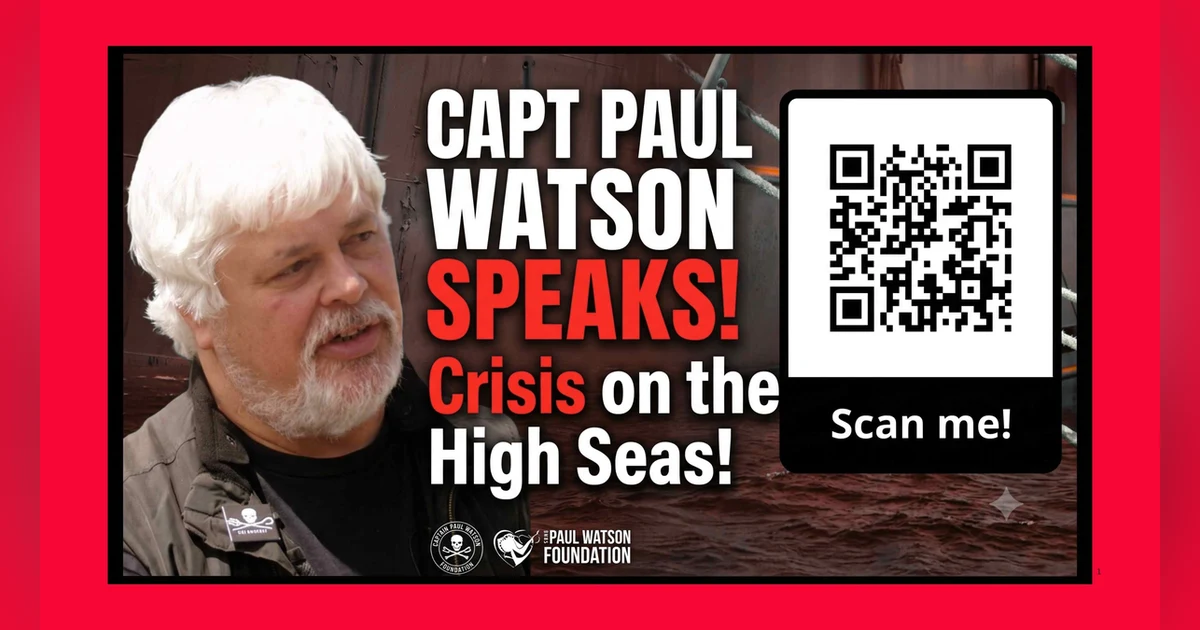
Protect our oceans before one of their most important species disappears. What happens if whales disappear from our oceans—and why should every person on the planet care? In this powerful conversation, Captain Paul Watson joins Jane Velez-Mitchell to expose the ongoing fight against whaling in Iceland and explain why protecting whales is essential to the health of our oceans and our future.
"If phytoplankton disappears from the ocean, we die."
– Captain Paul Watson
What You'll Discover
Captain Paul Watson takes us inside the dramatic confrontation in Iceland involving the Bandero, the Icelandic Coast Guard and the fight to stop whales from being killed. He explains how decades of anti-whaling activism have helped transform attitudes toward commercial whaling and reveals why whales play such an extraordinary role in maintaining ocean ecosystems.
Watson also discusses climate change, marine wildlife, factory farming, fishing gear and plastic pollution—and why he believes going vegan can help protect our oceans.
"The whales are the farmers of the ocean."
– Captain Paul Watson
Join the Adventure
Discover why the fight to save whales is ultimately a fight to protect our oceans and ourselves. Hear Captain Paul Watson's extraordinary stories of direct action, learn about his philosophy of "aggressive non-violence," and find out how ordinary people can speak up for whales and marine wildlife.
Jane Velez-Mitchell is an award-winning journalist, TV producer and NY Times bestselling author who founded UnchainedTV, the world's premier plant-based streaming network. UnchainedTV offers 2,000 free documentaries, cooking shows, lifestyle and news programs. Download UnchainedTV free on mobile or TV streaming devices like Amazon Fire, Roku, and Apple TV. Watch online: https://watch.unchainedtv.com/browse
💡 DONATION INFO & UNCHAINEDTV LINKS
Thank you for watching! UnchainedTV is a 501c3 nonprofit. Our vision is a world where plant-based, cruelty-free, sustainable living is the norm—across food, fashion, science, and entertainment. You can help us spread this crucial message here:
👉 Donate: https://unchainedtv.com/donate/
Links:
🎥 WATCH for FREE: https://unchained.tv
✅ LEARN MORE / https://unchainedtv.com
📘 Facebook / janevelezmitchell
📬 SubStack / https://unchainedtv.substack.com
📸 Instagram / unchained_tv
🐦 Twitter / jvm
🔴 Reddit / https://www.reddit.com/user/Unchained_TV/
📺 Rumble / https://rumble.com/user/UnchainedTV
TRANSCRIPT:
captain paul watson speaks! (720p)
(0:18) At least at the door of the bridge. (0:19) You know, you know, you know. (0:20) John, John, John, let's go.
(0:21) John, now, at the door of the bridge. (0:24) Okay. (0:24) You'll be alright in a bit.
(0:42) Put the phones down! (0:45) Put the phones down! (0:47) Hands up! (0:49) Put the phones down! (0:51) Hands up! (0:54) Thank you! (0:56) Captain! (0:58) Uh... (1:00) Uh... (1:28) few days ago, tell us what exactly went on. Put that extraordinary footage into context for us. (1:36) Well, we decided we were going to, you know, have to focus attention on Iceland's continued (1:41) illegal whaling operations.
So I sent the Bandera to Icelandic waters and the object was to confront (1:48) one of the whaling vessels that came out. The problem right from the beginning was is that (1:52) Iceland put their entire coast guard on alert to stop us. And so they were providing our positions (1:59) to the whaling ships all the time.
That made it unable, we could not close in on them to confront (2:04) them. So finally I decided, okay, let's go right into the 12 mile limit and go straight towards (2:10) the whale processing plant and we'll head off the whaling ships that way. And that worked.
(2:13) As we went in, we saw the Havlar 9, one of the whaling vessels. As soon as it saw us, it turned (2:19) and returned to port fleeing and calling the Coast Guard for support. And the Coast Guard were (2:26) well prepared for this.
They had one ship, two aircraft, one helicopter, a so-called special (2:31) forces boarding unit. In fact, it couldn't have gone better if I had have scripted it myself, (2:37) because as the director of the Coast Guard, he said this was a real James Bond operation. So they (2:43) had a lot of fun with it.
But, you know, all of this was provided by the Coast Guard and helped (2:49) us to focus attention on Christian Lawson's whaling operation. Nobody got hurt. We didn't (2:55) actually break any laws.
So everybody overreacted and we got our message across. And Iceland is (3:03) right now debating whether they're going to join the European Union. And if they do, (3:07) they won't be allowed to kill whales.
So we wanted to put a lot of attention (3:10) on this whaling operation in Europe, especially. So you have 21 crew members. They were (3:18) captured essentially by the special forces unit that boarded their ship in such dramatic fashion (3:26) and they were kept on the ship for several days.
And then what happened and what is their status (3:34) right now, Captain Watson? Well, Iceland made a lot of mistakes. They detained the crew. (3:39) There were no charges.
They brought them into Reykjavik and confined them to the ship for four (3:44) days. They seized cameras, phones, laptops without warrants. They then took people to interrogation (3:53) without allowing us to have lawyers present.
All of this certainly helped us our case quite a bit. (4:00) And then after four days, the decision was made to release everybody and allow them to have access (4:07) to Reykjavik or walk about town if they wanted to. And then a few days later, the order says deport (4:13) everybody.
So then they deported everybody except for our chief engineer and one of our officers (4:18) to watch the ship. So there are no charges, but they were deported. We were trying to figure (4:23) out exactly on what justification was that deportation if there was actually no criminal (4:28) charges.
And we haven't been able to get an answer on that. So the bottom line, though, for the 21, (4:35) that except for one individual, they've all been deported out of Iceland. So they're no longer (4:41) in Iceland, just to clarify.
They're no longer in Iceland. Our chief engineer and one of our officers (4:48) elected to stay. And we convinced the Icelandic government that they needed to be there to take (4:53) care of the ship.
Otherwise, you know, the ship was at the mercy of the Icelandic authorities. (4:59) I want to show this QR code to those watching because so many people are outraged by this. (5:05) You can take your phone, put it on the QR code.
I did it last night and sent letters to something (5:13) like 17 officials in Iceland. For those watching, why is that outreach to Iceland officials so (5:23) important? The interesting thing in Iceland is about half the population is opposed to whaling, (5:28) half are for it. And there's a big division politically.
So there's one political party (5:32) that's opposed to whaling, another political party which is supporting it. And so we're right (5:37) in the middle of that. And certainly we're contributing to that controversy.
In addition (5:42) to our ship's crew, we also have a crew that's been on the ground for over a month and a half (5:46) and are still there. And that's our land crew from the Captain Paul Watson Foundation in the UK. (5:52) And what they've been doing and they've been doing it for the last few years is they document every (5:57) single whale that is brought into the whaling station to cite them for violations.
And we've (6:02) collected numerous violations, including one whale that was struck four times with a harpoon taking (6:07) over an hour to die. That's a violation of Icelandic law. We also have pollution evidence (6:14) from that plant.
We presented that to the Icelandic government. But there was no enforcement, (6:18) no charges. So the problem is, is that Kristian Lofsson is the wealthiest man and one of the (6:23) wealthiest men in Iceland, has enormous influence with the government and on the island.
And he's (6:30) the one behind the killing of whales. He's 80 years old. He doesn't kill whales for money.
(6:34) There's no money made by this whaling operation. It costs Lofsson between one and two million (6:40) dollars a year just to do it. There's no market for it to sell this whale meat.
It's just put (6:44) into warehouses and kept. And the reason he does it, he likes to do it. It's a hobby, pretty much.
(6:50) It's a very expensive hobby, but it's what he wants to do. And he's not going to have anybody (6:55) tell him what they can and cannot do. So this is really Kristian Lofsson exercising his authority, (7:01) his influence in Iceland.
And a lot of Icelanders are very upset with this. (7:08) Well, I have to say, we invite him on Unchained TV anytime. We would love to dialogue with him.
(7:14) We'd love to set up a debate between him and Captain Paul Watson. I have to say, (7:19) it doesn't make any sense to me. There's no justification for killing these whales.
(7:26) People aren't eating whale meat. Correct me if I'm wrong. We no longer need or could even use whale (7:35) products for fuel or the alternative to gas.
So you're saying that it's simply a hobby by one (7:45) rich individual, all this carnage? And the only market they had was Japan, (7:50) but Japan refuses to buy the whale meat from Iceland now because they say they don't need it. (7:55) There is a couple of restaurants in Reykjavik that sell whale meat, but one whale could provide all (8:00) of that. And strangely enough, the only customers that really go to this restaurant to buy whale (8:05) meat or to have a whale dinner are Americans and Europeans.
The Icelanders don't actually do it. (8:11) So it's really part of the tourist trade, but that's one whale. That's all it takes.
(8:15) They've also come up with this bizarre idea to make whale testicle beer. (8:19) They market this beer that's made out of, that includes the testicles of the fin whales. (8:24) It makes no sense to me why they do this.
This guy's a rather strange individual. (8:29) He didn't do himself any favors when they brought in one big male whale. And on camera, (8:35) our crew caught them, this one employee grabbing this penis of this whale, which is bigger than (8:41) himself and like sort of playing with it.
Well, the rest of the crew sang the Icelandic national (8:47) anthem and laughed and that's all on camera. So a lot of Icelanders are pretty upset about that too. (8:54) Wow.
It's so sad and so sick. And it just breaks my heart that humanity treats other sentient (9:01) beings this way, especially when we're in the midst of the sixth mass extinction and we should(9:06) be preserving every wild animal. And this battle is happening to whales.
It's also happening right (9:13) here in my own backyard. We have a whole community trying to save the last coastal wetlands here in (9:19) Los Angeles from bulldozing. Why do you think, despite all the dire warnings, despite the (9:26) evidence that climate change is upon us with fires raging in the United States, Canada and Europe, (9:32) that people are not connecting the dots, even at their own peril, that when the wildlife goes (9:40) on land and on sea, we go? People just are in denial on this.
I've written two books on climate (9:47) change, first in 2015 and one two years ago. And in those books, I actually predicted the fires (9:52) in Los Angeles and Spain and France and said it's going to get worse. And it is going to get worse.
(9:58) But people don't want to hear it. And politicians won't solve the problem because it's too(10:02) controversial. They're only interested in the next election.
They're not really interested in what's (10:07) going to happen 10, 15, 20 years from now. I thought it was rather strange the other day when (10:12) Donald Trump was on there. He says, I don't understand that these are the hottest last (10:17) four years I've ever heard of.
Where are all these fires coming from? He's asking the question (10:23) and he refuses to listen to the answer. Now, you are known, renowned, famous for your bravery, (10:33) which was documented on the hit TV series Whale Wars. And your crew, it's contagious because your (10:40) is very, very courageous as well.
You in 2024 were arrested in Greenland and they wanted to (10:50) extradite you to Japan. Tell us what happened there because we have some images of protests (11:00) that were happening globally around the world. And by the way, people are watching from Belgium, (11:04) Costa Rica, France, all over the world as we converse and talk today.
But tell us what happened (11:12) that sparked these protests and how it ended up. Well, we were on our way to Japan through (11:17) the Northwest Passage, but we had to stop and refuel in Nook in Greenland. And we had just (11:23) come in and about a half hour after arriving, this special force team of Danish police officers (11:29) came on board looking very serious.
And one of them came right up to me, grabbed me by the shirt, (11:35) pulled me off the chair and didn't. I said, am I under arrest? He says, come with me and whatever. (11:41) Interestingly enough, those police officers were flown the night before in from Copenhagen just to (11:45) do this.
And this was all on a Japanese Interpol warrant to have me arrested and extradited. (11:51) And so that actually was a great opportunity. I went to the prison for the next five months and (11:57) used that as a way of focusing attention on Japan's continued illegal whaling operation.
(12:03) And we went every month. I had to appear in court and they didn't know what to do with me. And (12:07) finally, after five months, I was released.
But that was thanks to the fact that a million people (12:12) signed a petition. There were protests all over the world. Most of the cities in Paris, actually, (12:18) or in France, hung banners asking for my freedom.
And I got support from President Macron, (12:24) Prime Minister of France, the President of Brazil and also from Pope Francis. And this (12:30) really spooked the Danes. And the decision by the court was to extradite me.
But the next day, (12:35) the attorney general for Denmark made the political decision to release me. And then (12:41) within six months, Interpol dismissed the red notice on the grounds that it was politically (12:47) motivated. So Japan lost that.
But they're still trying to get me. So last November, (12:51) when I attended the climate change conference in Brazil, I arrived. And two days later, (12:57) or I mean, yeah, just two days later, I got a call from the Brazilian federal police saying (13:02) that Japan had asked for my arrest and extradition.
And I said, well, what are you going to do about (13:07) it? And the officer said, well, they said they submitted their request in English. And we told (13:12) them, you know, it has to be submitted in Portuguese. So I had to resubmit it.
And in the (13:18) of Brazil to remain in Brazil with the assurance that I would not be extradited.(13:25) So we're getting so many comments. Patty Shanker, who's a big fan of yours, says, (13:31) what can people like us do to help now? I may be able to help with that because (13:36) Captain Watson's foundation has a whole very sophisticated system where if you just scan (13:44) that QR code right there, it opens you up to sending a series of letters to something like (13:49) 17 officials in Iceland, including the very top government officials.
So I'm speaking long enough (13:57) to give you the opportunity to whip out your cell phone. And you can take a snapshot of it. Or you (14:03) can just put your phone on and scan it and start writing those letters right now.
Everybody (14:10) watching, take a moment to either take a photograph of this to do it later or do it right now. I did (14:17) it last night. It took me 30 seconds.
And I sent emails to 17 top officials in Iceland. And this is (14:25) so important because the government's resources are not being used to stop climate change, to stop (14:35) habitat destruction, to stop wildlife extinction, to stop the persecution of these whales that are (14:44) so threatened. The resources of the government are being used to persecute Captain Paul Watson's crew (14:52) on the Bandero.
So it is such extraordinary footage. I want to take an opportunity to (14:59) watch it again, because it is something out of a movie. (16:15) Truly bizarre.
Some of the comments we're getting, Patty, arresting the wrong people. (16:22) Dionne, this is literally insane. The footage cannot be real, but unfortunately it is.
(16:28) Ruta, Captain Paul Watson is a hero. We've got somebody else saying there's only one reason for (16:34) killing any life form, stupidity, brainwashing, which results in sadism. Humans are frugivores.
(16:40) Our natural food is fruit, the Ahimsa diet. Everyone send those emails. We will put up(16:47) the QR code again.
But just giving a sense of, Maria says, I sent all of those emails last week. (16:58) What else can we do? What else can be done beyond sending those emails via the QR code, Captain (17:05) Watson? You know, I would have had my crew resist boarding, but it worked better out this way,(17:11) because they really had nothing that they could charge us with. But they're still holding the(17:16) Bandero, but without any reason for holding the Bandero.
I said, I'm not going to pay any fines. (17:22) I'm not going to pay for berthage costs, port costs or anything. And they said, well, if you (17:25) don't pay, you don't get your ship back.
And I said, well, then we'll go to court and see how (17:28) long that lasts. But the ship is now in downtown Reykjavik with a big banner on the side saying, (17:34) stop whaling. And the actual Reykjavik camera that goes out to the general public is focused (17:39) right on the ship.
So it's great, great advertising. But yeah, keep putting pressure (17:45) on the government in Iceland and making it clear to also members of the European Parliament that (17:51) if Iceland wants to join the European Union, they have to stop whaling. And it automatically, (17:58) they will have to stop anyway.
So the negotiations are going on right now between Iceland and the (18:03) European Union about joining. And of course, the whalers want to not join, but I think the general (18:09) consensus in Iceland is to join. The Icelanders have found that there is much more money to be (18:14) made from the whale watching industry, which is very, very big in Iceland.
And it's probably (18:19) the only whale watching place in the world where as people are going out to watch whales, (18:23) they see ships coming back with dead whales strapped to the side. And that's really offending a lot of (18:29) people. But the thing that we can never forget here is that Iceland, specifically Christian (18:35) Lawson, is killing endangered fin whales in violation of the International Whaling Commission's (18:40) global moratorium on whaling.
What he's doing is illegal. And the United States and other countries (18:47) have an obligation under the International Whaling Commission rules to impose sanctions (18:52) on any country that doesn't abide by IWC regulations, but they refuse to do it because (18:57) of trade considerations. Trade considerations always take precedence over the enforcement of (19:03) international conservation law.
When people ask, why do I do what I do? Why don't my crew do this? (19:08) The answer is very simple, because the governments of the world are not doing their job. They're not (19:12) upholding their responsibility. Last year at the United Nations Conference on the Ocean, (19:17) everybody was patting themselves on the back, all the world leaders, because they ratified the thing (19:22) called the High Seas Treaty on the Protection of Biodiversity Beyond National Jurisdictions, (19:26) a great achievement, except it's a piece of paper.
It means nothing, because nobody's (19:32) enforcing it. And without enforcement, all it does is make world leaders look good, but (19:36) nothing's happening there. The High Seas Treaty should prohibit anybody from killing whales (19:42) anywhere.
There's only three countries left that kill whales, and that's Iceland, Norway, and (19:48) Japan, and, of course, Denmark and the Faroe Islands, killing pilot whales and dolphins. (19:54) Well, let's talk about the successes, because so many people are saying, (19:58) you are so heroic, you never give up. You've been at this for so long, but are you winning (20:06) in the sense that the number of whales are going down? Obviously, they're under threat (20:12) and from many, many different forces, but I believe you said that the number hit this year (20:24) is radically lower than previous years.
Correct me if I'm wrong. (20:28) It is. They've taken about half the number that they would have taken normally on this.
(20:32) But here's where the real success, when I began 50 years ago, whaling was legal everywhere. And (20:39) since then, whaling has been shut down in Australia, South Korea, South Africa, Spain, (20:45) the Soviet Union, so many countries that have ended whaling except for Japan, Norway, and Iceland. (20:51) So about 90% of the world's whaling has been shut down, and all whaling outside in international (20:59) waters has been shut down.
So it's been a very, very successful movement. When we chased the (21:05) Japanese whaling fleet out of the Southern Ocean, that was 10 years of confrontations with them. (21:08) We saved 6,500 whales in the process.
But the problem is that people fail to understand (21:16) just how important whales are. Aside from the fact that they have a right to live, (21:20) they're intelligent, they're social, they're extremely self-aware sentient creatures. Aside (21:24) from that, they are absolutely essential for survival of life in the ocean.
And the reason (21:29) for that is since 1950, there's been a 40% diminishment in phytoplankton in the sea. (21:34) And phytoplankton provides 70% of the oxygen in the air we breathe. And phytoplankton requires (21:40) iron, magnesium, and nitrogen.
And where they get those nutrients is from the feces of the whales (21:46) and other sea creatures. One blue whale every day drops three tons of manure onto the sea, (21:52) heavily rich in those nutrients that phytoplankton requires. So when we see the (21:56) diminishment of whale populations, we see a corresponding diminishment in phytoplankton.
(22:00) And the reality is this, if phytoplankton disappears from the ocean, we die. The ocean(22:06) dies and we die with it. Because that is an absolutely essential group of aquatic species.
(22:14) The trees of the world provide 30% of the oxygen, phytoplankton provides 70%. And the whales are the (22:19) farmers of the ocean. They keep those crops of phytoplankton rich and blooming every single year.
(22:27) And also, of course, we'll be going down again at the end of the year to confront the krill(22:31) fishery, which is the zooplankton, which is under siege by Chinese, Norwegian, and Ukrainian (22:37) operations. Extraordinary what you've done. And so many people are commenting.
Patty Schenker says, (22:46) I think boycotts are always helpful, but what besides fish, which I already boycott, (22:50) is there to boycott? First thing that comes to mind, I don't know how big(22:53) Iceland's tourism industry is, but could there be a way to leverage that to get them to(23:02) stop persecuting your crew? People talk about boycotting tourism in Iceland. I'm not(23:09) exactly for that because that's a very powerful group of anti-whaling people is the tourist(23:14) industry of Reykjavik and Iceland. The whale watching people, those people are against whaling (23:19) and we should give them as much support as possible.
But there are other products, (23:24) aside from fish, there's Icelandic sweaters, there's Icelandic vodka, there's all kinds of (23:28) products that come out of Iceland. But I would encourage the whale watching industry in Iceland (23:35) and the tourism industry because they are actually allies in this regard. (23:40) Let me ask you about something that I read here and we wrote a little article on, (23:46) and that is whales dying along the coast of the United States and Canada, the west coast, (23:54) and that those are up because of the changes in temperature in the water, the warming of the (24:00) water, and it's affecting the food supply.
Different kind of whale, I very much assume, (24:08) from the whales in Iceland waters. But it was a very disturbing article saying that (24:15) they're starving because of climate change and their migration patterns are being affected. (24:21) What do you know about that and what can be done? (24:23) Well, it is an epidemic of diminishment in the ocean.
Climate change is responsible not just (24:28) for the whales, but also the fish that the whales feed upon. Migratory patterns of fishes and other (24:35) creatures in the sea are changing radically because of climate change. It's causing a (24:39) lot of disruption.
Other factors that are affecting the whales are sonic pollution (24:44) caused from seismic testing, military operations, and strangely enough, windmills. (24:50) And the building of windmills is a huge seismic disturbance on that. And also pollution, (24:56) of course.
Plastics kill a lot of whales. A lot of entanglement in the fishing industry gears. (25:02) You know, there's about 60,000 miles of fish line and nets that are set in the world's oceans every (25:09) single day.
That's a lot of plastic netting and lines that get in there and that causes a lot of (25:14) entanglement for a lot of marine mammals and a lot of seabirds die as a result. But diminishment(25:19) has been a major problem over the last 50 years. And wildlife populations have diminished by 75% (25:27) over the last 50 years.
And this is a very, very serious problem. Insect populations have (25:31) diminished up to 40, 45%. And, you know, we don't live on a planet without insects.
We don't live on (25:37) a planet without fishes and trees and other things, too. Actually, I wrote an article last month, which (25:43) not many people are aware of. But what is the biggest predatory seabird on the planet? And (25:49) strangely enough, it's the chicken.
Because there are about two billion, one and a half to two billion (25:55) numbers of seabirds in the world. But there are 28 billion chickens at any one time. And 12% of (26:02) the fish meal that is taken from the fish, millions of tons of fish converted into fish meal, 12% (26:07) of that is fed to chickens.
So chickens are eating more fish than all the seabirds on the planet. (26:13) That is a world out of balance because we're catching fish and about 40% of all of the fish (26:18) that's caught converted into fish meal to be fed to salmon, to pigs and to chickens. So factory farms (26:23) are a major contributor to the destruction of life and the diminishment of diversity in the sea.
(26:29) So would you say, as somebody just said in the comment section, that we should go vegan and stop (26:37) eating animals to save the oceans? Well, we should, but will humans do that? I would like to (26:45) think that they would, but we're not a very intelligent species, especially when it comes (26:50) to ecological realities. We're in a state of denial all the time. And it's a very, very small (26:57) number of people who are actually vegan or active environmentalists.
And how do we change that? I (27:03) think, unfortunately, human history has the key to that. People change when their lives are (27:09) threatened, when their health is threatened. And until then they just are in a state of denial, (27:15) until they can no longer be in a state of denial.
And right now we see all these fires that are (27:20) happening and people say, oh, you know, some people are saying it's normal or God says, you (27:24) know, created this or homosexuals are the reason for it. There's all sorts of excuses for it. But (27:30) nobody wants to come to terms with the fact that climate change is caused by our incredible (27:36) emissions of carbon year after year.
We take 100,000 years of carbon and release it in a year. (27:44) And that has been a steady increase. I mean, in 1910, the oil industry actually predicted, in 1910, (27:53) they predicted global warming because of the, they saw the chemistry, they knew what would happen.
(27:59) And now we've reached a point where there's no going back. There's no stopping (28:05) greenhouse emissions. And so we now have to find out how are we going to mitigate it? How are we (28:09) going to live with it? How are we going to survive? How are we going to protect other species from it? (28:14) But society as a whole has been radically changed and will not recover.
It won't be the way it was. (28:21) Well, you've been warning this for years. We did a documentary called Countdown to Year Zero (28:28) decade ago now, and you were interviewed and had the same warning.
(28:34) We've got so many comments here. We only have a couple of minutes, but we have one from Joseph (28:41) Maltese that is quite detailed. Why not give him a shot? What are your thoughts on how we should (28:46) save the rices, whales in the Gulf of Mexico, given the US never signed the UN world charter (28:51) for nature, therefore NGOs have more limited options than even in Iceland.
I don't fully (28:56) understand the question, but maybe you do. Well, the UN world charter for nature is a UN document. (29:02) The United States didn't sign it, but under the UN charter for nature, all individuals and (29:08) non-government organizations are empowered to uphold international conservation law.
(29:11) That in fact is our reason for intervention. We use the UN world charter for nature that states (29:17) that in international waters, we have the right to do this, and I've used it in court effectively. (29:23) You know, one of the things I should point out over the last 50 years is that I've never been (29:28) convicted of a felony, and I've never caused a single injury to anybody in any of our campaigns.
(29:34) Now, they call us all kinds of names, fecal pirates and terrorists, but that's just name(29:37) calling. It doesn't mean anything. We've always operated with a very good understanding of (29:42) international law, especially international conservation law, and we've always operated(29:46) within the boundaries of those laws and the boundaries of practicality.
And it's because of (29:51) our non-violence, our history of non-violence, that governments of the world have a very difficult time (29:57) knowing how to deal with this. They know how to deal with violence, they'll just kill you, (30:01) but they have a hard time dealing with the non-violent approach. And my approach that I (30:05) created about 50 years ago was called aggressive non-violence, to aggressively intervene, (30:10) but to not cause injury.
But that doesn't mean we don't cause destruction to equipment, which is (30:15) being used to take life. Somebody asked me for a definition of aggressive non-violence, and it's (30:20) this. If a poacher is about to shoot an elephant, and you walk over and you grab the rifle out of (30:25) the poacher's hand and break the rifle, but you don't hurt the poacher, but you save the elephant,(30:29) that's aggressive non-violence.
(30:32) So as we wrap up, what are your final thoughts, Captain Watson? Obviously, we want everybody (30:39) to go to this QR code, scan it, take a photograph of it now. I did it last night. Within seconds, (30:49) you can send an email to 17 top officials in Iceland, and the message is essentially, (30:58) don't prosecute the people who are trying to save the whales.
There's no need to kill whales. You (31:05) have a better financial setup by catering to tourists who want to see the whales alive and (31:12) thriving in the ocean. It seems crazy to me, as I think about it here, that they've got this great (31:22) tourism thing going with people wanting to see the whales, but then they're persecuting the (31:28) people who are trying to save the whales from being butchered, even though there's absolutely (31:35) no market for what's left over.
Nobody's eating whales. Basically, it's a novelty that occasionally (31:44) a couple of tourists might eat at a couple of restaurants, but there's no real market for it. (31:49) It seems, I guess my last question, it seems crazy.
The whole thing seems completely crazy, (31:58) especially, Captain Watson, when you consider the resources that they spent boarding your ship (32:06) with special forces units, helicopters, these speedboats, cameras. It seems insane. (32:17) Yeah.
We estimate they spent well over $2 million on this exercise, especially since it was all done(32:24) during a holiday thing, so everybody there was on overtime. There are some good people in Iceland, (32:30) and there are good people in the Icelandic government, including the party that(32:34) is controlling the government right now. We have this opposition, which is influenced by(32:40) Christian Lawson.
He's like a Donald Trump character. In fact, the MAGA people are very (32:45) involved in Iceland now, trying to influence Icelandic politics. There's visits from them (32:50) to Iceland.
Of course, they meet with people like Christian Lawson, because he represents (32:56) their attitude, their idea. As far as they're concerned, the natural world is there for (33:01) exploitation to make as much money as possible. I've actually had whalers and other people in (33:06) this industry say to me in the past, well, it doesn't matter because they're going to go extinct (33:10) anyway.
We might as well profit as much as we can while we still have the opportunity (33:14) to do so. This is the kind of mentality that we're dealing with. (33:18) Wow.
It doesn't matter because they're going to go extinct anyway. (33:23) Of all the horrifying things I've heard, that one may take the cake. I just want to say, (33:30) Captain Watson, you are my hero.
I am in never-ending awe of everything you've done, (33:37) and your relentlessness is inspiring to me and to so many other activists. When we get tired, (33:44) when we feel like it's a constant pushing a boulder up a hill, I think of you. I think of (33:51) Jane Goodall.
I think of a very few handful of people, but you're right up there. Please know (33:59) that you are inspiring so many people around the world. We thank you so much for joining us today.
(34:06) Thank you, Jane. (34:06) Thank you. (34:07) All right.
Well, we'll keep updating everything you have to do, and we'll see you hopefully (34:13) back here soon with more good news about the reduction in the number of whales (34:18) being killed on the high seas. See you next time. (34:21) So it's a vegan Netflix.
Okay, that's the craziest thing I've ever heard. (34:25) I love Unchained TV. (34:27) Unchained.
Unchained TV. Your life will change. It's just that easy.
(34:31) Unchained TV has all sorts of content for everybody. (34:34) Unchained TV changed my life. (34:37) Unchained TV is crushing it.
(34:40) I love Unchained TV. (34:42) Unchained TV is my go-to. (34:44) Unchained TV.
(34:45) Who knew?